An Operational Blueprint for Scale: A Summary of "Traction" by Gino Wickman
When Operational Complexity Threatens Your Business, It’s Time to Get Strategic

Start to Scale
Powered by FINSYNC
Many early-stage founders reach a point where determination is no longer enough to sustain momentum. As you transition out of the early days of finding product-market fit and into a true growth phase, operational complexity takes over. The informal habits and loose procedures that worked when you had just a handful of employees become liabilities.
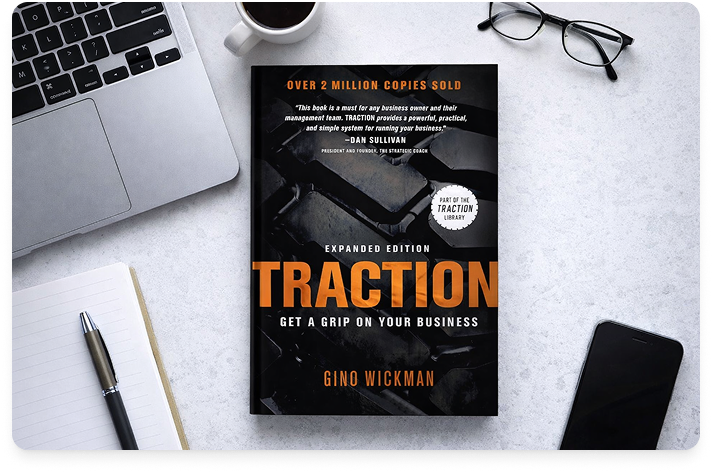
In his book Traction: Get a Grip on Your Business, Gino Wickman introduces the Entrepreneurial Operating System (EOS), a toolkit for aligning your executive team, tracking weekly metrics, and systematizing core processes.
Designed for companies with 10 to 250 employees, the book distills classic management theories — such as Jim Collins’s concept of getting the “right people on the bus” from Good to Great and Patrick Lencioni’s teamwork principles from The Five Dysfunctions of a Team — into repeatable, day-to-day processes.
We feel that Traction is a pivotal book for startup leaders because it offers a proven path for the operational strength and good leadership required to survive the stress of growth.
Core takeaway: Enduring business growth requires a unified operating system that aligns your vision, people, and daily execution — and the blueprint already exists.
How the Traction’s Entrepreneurial Operating System Works
In practice, EOS establishes a predictable cadence for your entire organization. Leadership defines their overarching vision and breaks it down into 90-day execution goals called Rocks. Each week, they meet for 90 minutes in a highly structured “Level 10” format to review KPIs, check the status of their Rocks, and identify and solve problems.
While Traction provides the foundational theory and DIY tools, some busy founders seek assistance in implementing the framework. Wickman has scaled his methodology into a global EOS ecosystem with courses and a network of over 850 Professional EOS Implementers.
Key ideas to understand from Traction include:
- The Six Key Components. Wickman identifies six components every business must manage to achieve success: Vision, People, Data, Issues, Process, and Traction. Strengthening these areas brings order to a chaotic operational environment.
- Visionary vs. Integrator. Scaling a company requires two distinct leadership functions. The Visionary generates the big ideas, builds major relationships, and drives culture. The Integrator unites the company’s major functions, executes the business plan, and runs the day-to-day operations.
- The Accountability Chart. Unlike a traditional org chart that focuses on job titles, the EOS Accountability Chart maps out the actual functions and accountabilities, clarifying who is truly responsible for what and reducing cross-departmental friction.
- Letting Go of the Vine. To make EOS work, founders must trust the systems they build and delegate the tasks they’ve outgrown by “letting go of the vine.”
What the Experts Say About Traction and EOS
“Did [EOS] save our company? It sure did. A system that the entire management team bought into created unity and accountability, led to the establishment of corporate core values that we still use today and — most importantly — improved our focus.”
The StartToScale Takeaway
Many founders successfully build early-stage companies through determination and energy, but hit a ceiling where what works for a team of five breaks a team of 50.
EOS provides the operational sanity required to scale your business once you’ve established product-market fit and are looking to scale from seven figures to eight or more. It forces you to clarify expectations and define exactly what “good” looks like across your entire team. The EOS framework in Traction helps your startup shift from founder-driven survival to systems-driven scale.
Translating Traction Into the SmartToScale Framework
Start ➡️ Define your core values early and identify whether your natural wiring makes you a Visionary or an Integrator.
Build ➡️ Establish your Accountability Chart to clarify operational roles before you begin hiring rapidly.
Grow ➡️ Implement the weekly Scorecard and Level 10 meetings to maintain team alignment as your headcount increases.
Scale ➡️ Empower a dedicated in-house Integrator (such as a COO or tactical co-founder) to run daily operations so the visionary founder can focus on strategic growth.
Action Plan: Start Locking Down Operational Strength This Week
- Assess your seats. Honestly evaluate if you have the right people in the right seats using the GWC filter. Team members should “Get it, Want it, and have the Capacity to do it,” while aligning with your company’s core values.
- Draft a scorecard. Identify five to 15 objective metrics that accurately indicate the weekly health of your operations, moving away from trailing financial indicators.
- Conduct a self-evaluation. Are you a visionary or an integrator, and do you have the right leaders or co-founders in place to fill the other role? If not, consider who you must hire to get there.