Begin With Day One: A Summary of "The Bezos Letters" by Steve Anderson
Why Most Founders Are Stuck in a Reactionary Short-Term State

Start to Scale
Powered by FINSYNC
The quest for short-term gains leaves founders obsessing over quarter-to-quarter successes and rapid returns. But when you’re laser-focused on short-term achievements, you optimize what already exists instead of looking to the future and building what will scale.
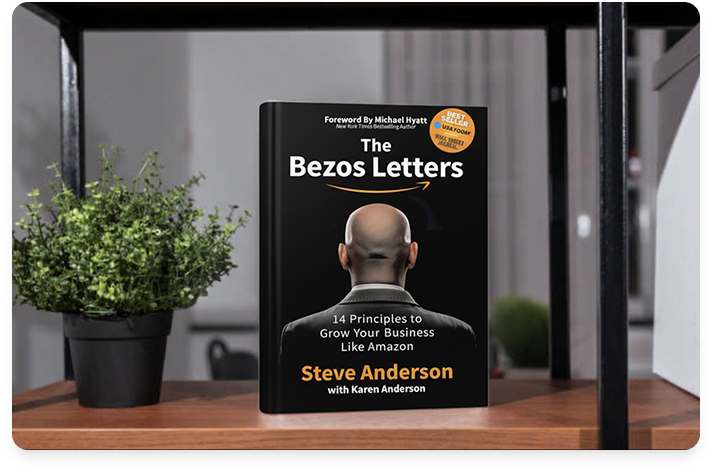
The Bezos Letters offers a different approach. Author and futurist Steve Anderson analyzes Jeff Bezos’s shareholder letters to learn how Bezos built Amazon by consistently making decisions that prioritized long-term outcomes, even when those decisions looked inefficient or risky in the moment.
Why feature The Bezos Letters? By providing a framework to shift your focus from immediate gratification to compounding decisions, the book helps founders evaluate whether a strategy will still work in five years, rather than just tomorrow.
Core takeaway: Sustainable growth comes from the discipline of consistently prioritizing long-term, compounding decisions over short-term gains.
The Architecture of Compounding Growth
Anderson breaks Amazon’s operational approach into four primary principles that show up consistently across Bezos’s shareholder letters. Long-term growth and scale requires applying these frameworks consistently, especially when the choices are uncomfortable.
- Test relentlessly: Run continuous experiments even when outcomes are uncertain, accepting that failure enables you to learn faster than competitors.
- Invest for the long term. Exercise deep patience when results are slow. Certain decisions may look inefficient in the short term, but they create advantages that compound over years. This is where most founders lose alignment.
- Obsess over the customer. Customer focus is easy to claim and harder to maintain. It requires discipline when short-term revenue opportunities conflict with long-term trust. But over time, that trust will become a stronger growth driver than any single tactic.
- Make bold decisions when others hesitate. Growth often comes from decisions that are not obvious at the time. Acting without full certainty requires conviction. Waiting for definitive proof usually means the opportunity has already passed.
Most companies adopt parts of this framework. They test occasionally and talk about long-term thinking. They prioritize the customer — as long as it aligns with immediate goals. But few commit to all of it.
What separates those who grow is applying these principles consistently and especially when it isn’t convenient. This approach will shift your focus toward building infrastructure that can scale, processes that allow continuous experimentation, and customer experiences that inspire lasting trust.
What Experts Say About The Bezos Letters
“One of the biggest risks of success is actual success because you tend to start protecting what got you there, not looking at what’s next.”
The StartToScale Takeaway
Patiently awaiting the outcome of long-term decisions and initiatives can feel unwise and even dangerous. But from our perspective, switching tactics to meet short-term needs and taking your eyes off the long-term health of your company is much riskier.
Amazon mediates the risk of long-term planning through massive numbers of experiments. They don’t deviate from long-term plans because of fear over this quarter’s results. They generate the hard data needed to stay the course or make strategic shifts.
Experimentation is your primary system for long-term growth. And failure isn’t something to avoid. It’s necessary for better decision-making. You must judge a decision not by its immediate outcome, but by whether it strengthens your business’s foundation.
Translating The Bezos Letters into the StartToScale framework
Start ➡️ Focus on solving meaningful customer problems instead of chasing immediate revenue.
Build ➡️ Create systems that support testing, learning, and iteration.
Grow ➡️ Invest in decisions that compound and strengthen your position over time.
Scale ➡️ Maintain long-term discipline while increasing speed and output.
Action Plan: Start Building Your Long-Term Vision This Week
- Identify a short-term priority. Note one area where you are prioritizing quick results and adjust your strategy to support long-term value instead.
- Run one extra experiment this week. Aim to gather data, learn, and iterate, rather than to succeed.
- Assess your current KPIs. Adjust at least one performance metric to track a long-term, rather than short-term, impact.