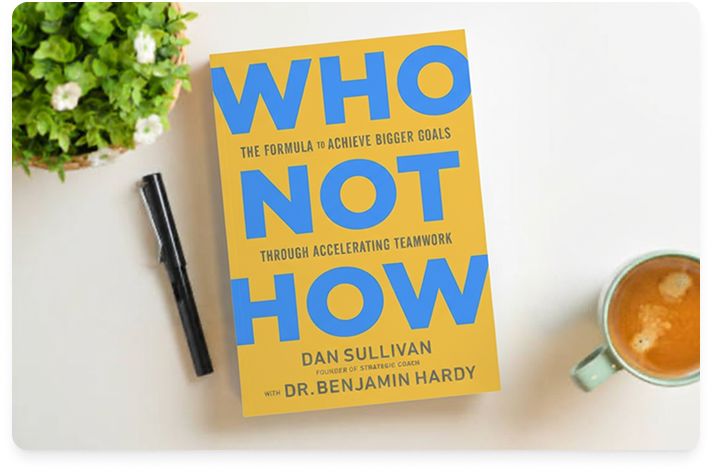
Find Your Problem-Solving “Whos”: A Summary of "Who Not How" by Dan Sullivan and Dr. Benjamin Hardy
Collaboration Is Critical for Startup Success

Start to Scale
Powered by FINSYNC
Early-stage founders are conditioned to believe that doing everything themselves proves their dedication and saves money. In Who Not How, Dan Sullivan and Dr. Benjamin Hardy argue that this severely limits growth.
When confronted with an ambitious goal, most people ask, “How do I do this?” This approach can lead to burnout, isolation, and decision fatigue because it places the burden on your already limited time.
Sullivan and Hardy shift this paradigm by pushing leaders to instead ask, “Who can help me achieve this?” The goal is for founders to define the vision and then delegate the execution to capable collaborators. This way, you can protect your time to focus on high-impact strategy.
We believe this book evolves Sullivan’s 1994 classic The Great Crossover into a modern, practical playbook to help founders scale without burning out. This framework also serves as the core for Sullivan’s Strategic Coach program.
Core takeaway: Scale requires building a trusted network of “whos” to produce results, freeing you from the burden of figuring out “how” to execute every task.
How the Who Not How Framework Works
The methodology functions by separating the visionary (i.e., you) from the tactician (your staff and collaborators). When you identify a major objective, you skip the “how” (planning and execution) and instead define the success criteria, the project stakes, and its overarching purpose.
With that clear brief in hand, you can tap into your network to find or hire a specific “who” equipped with the exact skills required for the job. Then you step away, giving your collaborator full autonomy to dictate the process. This non-linear approach benefits startups by allowing the company to execute multiple massive goals simultaneously without projects getting stuck on your to-do list.
Some key principles from Who Not How include:
- Listening to Procrastination. This isn’t a character flaw, but rather a signal that indicates that you lack the knowledge, capability or time to execute your goal. Procrastination is your instincts telling you to find a “who” to handle the task.
- The Impact Filter. This is a delegation framework used to define exactly what a successful outcome looks like and why the project matters — the “what” and the “why.”
- “Whos” Are Investments. Viewing a collaborator’s fee to execute the “how” as a financial loss keeps you playing small. Treating that fee as a direct investment buys back your time to focus on revenue-generating strategies that multiply the collaborator’s cost.
- Escaping Decision Fatigue. Every minor logistical choice you make drains the finite energy needed for high-level leadership. With “whos” managing routine decisions, you preserve your mental bandwidth.
What Experts Say About Who Not How
“When you’re faced with a problem, do you consider HOW you can solve it? ‘How’ is linear and slow. It puts all the weight and responsibility on yourself, even if you’re not the best person for the job. What if, instead, you consider who the WHOs are in your life? ‘Who’ is non-linear, instantaneous, and exponential. When you train your brain to think about WHO in your life can help you achieve something, you instantly get access to knowledge, insights, resources and capabilities that you might not have yourself.”
The StartToScale Takeaway
Startup culture frequently glorifies the “grind.” Who Not How exposes this behavior as a severe bottleneck. Trying to do everything yourself restricts your company’s potential to the size of your personal bandwidth.If you are still trying to figure out the logistics of completing a task, you are playing a small game while your competitors are acquiring the talent to win.
True scale requires abandoning the employee mindset of working harder and adopting the owner mindset of sourcing the right network of people to execute your vision.
Translating Who Not How Into the StartToScale Framework
Start ➡️ Find a co-founder or early team of “whos” to complement your strengths and fill your skill gaps.
Build ➡️ Use the Impact Filter framework to clarify your product vision so your early team can execute their roles with complete autonomy.
Grow ➡️ Tap into your network to find specialized collaborators and hires who can multiply your capabilities without draining your time.
Scale ➡️ Step entirely out of the execution phase. Your primary job at this stage is to create the vision and fund the “whos” that will navigate the path to get you there.
Action Plan: 3 Steps to Take to Find Your “Whos” This Week
- Choose the project. Write down the most important project you have been procrastinating on recently.
- Draft a one-page brief. Define exactly what successful completion looks like and the specific business impact it will have.
- Comb your network. Whether you want to hire an employee, a consultant, or a contractor, reach out to your network to ask them who they know that could accomplish this specific project for you.