From Buildup to Breakthrough: A Summary of "Good to Great" by Jim Collins
Why Entrepreneurs Should Chase Excellence, Not Hype

Start to Scale
Powered by FINSYNC
Many startup leaders believe they need a larger-than-life personality or an overnight breakthrough to build a successful company. In Good to Great, Jim Collins dismantles this myth with rigorous data collected by analyzing companies that made the leap from average performance to sustained greatness.
They found sustained growth requires a methodical process of hiring disciplined people, facing brutal market realities, and relentlessly pushing a strategic flywheel.
Why is it important to understand the concepts in Good to Great? For entrepreneurs feeling the pressure to invent a radical pivot, this book provides a grounded roadmap. It proves that enduring companies are built by humble, fierce operators who focus on building sustainable operations, rather than chasing the next hype cycle.
Don’t just take it from us: The concepts in Good to Great have become the standard operating language for modern startups and their advising networks. Global coaching communities like Scaling Up and the Entrepreneurial Operating System (EOS) translate Collins’s principles into tactical accountability and guidance for entrepreneurs across the globe.
Core takeaway: Enduring greatness is a matter of conscious choice, disciplined people, and relentless commitment to a simple, validated concept.
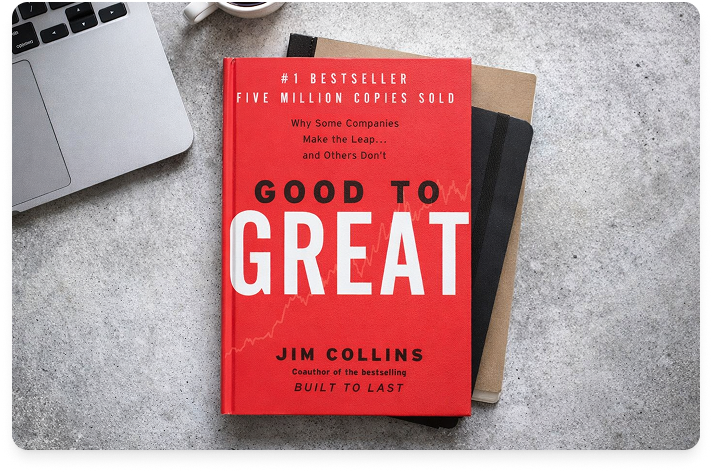
How The Good to Great Framework Works
Achieving the massive, sustained breakthrough that Good to Great outlines requires a process that leads to “Level 5” leadership. This blend of strong determination and personal modesty is built only after you accomplish the four earlier stages: becoming a highly capable individual, contributing team member, competent manager, and effective leader.
Once you’ve hit Level 5, you first prioritize building your team by hiring based on character rather than specific skills. Then you must confront brutal market facts while maintaining faith in ultimate success. This honesty reveals the “Hedgehog Concept”; this is where your company’s passion, economic engine, and what you can genuinely do best intersect.
Next comes the hard part: discipline. You must translate your concept into action by systematically stripping away any distractions outside your core focus and applying carefully selected technology that accelerates progress.
Picture this process like pushing a massive, heavy flywheel in one direction to build compounding momentum and replace chaotic, reactionary pivots with true market dominance.
Key principles from Good to Great include:
- Level 5 leadership. True transformation requires leaders who channel their ego away from themselves and into the larger goal of building a great company. They combine extreme personal modesty with stoic determination to do what needs to be done.
- First who…then what. Great leaders first get the right people on the bus and the wrong people off it before figuring out where to drive it. This ensures the team is adaptable to changing realities and inherently self-motivated.
- The Stockdale Paradox. You must maintain unwavering faith that your business will prevail in the end. Simultaneously, you must have the discipline to confront the most brutal facts of your current reality, whatever they might be.
- The Hedgehog Concept. Great companies simplify a complex world into a single organizing idea. This concept sits at the intersection of three circles: what you are deeply passionate about, what drives your economic denominator, and what you can genuinely be the best in the world at.
- The Flywheel Effect. Transformations resemble relentlessly pushing a giant, heavy flywheel. Initial progress is slow, but consistent, collective effort eventually builds the momentum required for a breakthrough.
What the Experts Say About Good to Great
“How does a company go from being merely successful to sustaining profits over long periods? That's the central question of Jim Collins' book, a deeply-researched analysis that starts with all 1,400 companies on the Fortune 500 since 1965 and narrows the list to 11 companies that sustained excellence over time — often by going against accepted industry wisdom.”
The StartToScale Takeaway
Many entrepreneurs operate under the “genius with a thousand helpers” model, where the entire company relies on their personal vision and direction. Collins proves that this model inevitably fails when the genius leaves or the market shifts.
While Good to Great is widely regarded as a corporate roadmap for massive legacy companies, this book is fundamentally a survival manual for dismantling the founder’s ego to build a self-sustaining enterprise capable of enduring for generations.
True scaling requires the founder to prioritize the selection of highly capable, self-disciplined partners and networks. By building a trustworthy team, you’ll go from being a single point of failure to the architect of a self-sustaining system.
Translating Good to Great Into the SmartToScale Framework
Start ➡️ Exercise Level 5 leadership by making “first who, then what” your absolute priority when building your founding team.
Build ➡️ Employ the Stockdale Paradox to confront the brutal facts of your early product iterations while maintaining absolute faith that you will succeed.
Grow ➡️ Define your Hedgehog Concept and ruthlessly eliminate any secondary products, services, or distractions that fall outside of your three circles.
Scale ➡️ Lean into the Flywheel Effect, applying targeted technology to accelerate your established momentum.
Action Plan: Start Your Good to Great Journey This Week
- Audit your team’s seats: Identify one person who is struggling and determine if they are simply in the wrong role or if they need to be removed from the bus entirely.
- Create a “stop doing” list: Outline three current initiatives or daily tasks that fall outside your core economic engine and immediately cease funding or spending time on them.
- Leverage your connections for brutal facts: Meet with a trusted mentor, advisor, or peer and ask them to point out a harsh reality that your internal team might be afraid to address.
