How to Beat Industry Giants: A Summary of "The Innovator’s Dilemma" by Clayton Christensen
Escape the Perfectionism Trap and Make Some Cash

Start to Scale
Powered by FINSYNC
It seems counterintuitive, but massive corporate giants often lose market dominance simply by listening too closely to their best customers.
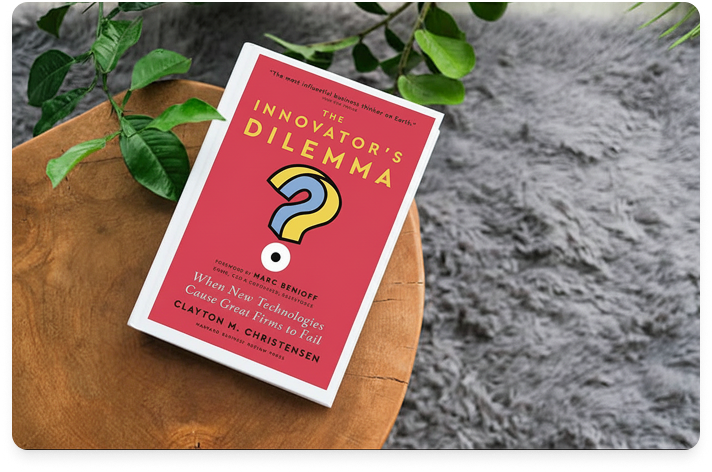
This is one of the key messages founders can take away from The Innovator’s Dilemma, written by Clayton Christensen, a legendary Harvard Business School professor and co-founder of the consulting firm Innosight. Widely considered one of the most influential business texts of all time, The Innovator’s Dilemma was famously the only business book Steve Jobs cited as a deep influence.
What can you gain from reading it? Christensen introduced the concept of “disruptive innovation” to explain why successful companies can do everything right and still fail. He observed that industry giants become vulnerable by focusing on existing clientele, creating a structural blind spot where upstarts can capture the market from underneath them.
If you’ve ever thought, “What’s the point in bringing my product to market when a giant company already has a lock on it?,” this is the book for you. It provides a proven framework for taking on well-funded competitors and how to weaponize your limited resources. Christensen showed that small size and lack of established customer expectations can be the greatest competitive advantages for disruptors.
Core takeaway: Your greatest startup advantage is the ability to target the overlooked customers that market leaders structurally ignore.
The Mechanics of Market Disruption
Why do market leaders become mired in their own success? Large companies require massive revenue to maintain profitability. Management naturally directs all energy toward sustaining innovations, which means improving existing products for their most demanding, highest-paying customers. This dynamic creates “the innovator’s dilemma” and opens the door for disruptive innovation.
A disruptive product typically enters the market as a cheaper, simpler alternative to the established leading product. The major incumbents ignore this new offering because it doesn’t meet the needs of their top-tier customers. By the time the disruptive startup refines its product and moves upmarket, the incumbent has lost the game.
You can leverage this dynamic by consciously targeting the market segments that big companies view as unprofitable distractions. To navigate this landscape, understand these three core concepts:
- Sustaining Innovation: Incremental improvements that make good products better for existing customers. Incumbents almost always win this game due to deeper resources.
- Disruptive Innovation: A cheaper, accessible product that appeals to low-end or entirely new consumers, which incumbents actively dismiss.
- The Upmarket Trajectory: The process of capturing the low-end market first, improving your technology over time, and eventually displacing the market leader.
What Experts Say About The Innovator's Dilemma
“It’s important that we make this transformation, because of what Clayton Christensen calls ‘the innovator’s dilemma,’ where people who invent something are usually the last ones to see past it, and we certainly don’t want to be left behind.”
The StartToScale Takeaway
Founders frequently launch startups aimed directly at the biggest competitors in their space, attempting to build a premium product with more features. Christensen’s work proves this is a massive strategic error. Trying to beat an incumbent at sustaining innovation guarantees you will burn through your capital before gaining any real traction.
Disruption happens from the bottom up. Launch a product your biggest competitors view as a toy or a downgrade. Their dismissal provides the runway you need to establish a foothold and refine your technology without triggering a massive competitive response.
Translating The Innovator's Dilemma into the StartToScale framework
Start ➡️ Target a customer segment that established industry leaders ignore because it is too small or unprofitable.
Build ➡️ Create a simple, low-cost solution that solves a basic problem rather than over-engineering a premium product.
Grow ➡️ Capture the low-end market to establish reliable cash flow and a loyal user base.
Scale ➡️ Steadily improve your product’s performance until you can move upmarket and unseat your legacy competitors.

Action Plan: 3 Ways to Start Disrupting Your Market This Week
- Identify an over-served market. Look closely at your industry and find a customer segment that is paying for complex features they don’t need, want, or use.
- Define your low-end alternative. Map out the simplest, cheapest possible version of your product that will satisfy overlooked, budget-conscious buyers.
- Audit your competitor’s blind spot. Dig deeper into the over-served market to identify a specific customer demographic your biggest competitor has actively abandoned to chase higher margins. Direct your initial marketing efforts entirely toward that group.