Overcome Adversity with Action: A Summary of "The Obstacle Is the Way" by Ryan Holiday
Grow Stronger by Escaping the Trap of Emotional Decision-Making

Start to Scale
Powered by FINSYNC
Building a startup guarantees that you’ll face frustrating hurdles. Author Ryan Holiday argues that how you reach success is by how you respond to problems.
Ryan Holiday, founder of the popular Daily Stoic podcast and website, drew on his entrepreneurial background to write the 2014 bestseller The Obstacle Is the Way. In the book, he strips away the academic jargon from three interdependent principles of Stoicism: controlling your perception of the problem, directing your actions to dismantle it, and developing the will to endure what you cannot change.
We feature this book because it’s easy to lose momentum by freezing or reacting impulsively to stressful setbacks. Holiday’s framework teaches you how to quiet your emotional reactions and find the tactical advantage hidden inside your biggest bottlenecks.
Core takeaway: True business advantage comes from treating problems as solvable puzzles rather than existential crises.
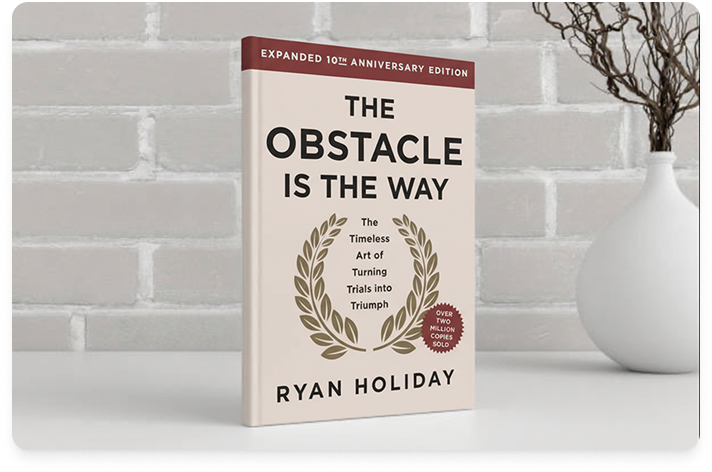
A Framework for Turning Your Problems Into Leverage
The first discipline is perception. When a crisis hits, your primal instincts trigger panic or frustration, tricking you into thinking the problem is worse than it actually is. Holiday instructs you to train yourself to see events objectively by separating the raw facts of a situation from the negative story you tell yourself about it. With a cool head, you can look for the opportunity or lesson embedded in the setback.
Once you perceive the obstacle clearly, you must attack it with directed action, even when conditions are imperfect. Here, Holiday praises the concept of the Minimum Viable Product (MVP).
Trying to launch a flawless product often paralyzes founders. An MVP forces you to bypass the big picture, test the most basic version of your idea, and gather real feedback so you can iterate. This tactic can be applied to any problem: Break the issue down, focus on the immediate task, and keep advancing.
The final discipline is will. This represents the inner strength needed when a situation is completely outside your control. Holiday highlights the Stoic exercise of the premortem, where you systematically envision everything that could go wrong with your plans. If failure occurs, you welcome it as a chance to practice resilience and adapt your strategy.
What the Experts Say About The Obstacle Is the Way
“Through this book, Ryan is showing us that what blocks our path actually opens up a new and better one. This book is optimistic in its approach to life’s problems, and a must-read as we all are going through some obstacles in our lives.”
The StartToScale Takeaway
Reading The Obstacle Is the Way forces a critical mindset shift: the realization that avoiding friction creates fragile companies. Many founders try to build startups in a vacuum, waiting for ideal market conditions or hoping to dodge competitors.
This book demonstrates that actively engaging with your constraints makes your product better. If a competitor undercuts your pricing, they are handing you a mandate to build a superior customer experience. Friction doesn’t stop growth. It dictates exactly where your growth needs to happen.
Translating The Obstacle Is the Way into the StartToScale framework
- Start ➡️ Anticipate potential failures before launch by conducting a premortem on your initial business model.
- Build ➡️ Launch a Minimum Viable Product to gather feedback quickly, using early missteps to improve your offering.
- Grow ➡️ Attack growth bottlenecks with creative workarounds instead of burning cash on brute-force marketing.
- Scale ➡️ Build a company culture that views market shifts and setbacks as tactical opportunities rather than existential threats.
Action Plan: Start Facing Your Obstacles This Week
- Identify your biggest bottleneck. List ways you can use the issue to your advantage.
- Perform a premortem. Evaluate your next product release to identify potential failure points.
- Break down a problem. Identify an intimidating problem you have been avoiding and break it down into its component parts. Then, tackle one immediate task today.