Test, Learn, and Pivot: A Summary of "The Lean Startup" by Eric Ries
How Continuous Product Experimentation Can Save Time and Capital

Start to Scale
Powered by FINSYNC
Many businesses fail not from lack of passion, but from focusing on the wrong thing for too long. In The Lean Startup, author and Silicon Valley vet Eric Ries introduces a scientific approach to entrepreneurship, which treats every product decision as a hypothesis to be tested, not a vision to be defended.
This systematic approach enables startups to take advantage of their size and nimbleness to become rapid learning engines. Inspired by lean manufacturing, a lean startup bases product decisions on testing, real customer feedback, and iteration, rather than assumptions and long development cycles.
Why does StartToScale believe in The Lean Startup? It helps innovative founders waste less time and capital on products customers don’t actually want. You can reduce risk and accelerate your with a practical method for testing hypotheses before you overbuild.
Core takeaway: Your startup will succeed not by executing a perfect plan, but by learning faster than anyone else what customers really want.
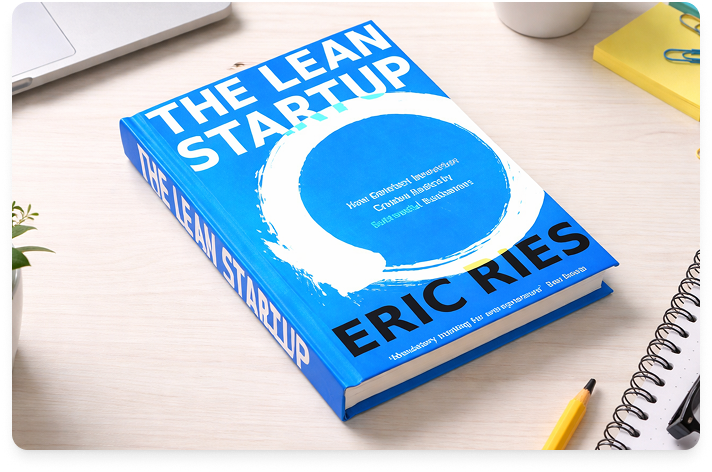
The Architecture of a Rapid Learning Engine
The Lean Startup method functions as a continuous cycle of experimentation designed to reduce risk while increasing speed to market. You achieve this through the “Build-Measure-Learn” loop:
- Build. Define your hypothesis (what problem you are solving and for whom) and build the fastest possible version of your idea.
- Measure. Test your hypothesis and measure how real users engage — not what they say, but what they do.
- Learn. Examine the hard data from your test to learn and decide whether to pivot or persevere.
Over time, as you compress this cycle, your speed of learning becomes a competitive advantage, creating a repeatable system for growth and innovation.
To execute this rapid learning cycle effectively and build products that are aligned with real customer needs, founders must master a few core concepts:
- Minimum Viable Product (MVP): The simplest version of your product that enables you to begin learning from real users. The goal is quick, purposeful experimentation, turning ideas into testable hypotheses before overbuilding and wasting resources.
- Validated Learning: True progress comes from proving or disproving assumptions with real data based on customer behavior, not vanity metrics or internal activity.
- Innovation Accounting: A framework for measuring progress and identifying early signals of success or failure in uncertain environments where traditional metrics, such as profit, don’t yet apply.
- The Pivot: By using customer feedback without losing your direction, you determine when to safely change your strategy (pivot) versus double down.
What the Experts Say About The Lean Startup
“Start-ups are not smaller versions of large companies. They do not unfold in accordance with master plans. The ones that ultimately succeed go quickly from failure to failure, all the while adapting, iterating on, and improving their initial ideas as they continually learn from customers.”
The StartToScale Takeaway
We consider The Lean Startup required reading for first-time founders. But what many reviews and summaries miss is that this is a cash discipline book disguised as product development philosophy.
From our perspective, every dollar wasted building an unvalidated feature is a cash flow problem. The Build-Measure-Learn loop forces you to treat capital like it’s scarce —- because it is. Pair this framework with a tight handle on your burn rate and you’ll have a real edge.
Translating The Lean Startup into the StartToScale framework
Start ➡️ MVP + Hypothesis Testing
Build ➡️ Iteration + Early Traction
Grow ➡️ Optimization + Scaling validated channels
Scale ➡️ Systems + Repeatable growth engine
Action Plan: Start Your Build-Measure-Learn Process This Week
- Write down your top three business assumptions. These are the things that must be true for your idea to work.
- Identify the riskiest one. If this assumption is wrong, it would change everything.
- Design a test. Validate this assumption with the smallest possible test this week.