
6 Valuable Time Management Skills for Business Leaders

Do you ever feel like there are not enough hours in the day to get everything done? You are not alone. Time is indeed our most precious resource, and once it’s gone, it’s gone forever. For business leaders and entrepreneurs, this is especially true. The ability to effectively manage time is critical for the success and growth of your business. 


In this article, you will discover valuable skills for effective time management. Learn how to stay ahead of the clock and transform minutes into milestones of progress and productivity.


Understanding Time Management


Effective time management in business leadership is about using your time wisely to achieve optimal results. It helps you handle multiple tasks quickly without feeling overwhelmed. With good time management, you can take on more responsibilities, reduce stress, and achieve your business goals and KPIs more effectively. Conversely, poor time management often leads to missed deadlines, strained team and client relationships, and struggles with business growth.


Mastering time management involves strategically deciding which tasks to address and when to tackle them. This skill is essential for your business’s success. By prioritizing the right tasks at the right moments, you align your efforts with your business objectives, ensuring steady progress and development.


Time Management Skills for Business Leaders


1. Prioritization


One of the first steps in effective time management is prioritizing. Not all tasks hold the same level of importance or urgency. Prioritizing tasks ensures your primary focus is on what truly matters to your business.

Here are a few examples of prioritization methods:


The 18-Minute Plan: Developed by Peter Bregman, this technique involves spending five minutes in the morning to plan your day and five minutes in the evening to review the day’s activities.

The Rule of Three: This involves identifying three outcomes you want to achieve by the end of the day, week, month, and even year. This simple strategy keeps you focused on your most important goals.

The Focus Funnel: Similar to the Eisenhower Matrix, Rory Vaden’s Focus Funnel is a methodology to categorize tasks by urgency and importance. It involves five steps: eliminate, automate, delegate, concentrate, and procrastinate. 

Time Blocking: Time blocking involves dividing your day into blocks of time, each dedicated to accomplishing a specific task or group of tasks. This method helps reduce multitasking and distractions, ensuring dedicated focus on one task at a time.


There are other methods for prioritization as well. Each one caters to different working styles and preferences, allowing you to choose the method that best fits your needs and habits.


2. Delegation


Delegation is key in time management. You cannot and should not do everything yourself. By identifying tasks that can be passed on to team members, you are not giving up control; rather, you are empowering them. This approach helps them develop their skills and also frees up your schedule to focus on tasks that specifically require your expertise and attention. 


3. Goal Setting


Your business needs direction, and that comes from setting achievable, measurable, and relevant goals. You can use the SMART framework to ensure your goals are Specific, Measurable, Achievable, Relevant, and Time-bound.


In addition to the SMART framework, several goal-setting techniques have emerged in recent years:


OKRs (Objectives and Key Results): Popularized by companies like Google, OKRs involve setting a high-level objective and tracking progress through results. This method effectively aligns team goals with the company’s vision and ensures measurable outcomes.

• Backward Goal Setting: This technique involves starting with the end goal and working backward to create a step-by-step plan. It helps break down large, intimidating goals into smaller, more manageable tasks.

The WOOP Method (Wish, Outcome, Obstacle, Plan): Developed by psychologist Gabrielle Oettingen, this method involves visualizing a wish or goal, imagining the best outcome, identifying potential obstacles, and planning how to overcome them. 

• The HARD Goals Method: HARD stands for Heartfelt, Animated, Required, and Difficult. It emphasizes setting goals that you are emotionally connected to, vividly imagined, necessary, and challenging enough to push you out of your comfort zone.


Each of these techniques offers a unique approach to setting and achieving goals, allowing you to choose the one that best fits your business’s needs and your personal management style.


4. Avoiding Procrastination


Procrastination, a hurdle faced by many, can significantly slow productivity and time management. Understanding the root causes of your procrastination is essential. It could stem from various factors like fear of failure, feeling overwhelmed by the task’s complexity, lack of interest, or even perfectionism. Identifying these triggers allows you to address them directly.


It can also be beneficial to create a work environment that minimizes distractions. This could mean turning off notifications on your devices, organizing your workspace to reduce clutter, or even changing your work location to somewhere more conducive to focus.


Remember that getting started is often the hardest part. The key is to take that first step, however small it may be.


5. Balancing Professional and Personal Time


Balancing your professional and personal life is a key component of time management. Try to ensure that while your business gets the attention it needs, your personal life does not suffer. Set clear boundaries between work and personal time, and take PTO when you need a refresh. Make time for your hobbies, family, and personal well-being. This balance is crucial for long-term success and happiness.


6. Creating a Time-Efficient Work Culture


As a leader, you have the opportunity to set the tone for your business’s culture. A time-efficient work culture starts with you. Show your team how to manage their time effectively by setting an example. Using techniques like prioritizing, goal setting, and balancing professional and personal time will likely inspire your team to do the same. Be open about discussing time management strategies and encourage your team to share tips and experiences with each other.


Closing Remarks


Effective time management is a continuous process of learning and adapting. As you add these skills to your daily routine, you will notice a positive change in handling your business responsibilities. Remember, the aim is not to work harder but to work smarter. You can lead your business towards greater efficiency and success with the right time management skills.


How FINSYNC Can Help


FINSYNC allows you to run your business on One Platform. You can send and receive payments, process payroll, automate accounting, and manage cash flow. To learn more about how we can help your business start, scale, and succeed, contact us today.


Discover the Ease of Cloud-Based Accounting for Business Finances

Dealing with finances can often feel overwhelming! Most likely, you are constantly looking for ways to save time, cut costs, and simplify managing your business. This is where the benefits of cloud-based accounting can make a difference.


This article breaks down this easy-to-use technology and how it can solve your biggest financial headaches, saving you time and money and making your day-to-day business operations smoother.


Understanding Cloud-Based Accounting


First, let’s clarify what cloud-based accounting is. Imagine all your accounting software and financial data stored securely on the internet, accessible anytime and from anywhere. Unlike traditional accounting systems that require software installed on a specific computer, cloud-based accounting leverages the power of the cloud to store and process your data, including essential aspects like data storage.


This means you do not have to worry about physical servers or data loss due to computer malfunctions. Everything is securely stored online. With cloud-based accounting, you have the flexibility to manage your finances on the go.


Benefits of Cloud-Based Accounting 


Now, let’s explore some of the benefits of cloud-based accounting:


Real-time Financial Data Access

Having access to up-to-date financial information is essential. Cloud-based accounting allows you to see your financial status in real-time. This immediate access aids in making informed decisions quickly, a key to staying agile in today’s fast-paced market.


Cost-effectiveness and Scalability

Cloud-based systems are generally more cost-effective compared to traditional accounting software. There are no hefty upfront costs; you can scale the services as your business grows. This flexibility ensures that you only pay for what you need.


Enhanced Security and Data Backup

The security of your financial data is vital. Cloud-based accounting offers robust security measures along with automatic backups. This means your data is safe and retrievable in case of any unforeseen events.


Streamlining Business Operations


Cloud-based accounting can also help your business run more smoothly. Here are three examples:


Automation 

Cloud-based accounting can automate many of your routine financial tasks, such as invoicing, payroll processing, and reconciling bank statements. This automation saves you time and reduces the likelihood of human error, allowing you to focus on other aspects of your business.


Collaboration and Access

These systems make collaboration easier. You can share access with your team members, business coaches, or financial advisors. This helps with transparency, improves communication, and also can save quite a bit of time. Further, being able to access your financial data from various devices and locations means you are never out of touch with the financial health of your business.


Integration 

Another significant benefit is the ability to integrate with other business tools, such as Customer Relationship Management (CRM) systems or e-commerce platforms. Integrations like this can reduce manual data entry errors, allow you to create a more personalized experience for your customers, and, like the other suggestions above, save you time!


Making the Transition 


Switching to a cloud-based system might seem intimidating, but it can be smooth with the right approach:


Choosing the Right Software

Research and choose a software that meets the unique needs of your business. Look for features like ease of use, scalability, security measures, and customer support. Several options are tailored for small businesses, offering a range of functionalities.


Step-by-Step Transition Guide

Start by migrating small, non-critical parts of your accounting process to the new system. Gradually increase the load as you and your team become more comfortable. Ensure that all relevant staff are trained on the new system.


Overcoming Challenges 

It is natural to encounter challenges during this transition. Common issues include resistance to change and data migration complexities. Address these challenges by involving your team in the process and, if necessary, seeking help from your software provider or an accounting professional.


To Recap


Business is always changing; keeping up usually means trying out new tech. Switching to cloud-based accounting is more than just a tech update. It is a smart move that can make your business run smoother and grow faster. If you were reading this article and at any moment thought, “That would be a great help,” then it’s probably time to explore a cloud-based accounting software.


How FINSYNC Can Help


FINSYNC allows you to run your business on One Platform. You can send and receive payments, process payroll, automate accounting, and manage cash flow. To learn more about how we can help your business start, scale, and succeed, contact us today.

Why Every Small Business Needs an Emergency Fund

Your small business is thriving! Every day brings new customers and a steady stream of sales. But then, out of nowhere, a curveball is thrown your way. It could be a crucial piece of equipment that breaks down, a sudden increase in supplier costs, or an unexpected tax bill. The potential for that moment is why an emergency fund is so important.


Without this fund, you might be scrambling to cover these costs, potentially leading to rushed decisions like taking out high-interest loans or dipping into funds for other critical business areas. 


This article aims to provide a comprehensive guide on emergency funds to give small business owners like you the knowledge and tools to establish secure financial health.


Understanding an Emergency Fund


An emergency fund is your business’s financial safety net. It is a pool of funds set aside specifically to handle unexpected situations you could not have foreseen or included in your budget.


Unlike regular business savings that are allocated for future goals and growth, an emergency fund is designed for stability and resilience. It acts as a protective buffer during times of sudden financial stress. Whether it is a shift in the economy, an unexpected large expense, or other unforeseen challenges, this fund helps ensure your business can keep moving forward.


The primary aim of an emergency fund is to safeguard financial stability. You may face situations demanding quick, potentially harmful decisions without an emergency fund. However, with this fund in place, you have the resources to navigate these challenges effectively, keeping your business on track even as you tackle these unexpected issues.


Risks of Not Having an Emergency Fund


Operating your business without an emergency fund is similar to walking a tightrope without a safety net. Unexpected expenses are not just possibilities; they are inevitable in business. When these arise, the absence of a financial cushion can leave you in a difficult position.


To paint a clearer picture, imagine you run a small retail business. One day, your point-of-sale system crashes. This system is your lifeline of daily transactions and inventory management, and its sudden failure disrupts your business operations. Without an emergency fund, your options to address this urgent issue are limited and often come with steep costs. You might consider a high-interest loan or, worse yet, need to close temporarily. 


The stress of handling these financial emergencies without a backup fund can have broader implications. It can distract you from your core business activities, hinder your growth plans, and even affect the personal well-being of you and your employees.


Determining the Size of Your Emergency Fund


Deciding how much to save in your emergency fund requires careful consideration. The ideal amount varies depending on several factors unique to your business. These include the size of your business, your industry, and the nature of your revenue streams. For instance, a small online boutique might face different financial uncertainties than a local restaurant or a tech startup. However, as a starting point, a common recommendation is to have a fund that can cover three to six months of operating expenses. This range gives you a solid buffer to weather financial storms without hindering the day-to-day operations of your business.


3 Steps to Build Your Emergency Fund 


1. Create a budget

• Start by reviewing your income, fixed expenses, variable costs, and discretionary spending.

• Identify areas where expenses can be trimmed without impacting your operational efficiency. This might include negotiating with suppliers for better rates, reducing unnecessary software subscriptions, or finding more cost-effective solutions for services.

• The savings you identify here are the funds you can use to start your emergency account.

2. Set a Clear Savings Target

• Set a realistic and achievable monthly savings goal based on your revised budget. Consider this a vital business expenditure.

• Your target should reflect what you can save without straining other business areas. A good practice is to aim for a percentage of your monthly revenue.

• Remember, the goal is to build your fund over time, so even modest savings can be significant.

3. Automate Your Savings

• Automating your savings can simplify the process and ensure you consistently contribute to your emergency fund.

• Set up automatic transfers from your business checking account to a designated savings account, timed with your regular revenue cycles.

Building an emergency fund might seem challenging initially. Still, by breaking it down into these steps and integrating it into your business’s financial plan, you can create this important safety net that secures your business’s future.


Managing Your Emergency Fund


Proper management of your emergency fund is just as important as having one. This fund should be reserved exclusively for emergencies: unexpected and critical situations for your business’s operation, like sudden equipment failures or unexpected regulatory fines. Resisting the temptation to dip into these funds for everyday business expenses or new investment opportunities is crucial. These funds are different from your regular cash flow or planned expenditures.


◦ Define “emergency”: Identify what situations qualify for using these funds.

◦ Replenishment plan: If you have to use the fund, you must refill it to prepare for future emergencies, just like you built it initially. This might mean temporarily adjusting your budget to redirect more funds into the emergency account. 

◦ Insurance can cover many potential risks, reducing the need to use your emergency fund. However, it is only a partial replacement. Your emergency fund complements insurance by covering expenses that may not be insured.


Closing Remarks


There are many elements to financial stability for your business. An emergency fund is an important one. It provides financial security and peace of mind, allowing you to focus on growing your business rather than worrying about potential financial pitfalls. If you have yet to start an emergency fund for your business, now is the time to do so. Use the steps above to get started today so that in the near future, you can enjoy the confidence that comes from your business being financially stable.


How FINSYNC Can Help


FINSYNC allows you to run your business on One Platform. You can send and receive payments, process payroll, automate accounting, and manage cash flow. To learn more about how we can help your business start, scale, and succeed, contact us today.

5 Key Players that Every Entrepreneur Needs in Their Business Network

You are an entrepreneur, a visionary, someone who saw a niche in the market and had the expertise and passion to fill it. Whether crafting artisanal coffees or offering cutting-edge tech solutions, you started your business because you knew you could do it better than anyone else. 


But launching a business isn’t just about excelling in your field; it can also involve activities and skills you might not be passionate about or any good at. This is where the power of a business network comes into play.


Envision yourself as the quarterback of a championship-level sports team, where every role, from accountants to bankers, business coaches to insurance agents, is played by experts who improve your business’s offensive and defensive strategies. Read on as we break down these positions and show how each contributes to creating a successful business team.


1. Bankers: The Running Backs


Bankers are like the running backs on your financial football team, skillfully advancing your capital resources down the field. Establishing a strong partnership with a banker can open up avenues for funding, whether you are pushing forward with growth or holding your ground in tough times.


Financial running backs bring diverse plays to the game, from managing business bank and credit card accounts to crafting loan strategies to keep your business’s cash flow strong. Regularly sharing your business plan and achievements with your banker keeps your running back prepared so they are ready to make critical financial gains when you need them most.


2. Accountants: The Wide Receivers


Accountants are like the wide receivers in the financial game of your business. They are the ones who run a complex financial route to catch a pass and turn it into strategic gains. They navigate the complicated details of finance, ensuring your business is always moving downfield, especially during tax season and other financial challenges.


These financial wide receivers are really good at planning your next financial move, from managing budgets to preparing for audits. Their skill ensures that your business not only maximizes every opportunity to advance but also stays in bounds to catch a long pass near the sideline. When looking for the right accountant, choose someone who understands the specific needs of your industry and can provide customized, strategic financial advice.


3. Business Coaches: Your Coach


Imagine having a coach or mentor whose primary goal is to lead your team to victory. This is the role of a business coach, acting as the head coach of your business team. 


They provide direction, act as a sounding board for ideas, encourage you to play your best and assist in crafting the plays that will get you to the goal line. They are there to review your game plan and push you to outthink the competition. When searching for a coach, focus on professionals with a winning history of mentoring businesses in your field.


4. HR Consultants: The Scout


The heart of your business lies in its roster. HR (human resources) consultants act as the scouts, helping you draft and retain the all-stars for your team. They scout the marketplace for talent that shines so that new players fit into the unique playbook of your company’s culture, benefits, and work environment. 


Beyond recruitment, HR consultants can help with training materials and support systems that promote player development and satisfaction, maximizing teamwork and dedication. When selecting your HR consultant, opt for someone who understands your team’s spirit and has a solid track record in assembling winning lineups.


5. Insurance Agents: The Offensive Line


Insurance agents are the offensive line of your business, strategizing coverages that protect you from financial harm and prevent sacks or other unexpected collisions. They learn your playbook inside out, ensuring your strategy adapts from game to game and season to season. 


Regular huddles and a solid game plan with your agent allow you to stay focused on making plays, knowing your offensive line has your back. As you draft your business dream team, it’s important to find the right insurance agent who is ready to guard your organization from blindside hits.


Teamwork Makes the Dream Work


Think of your business as a championship team, where every player’s role is critical to the win. As the quarterback, you and your (business) coach should spend quality time in the film room, studying the market, the competition, and the opportunity, then working on strategies and the game plan. In the huddle, work closely with your banker (running back), your accountant (wide receiver), and your offensive line to ensure everyone understands the plays. In business, success starts with making the playoffs, followed by winning the big game and eventually creating a dynasty. However, achieving that growth level will take the team’s best effort.


Securing the Win


As the final whistle blows on our exploration of business networking, remember that each member of the team is a valuable part of your company’s journey to success. They provide the expertise, support, and strategy that allows you and your business to make winning plays, no matter what the opposition throws your way.


How FINSYNC Can Help


FINSYNC allows you to run your business on One Platform. You can send and receive payments, process payroll, automate accounting, and manage cash flow. To learn more about how we can help your business start, scale, and succeed, contact us today.

 

Small Business Retirement Plans Made Simple

Whether you work solo or have a team, planning for your retirement as a small business owner can initially seem complex. However, this is a path well worth exploring. Ensuring your financial stability and long-term success hinges significantly on effective retirement planning.


In this article, we will break down the essentials of small business retirement plans, covering options for both solo entrepreneurs and those with employees. We aim to demystify the process and equip you with the knowledge to strengthen your financial future. So, without further delay, let the journey begin.


Understanding the Basics


What exactly are small business retirement plans, and why do they matter for your company? Simply put, these plans are savings vehicles designed to help you, the business owner, set aside money for your retirement. They come with tax advantages and can benefit you and your employees.


There are several types of retirement plans to choose from, each with its own set of rules and benefits. The most common options for small business owners are the SEP-IRA, SIMPLE IRA, Solo 401(k), and SIMPLE 401(k). Let’s briefly explore each of these:


• SEP-IRA (Simplified Employee Pension IRA): This plan is easy to set up and maintain. You can contribute up to 25% of your annual compensation or a fixed dollar amount up to a maximum limit.

• SIMPLE IRA (Savings Incentive Match Plan for Employees IRA): As the name suggests, this plan is designed to be simple for you and your employees. You can match your employees’ contributions up to a certain percentage or make non-elective contributions.

• Solo 401(k): As both a business owner and employee of this business, this plan is ideal if you don’t have additional employees. It provides the dual advantage of contributions as an employee through the 401(k) option and as the business itself through a profit-sharing component, maximizing your savings opportunities.

• SIMPLE 401(k) Plan: Similar to the SIMPLE IRA, the SIMPLE 401(k) plan is designed for small businesses with fewer than 100 employees. It offers an easy way to provide retirement benefits to your employees while allowing you to save for your own retirement.


Assessing Your Needs


Now that you have an overview of the options, it is time to assess your needs. Start by thinking about your retirement goals and how much time you have to achieve them. Consider factors like your age, current income, and the structure of your business.


Ask yourself:


– How much money do I need to maintain my desired lifestyle in retirement?

– What is my current financial situation, including debts and other obligations?

– How long do I plan to continue working, and when do I want to retire?


The answers to these questions will help you determine the right retirement plan for you and your business.


Exploring Different Plan Options


Let’s delve a bit deeper into the four main retirement plan options:


SEP-IRA

This plan is known for its simplicity. You can set it up with your financial institution or a qualified plan provider. Contributions are tax-deductible, reducing your taxable income. It is a great choice if you want to contribute a percentage of your income without the complexities of a 401(k).

SIMPLE IRA

Beyond its ease of setup and management, this plan offers an opportunity to foster employee loyalty. Under this plan, you can match your employees’ contributions up to a specific percentage of their compensation, which can serve as an enticing incentive for your team to participate in retirement savings. Alternatively, you can make non-elective contributions to their accounts, demonstrating your commitment to their financial well-being. This flexibility can aid in attracting and retaining valuable talent within your company.

Solo 401(k)

This plan is particularly advantageous for sole proprietors and small business owners with no employees other than spouses. The Solo 401(k) plan offers a unique benefit. It allows you (as the business owner) to contribute as both the employee and the employer, providing a dual-channel retirement-saving opportunity. This unique feature lets you save more for your retirement and also helps in lowering your taxable income, making it an excellent choice for individual business owners.

The SIMPLE 401(k) 

With this plan, employees can contribute a portion of their salary pre-tax. At the same time, employers can choose to match contributions up to 3% of the employee’s compensation or make a 2% non-elective contribution for all eligible employees. This plan is only available for businesses with less than 100 employees. 

When deciding between these plans, consider your business structure, expected income, and how much you can realistically contribute each year.


Setting Up Your Plan


Once you have chosen the right plan for your business, it is time to set it up. The process typically involves these steps:


1. Choose a Plan Provider – You can work with a financial institution or a qualified plan provider to establish your retirement. Ensure they have experience with the type of plan you have selected.

2. Complete Necessary Paperwork – There will be paperwork, such as plan adoption agreements and participant forms. Your plan provider will guide you through this process.

3. Notify Your Employees – If you have employees, you will need to inform them about the retirement plan, its benefits, and any contribution options available to them.

4. Set Up Contributions: Determine how much you’ll contribute each year and ensure you meet the contribution deadlines to maximize your tax benefits.


Funding Your Retirement Plan


Now, onto the contributions. Here are some strategies to consider:


Regular Contributions: Set up automatic contributions from your business income to ensure you consistently save for retirement.

Tax Benefits: Take advantage of the tax deductions offered by your chosen retirement plan. These deductions can reduce your taxable income, putting more money in your pocket.

Catch-Up Contributions: If you are over 50 years old, you may be eligible to make additional catch-up contributions, allowing you to save even more.

Remember, the key to a successful retirement plan is consistency. The more you contribute over time, the more secure your retirement will be.


Managing and Monitoring Your Plan


Once your retirement plan is in place, it is crucial to monitor and manage it regularly. Here are some essential steps:


• Review Your Investments: Periodically assess your plan’s investments to ensure they align with your retirement goals and risk tolerance.

• Adjust as Needed: Life circumstances change, as do your financial goals. Be prepared to adjust your contributions and investment strategies as your business and personal situation evolve.

• Stay Informed: Keep up with changes in retirement laws and regulations that may affect your plan. Consulting with a financial advisor or business coach can help you stay on top of these updates.


Endnotes


Small business retirement plans may seem complicated, but they do not have to be. By understanding the basics, assessing your needs, and choosing the right plan for your business, you can take significant steps toward securing your financial future


Remember to stay consistent with contributions and monitor your plan to ensure a comfortable retirement for you and your business. Your future is in your hands, so start planning today.


How FINSYNC Can Help


FINSYNC allows you to run your business on One Platform. You can send and receive payments, process payroll, automate accounting, and manage cash flow. To learn more about how we can help your business start, scale, and succeed, contact us today.


Growing Your Business: 5 Steps to Optimal Financial Health

Financial health often directs the success or failure of an organization. Staying on top of your finances can mean the difference between growth and closing your doors. 


If you aim to advance your business’s financial well-being, you are in the right place. Here are five steps to help your company reach optimal financial health.


1. Understand Your Financial Position


Start with an overview of your business’s financial landscape. How much income is coming in, and where are your major expenses? Understanding these numbers is very important. 


Consider implementing tools or software that can help you track your income, expenses, and liabilities. Regular financial assessments will allow you to make informed decisions, ensuring you do not overextend or find yourself in a tight spot.


2. Set Clear Goals


Every successful journey begins with a destination in mind. In the context of your business, this means setting financial goals. Break them down into categories: short-term, mid-term, and long-term. Perhaps you aim to increase your profits by 10% in the next six months or plan to open a second location within two years. By setting these targets, you give your business direction and purpose.


Remember to use the SMART criteria when setting your goals. They should be Specific, Measurable, Achievable, Relevant, and Time-bound.


Another important element is creating a budget. A well-thought-out budget will serve as your roadmap, guiding you toward your financial targets.


3. Prioritize Debt Management


Debt is a reality for many businesses, so it is important to manage it wisely. Start by distinguishing between ‘good’ and ‘bad’ debt. Good debt might be a loan you took to expand your operations, expecting it to bring more income. Bad debt, on the other hand, might be high-interest loans or credit cards that do not contribute to growth. Your primary focus should be reducing the high-interest bad debt, which can quickly erode your profits.


Maintaining a favorable debt-to-equity ratio is also essential. Potential investors or partners might look at this measurement to determine the financial stability of your business. A lower ratio indicates your business is less dependent on external financing, which can make it more appealing to lenders, investors, or partners. If all these debt management details are still beyond your reach, you may still consider utilizing the expertise of a business administration worker, the experience of whom is backed up by an MBA degree.


4. Plan for Emergencies


Even with the best plans, unexpected events will occur. Equipment can break down. Clients might delay payments. Economic downturns can impact demand. How will your business weather these storms? The answer lies in preparing for such financial emergencies.


One of the best strategies is to establish an emergency fund, money set aside to cover unforeseen expenses. Determine how much your business needs to save by assessing your monthly costs and risks. Ideally, you should have enough money in the fund to cover three to six months of operational costs.


Purchasing business insurance is another layer of protection. Assess the risks your business faces and ensure you have appropriate insurance to cover potential losses.


5. Seek Education or External Expertise 


The business landscape is always evolving, and financial strategies that worked a year ago might not be as effective today. As an entrepreneur, it’s important to keep learning. Explore books that cover modern financial strategies, or consider joining workshops that discuss the latest best practices for business finances.


If the realm of finance isn’t your forte, there is no harm in seeking external expertise. Consulting with a financial advisor or business coach can provide invaluable insights tailored to your business’s needs. They can offer advice, suggest tools, and provide strategies to help enhance your financial health.


Caked: A Real-life Success Story


Take a peek into the journey of Ricky Gudino, the co-owner of a booming Las Vegas bakery called Caked. When Ricky opened Caked, he faced stiff competition in Vegas and struggled to keep his expenses lower than his earnings. Further complicating matters, a lack of internal checks and balances led to his team delivering wedding cakes for events that had been canceled weeks prior.


After signing up for FINSYNC, he was able to better understand his financial position and recognize areas where he was overspending. He was able to more effectively manage orders, delivery dates, and open invoices. 


Ricky also utilized CollectEarly to get paid immediately on net 30 invoices to his catering clients. As a result, Ricky’s vision of growing his business and opening a second location is a reality.


Summary


The future of your business depends on solid financial health. So, it’s important to understand your financial position, set goals, manage debt, plan for emergencies, and seek education or external expertise. These 5 steps can help you stay on top of your finances and grow your business to the next level.


How FINSYNC Can Help


FINSYNC allows you to run your business on One Platform. You can send and receive payments, process payroll, automate accounting, and manage cash flow. To learn more about how we can help your business start, scale, and succeed, contact us today.

 

Why Both Revenue and Profit Matter for Business Owners

You have launched your business, and the money is starting to roll in. Every sale is a moment of pride, and the rising revenue can make you feel like you are on the path to success. However, there is another metric you need to keep an eye on – profit. 


Understanding the relationship between revenue vs. profit is vital for the long-term stability of your business. While both are crucial, they each serve a distinct purpose in understanding financial health. 


Let’s break them down and uncover why both revenue and profit matter to you as a business owner.


Definitions and Basic Concepts


Revenue

Revenue is the total amount of money your business brings in from sales before any expenses are considered. While it shows market demand and provides a feel-good factor, revenue does not tell the whole story. Effective revenue planning is crucial to understand the true financial health of your business.

Profit

Profit remains after all the business expenses have been subtracted from the revenue. It is broken down into several categories: 

• Gross profit: after the cost of goods sold is deducted. 

• Operating profit: after operational costs are deducted.

• Net profit: after accounting for all expenses, including taxes and interest.


The Misleading Nature of Revenue Alone


Think of revenue as the flashy front display of a store. It catches the eye but does not show what is happening behind the scenes. 


As an example, your business gets a large order for a customized product. The purchase boosts your revenue significantly. However, if producing that custom order requires specialized materials, unexpected shipping fees, or an extra workforce, the costs might eat up a large chunk of the money you just collected.


If you only look at the big sales numbers, you might think you are doing great. But if those numbers are matched or even surpassed by related costs, you can actually make less money. It is like celebrating a packed restaurant without accounting for the higher food costs or extra staff hours. Revenue tells part of the story, but profit completes the picture, revealing the true health of your business.


The Practical Importance of Profit


When considering long-term sustainability and success, it is vital to recognize the importance of profit. Profit shows how much your business is growing. It is the amount of money you have left after paying all your bills and expenses.


One of the primary roles of profit is to serve as a foundation for reinvestment. For your business to expand, adapt, and remain competitive, you will need additional funds. This could be for additional inventory, updating equipment, or hiring new employees. Your profit provides the ability to make those moves without going into debt or seeking external financing.


Moreover, think of profit as your business’s protective shield. When your business has a temporary slowdown, a solid profit margin can be your safety net. It provides some security and flexibility to navigate through rough patches, ensuring your business thrives.


Strategic Decisions: Revenue vs Profit


As a business owner, you will be faced with countless decisions daily. The strategies you choose often come down to understanding your revenue and profit dynamics:


◦ Pricing Strategies: Should you price lower to gain more customers (and grow revenue) or price higher to ensure better profit margins per sale?  

◦ Expansion Decisions: Is it time to hire more staff or move to a bigger location? These decisions can increase revenue, but they also come with higher expenses. You need to ensure your profit margins can handle the change.

◦ Cost Management: Are there inefficiencies in your operations? Identifying and addressing them can improve profitability without necessarily affecting your revenue.

◦ Marketing and Promotion: A high-budget ad campaign might drive traffic and increase sales, but if the return on investment is not there, it could erode your profit. Analyze which marketing channels offer the best balance between raising revenue and maintaining profitability.


Common Mistakes Business Owners Make


Being aware of common pitfalls is another key to success. The most common avoidable mistakes are:


1. Overexpansion: When you notice an increase in revenue, the urge to scale quickly is tempting. However, rapid expansion can drain your resources without considering the profit implications.


2. Cost Cutting: On the flip side, some businesses cut costs drastically, intending to grow profits. This can affect product quality or customer service, damaging the brand and customer retention.

3. Rigid Pricing: Not adjusting your prices based on market feedback or profit analysis can leave money on the table or push potential customers away.


Final Thoughts


Your entrepreneurial journey is filled with challenges and rewards. Understanding the differences between revenue and profit is essential in navigating this path. While revenue paints a picture of your business’s growth and potential, profit ensures its viability and longevity. 


By monitoring both, you set your business up for sustained success. It is not about choosing between revenue and profit; it’s about ensuring both works in harmony for the betterment of your business.


How FINSYNC Can Help


FINSYNC allows you to run your business on One Platform. You can send and receive payments, process payroll, automate accounting, and manage cash flow. To learn more about how we can help your business start, scale, and succeed, contact us today.

 

Transforming Customers Into Fans With Effective Communication

The connection you create with a business customer can be the difference between a brief transaction and a long-lasting relationship. For entrepreneurs, understanding this dynamic can significantly impact your company’s success. 


You can turn average customers into loyal fans by making your customer communications more effective. This generates repeat business and creates the trust that leads to long-term partnerships.


Understanding the Audience


Every business interaction is a two-way street. As much as you have something to offer, the customer has specific needs and preferences that they hope you will fulfill. So, how do you communicate that effectively?


Before delving into communication strategies, pause and think about the average customer who calls, emails, or enters your store. What are their expectations? Are they looking for a quick solution or expert advice? 


Most importantly, why did they choose your business over countless others? Was it a recommendation, your social marketing efforts, a past positive experience, or simply convenience? Understanding this can provide insight into where you excel and which areas need improvement.


By understanding your audience, you start to predict their needs, which allows you to tailor your communications more effectively. This level of personalization makes customers feel valued and understood, which, in turn, can foster loyalty.


The Role of Effective Customer Communication 


Communication is the foundation of all strong relationships. Early humans relied on communication for planning a hunt or warning about danger. But it was also about the human need for community. That desire for genuine connection is very strong. It drives us and gives depth to our human experience.


Today, this same need plays a vital role in business relationships. When you communicate effectively with your customers, you tap into the fundamental human desire to be understood and valued.


Good communication means talking and listening. Through listening, you can sense a customer’s unspoken needs, hopes, and concerns. When they feel heard and understood, it creates a sense of trust and loyalty.


Think of every communication as more than just business. It is an opportunity to show customers they can be a part of your business community. In a world with many options, making that real connection through good communication can help your business stand out and build long-term relationships.


Personalized Communication


Your business is unique, and so are your customers. A one-size-fits-all communication approach will not suffice. Recognizing this is the first step in effective communication.


It is important to tailor your approach to each customer to show that you understand and value their preferences. Here are a few ways businesses are personalizing their customer communications effectively:


1. Segmented Email Campaigns: Businesses are moving away from a one-email-fits-all approach instead of segmenting their audiences for better engagement. Take a print shop, for instance. By tracking past purchases, they can craft tailored messages for their customers. So, someone who ordered photo prints might get tips on creating a photo book, while customers who printed business cards might receive special offers on future card designs or stationery. This way, customers get an email that speaks directly to their needs.

2. Customized Offers and Discounts: Retail stores often track customer purchases and offer tailored discounts. For instance, a sports equipment store might highlight customers who frequently buy running gear and send them an exclusive offer on the latest running shoes. This encourages someone to purchase from you again and reinforces that you are paying attention to what they care about.

3. Tailored Customer Service: Imagine a customer who has an issue with a product. Instead of a scripted response, a good customer service rep could refer to the customer’s history and address the problem based on their specific usage patterns or preferences. For instance, “I see you’ve been using our Green Model for the past three years, but based on the features you’ve used the most in the last six months, changing to the Blue Model will actually help you save some time.”

By personalizing communication, your business not only stands out in the memory of your customers but also creates an emotional attachment that is much bigger than just buying and selling. This tailored approach is what transforms customers into fans.


Celebrating Success


It is important to shine a light on your victories in any field. If your bakery’s signature pie gets praised, share that glowing review on Facebook or Instagram. For home service businesses, a testimonial about how you quickly resolved a customer’s HVAC emergency can boost your reputation on Google. 

Broadcast these wins across your website, social media, newsletters, and your physical space. By publicly celebrating positive customer experiences, you offer proof of reliability and quality that can attract new customers and retain existing ones.


Key Strategies to Foster Loyalty through Communication 


Regardless of your industry, certain universal strategies can help solidify your customer relationships:


• Personalizing Interactions: Every customer wants to feel valued. By tailoring your interactions, you make them feel special and show your commitment to their satisfaction.

• Be Proactive: Do not wait for problems to arise. Anticipate potential issues and address them head-on. This proactive stance showcases your dedication to customer satisfaction.

• Using Digital Tools: Many tools can help you stay connected with your customers, including Customer Relationship Management (CRM) systems, email marketing platforms, and others. These tools allow you to maintain regular contact, keeping your clients engaged and informed.


Key Takeaways


For your business, the difference between success and obscurity can be the quality of your customer relationships. By prioritizing effective communication, you pave the way for average customers to become loyal fans. So, reflect on your current communication strategies and adapt the insights shared here to help your business continue to grow!


How FINSYNC Can Help


FINSYNC allows you to run your business on One Platform. You can send and receive payments, process payroll, automate accounting, and manage cash flow. To learn more about how we can help your business start, scale, and succeed, contact us today.

 

10 Ways Tracking Business Records Impacts Your Small Business Success

Starting a small business feels like embarking on an exciting adventure. As an entrepreneur, you dream of success, expansion, and the opportunity to make a mark in your industry. But to make this dream a reality, you need a strong foundation. An important part of that foundation is tracking your business records. 


Here are 10 ways tracking business records impacts the success of your business.


1. Monitoring and Analyzing Business Growth


By comparing business records over time, you can chart your growth trajectory. Are you gaining more customers? Is your profit margin increasing? Insights like comparing sales records year-over-year, which month you see a spike in new customers, or highlighting which social media post produced the most engagement.  


Understanding past performance can help you plan better to create future success. By reviewing your records, you can discern patterns, milestones, and areas of improvement that are important for your business.


2. Streamlined Operations


A business that fully understands its operations will run like a well-oiled machine. Knowing when inventory is low, which suppliers are most reliable, or the length of time to complete a task can help you streamline operations. With clear insight into your records, you can identify bottlenecks or inefficiencies and address them promptly.


3. Improved Decision Making


Informed decisions are often the best ones. With accurate business records, you no longer have to rely on gut feelings. Instead, you can make decisions based on solid data. Whether considering a new product line, hiring more staff, or changing suppliers, your records can offer valuable insights to guide you. Here are a few real-world examples:

 A bookstore, noting a genre’s popularity from its inventory, might increase its stock or promotions. 

◦ A hardware store facing higher payroll expenses might consider hiring seasonal workers. This way, the store can align its periods of increased staffing with the times when it has higher sales.

◦ A tech startup observing consistent price hikes from a supplier might negotiate for better rates or find a cheaper alternative.


4. Better Cash Flow Management


For any business, cash flow management is critical to survival. Knowing how much money is coming in and going out, you can better oversee your finances. Tracking and maintaining accurate business records will help you monitor invoices, payments, and outstanding debts. With this information, you can identify potential cash flow problems early on and make plans to address them before they become serious.


5. Financing and Loans


There may come a time when you seek external business funding to expand. Lenders and investors are more likely to support businesses that can provide organized, transparent financial records. You position your business as a sound investment by showcasing solid record-keeping habits.


6. Efficient Tax Reporting


Nobody enjoys tax season, especially when accompanied by sifting through disorganized paperwork. By tracking your financial records methodically, you can ensure that tax reporting becomes straightforward. This organized approach minimizes the risk of costly errors and ensures you claim all entitled deductions.


7. Ensuring Compliance and Avoiding Legal Complications


Many industries have regulatory requirements that dictate how businesses should operate. For small businesses, these can range from health and safety regulations to employment laws and from environmental mandates to local business licensing requirements. Missteps or lack of evidence of proper employee management, purchasing receipts, or invoice history can lead to legal complications.


Therefore, maintaining organized and up-to-date records protects your company against potential violations. This prevents expensive fines and maintains your reputation as a trustworthy business in your community.


8. Reducing the Risk of Employee Theft or Fraud


Unfortunately, businesses, even small ones, can fall victim to internal theft or fraud. Regularly monitoring your business records can help you spot unusual transactions or discrepancies. Maintaining a close watch deters potential wrongdoers and protects your hard-earned profits.


9. Enhancing Customer Loyalty


Boosting customer loyalty is crucial for the sustained growth of a business. Take a cafe with loyalty cards; by accurately tracking purchases, they reward loyal customers, promoting return visits. Therefore, when businesses prioritize engagement and communication, customers notice and are more likely to return and recommend, helping small businesses grow.


10. Backup and Recovery


Data loss due to technical glitches or unforeseen situations can be an issue in today’s digital age. However, if you are proactive about backing up your digital business records, you can recover faster from such setbacks. This can ensure continuity and save you from potential revenue losses and undue stress.


Bottom Line


In the dynamic world of entrepreneurship, the importance of consistent record-keeping might seem mundane. But, as you have seen, it is an important factor that can significantly influence the growth of your small business. By properly tracking your business records, you safeguard your organization and set the stage for success.


How FINSYNC Can Help


FINSYNC allows you to run your business on One Platform. You can send and receive payments, process payroll, automate accounting, and manage cash flow. To learn more about how we can help your business start, scale, and succeed, contact us today.
 

A Business Guide to Holiday Time Off – 2024 Holiday Calendar Included

For small business owners, time is of the essence, and the 2024 holiday calendar is a crucial tool for effective business management. Making informed choices about which national U.S. holidays will be days off for your employees is an important part of building a happy work environment. 


This article provides the 2024 holiday calendar and valuable insights on balancing business needs with employee time off. Additionally, we will cover how taking time off can combat employee burnout and enhance your team’s well-being and productivity.


The Importance of the Holiday Calendar


Let us begin with why the holiday calendar deserves your attention. The choices you make about non-working holidays can influence your team’s well-being and your business’s success.


Some holidays, like Thanksgiving and Christmas, are widely accepted and celebrated. However, not all holidays are embraced by all companies. For instance, Juneteenth is a holiday commemorating the end of slavery in the United States.  Its observance may not be universal due to its relatively recent introduction into the calendar.


Furthermore, some small businesses have given their employees Election Day off, even though this is not an official government holiday. The goal is to get people involved in their community and make sure workers can take part in voting and decision-making without using their paid time off or PTO


As you consider which holidays to include in your company’s calendar, you may wonder how many to offer. The national average for U.S. companies is 7.6 holidays off throughout the year. However, your number should align with your business’s culture, industry, and workforce needs.


Consider the nature of your business and your employees’ preferences. Some industries may require more flexibility during certain times of the year, while others may have more traditional holiday expectations. It would also help to survey your employees to gauge their needs. Open communication with your team can help you strike the right balance and make choices that foster a positive work environment.


The 2024 Holiday Calendar: Key Dates and Significance


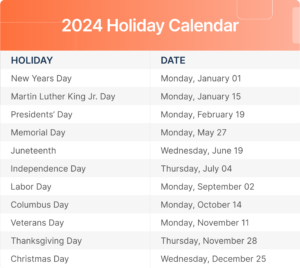
Here is a printable list of all U.S. National Holidays for 2024


2024 Holiday Calendar


Balancing Business Needs with Employee Time Off


You can strike a balance that benefits your business and your employees. The key is to approach it thoughtfully and flexibly.


One aspect to consider when creating your holiday calendar is the days of the week on which holidays fall. For example, if Christmas or another major holiday lands on a Sunday, you will want to ensure that your employees still receive their well-deserved days off. In such cases, it is common practice for businesses to provide additional time off on the nearest workdays, often on Friday and Monday. This allows your team to enjoy an extended holiday break without affecting the overall productivity of your business.


Another factor to remember is the nature of your industry and your clients’ expectations. Some businesses experience an increase in demand during specific holidays, while others may slow down. Understanding these patterns and careful planning can help you manage staffing and workload effectively.


Additionally, consider the preferences and traditions of your employees. Some may prioritize certain holidays over others due to personal or cultural reasons. Being flexible and accommodating with your holiday calendar can go a long way in promoting employee satisfaction and morale.


Creating and Communicating Your Holiday Time-Off Policy


Crafting a clear and fair holiday time-off policy is critical. This policy sets the stage for how your small business navigates the holiday season while promoting a positive work environment.


Creating a Policy

Begin by establishing a comprehensive holiday time-off policy that aligns with your business. This policy should address the holidays your company observes and lay out the expectations and guidelines for requesting time off.

Consider the number of holidays your business will provide, including any additional days for holidays falling on weekends, as mentioned earlier. Determine whether employees must create an out-of-office message during their time off, ensuring a consistent approach across all teams.

Communicating Your Policy

With your holiday time-off policy in place, effective communication is key to ensuring that everyone across the board understands and adheres to the guidelines. Your team should know the ins and outs of the policy without gray areas.

Roll out your policy to your employees before the holiday season. Clearly explain the “why,” “what,” and “how” of the policy, leaving no room for confusion. Emphasize the importance of adhering to the procedure to maintain both business and employee satisfaction.

Be approachable and open to questions from your team members. Encourage an environment where they feel comfortable seeking clarification or raising concerns. This approach conveys that you genuinely care about their needs and well-being during the holiday season.

Consistency is vital in applying your policy across all teams. Ensure that every department and manager understands and enforces the policy identically, leaving no room for discrepancies. This consistency ensures fairness and helps maintain a harmonious work environment.


The Positive Impact of Time Off 


Time off is about well-being and productivity. When your employees have the opportunity to recharge, the positive ripple effects extend far beyond the vacation days themselves.


Consider this: when your team members take a break, they return to work with renewed energy and enthusiasm. They are happier, more focused, and better equipped to tackle tasks and challenges. This enhanced state of mind translates directly into improved performance, higher-quality work, and a heightened commitment to their roles.


Conclusion


Your 2024 holiday calendar can help your small business succeed. Use it to make smart decisions, set guidelines, and look out for your team’s happiness and health.  When done right, providing time off for your team leads to happier, more focused, and more committed employees who deliver improved performance. So, embrace the holiday calendar as a tool to navigate the year ahead with confidence and success.


How FINSYNC Can Help


FINSYNC allows you to run your business on One Platform. You can send and receive payments, process payroll, automate accounting, and manage cash flow. To learn more about how we can help your business start, scale, and succeed, contact us today.


Apply For Business
Checking Account

Before you get started

1

We are not able to service these businesses at the moment:

  • Crypto Currency and Money Services
  • Privately Owned ATMs
  • Marijuana-Related
  • Gambling
  • Money Services Business
  • Business headquartered outside of the U.S.
2

At this time we are offering online business checking accounts through bank partners in these states:

  • Arizona
  • California
  • Idaho
  • Nevada
  • New Mexico
  • Oregon
  • Texas
  • Utah
  • Washington

Is your business in one of these states?