
Accumulated Depreciation: Definition and Calculation

You just purchased a new asset for your business; wouldn’t it be wonderful if you never had to worry about it again? That piece of equipment or machinery never needed maintenance and never needed replacing ever again. 


Unfortunately, this isn’t the reality, and organizations need to track accumulated depreciation to ensure operations continue to run smoothly.


Accumulated depreciation is not to be confused with regular depreciation. However, the only difference lies in the fact that depreciation appears as an expense on the income statement, and accumulated depreciation is reported on the balance sheet.


This article defines what accumulated depreciation is, how it is calculated and recorded, and the importance of keeping track of this vital piece of accounting.


Definition


Accumulated depreciation is the total depreciation of a fixed asset since it was placed in service. For every asset a business has in use, there are two numbers associated: the cost basis and accumulated depreciation.  


Cost basis or historical cost is how much the equipment or machinery originally cost. This number is documented and verified via the purchase receipt. Accumulated depreciation is how much value this asset has lost and now reduces the value of the asset on your balance sheet. This special type of account that impacts assets by reducing their value is called a “contra-asset” account.


The purpose of tracking the accumulated depreciation is to spread the total cost of an asset over its useful life or for as long as the asset is used by the business. Since each asset loses value each year and that loss is treated as an expense, depreciation also affects net income


Two Calculation Methods


Depreciation can be calculated on a monthly basis in two different ways. Either straight-line method or declining balance method is recognized by the IRS. A business needs to calculate the depreciation of every asset each month over the course of three to twenty years. 


Straight Line Method – This method depreciates your property at an equal amount each year over the product lifespan. Straight line depreciation is used when there’s no pattern to how the asset is used over time. This method is the most straightforward method of calculating depreciation. 

 

formula for straight line depreciation


Declining Method – The declining depreciation method is a system of recording larger expenses during the earlier years of an asset’s life and then smaller amounts during its later years. This method is based on the assumption that the piece of equipment such as a laptop will depreciate more quickly in the first few years versus at year 10. 

 

formula for declining depreciation


There are two commonly used forms of the declining balance method: the 150% declining method, and the double-declining method. 


◦ The depreciation factor under the 150% declining method is 150% or 1.5.

◦ Under the double-declining method, the depreciation factor is 200% or 2.


Examples


A small board game company called RealBlox needs to purchase an asset such as a cardboard printer to create board games on a commercial scale. This asset will cost $120,000 and is expected to last for 10 years, then, at the end of its life lifecycle, it will sell for around $2,000.


Using straight line depreciation, our formula will look like this:

 

numbers inserted for straight line depreciation calculation


RealBlox will need to recognize a yearly depreciation expense of $11,800.


Shane is setting up his own power washing business and needs to buy equipment totaling $50,000. He expects the assets to last 4 years but doesn’t expect any salvage value after this point. 


If we use the 150% declining depreciation method our formula will look like this: 

 

numbers inserted for declining depreciation calculation


After the first year, Shane will need to recognize a depreciation expense of $18,750 or $1,562.50 per month if the accounting periods are monthly.


For year two, Shane will need to subtract the $18,750 from the historical price of $50,000. Therefore, his beginning book value for Year 2 will be $31,250, and repeat the equation for each year. 


Importance of Accumulated Depreciation


Businesses track accumulated depreciation for each asset on the balance sheet. Each period, the depreciation expense increases accumulated depreciation and reduces the value of the asset over its lifecycle. 


When a company sees a number of critical assets on its balance sheet with high accumulated depreciation, that’s a good indicator that replacement may be required soon.


For outside companies considering the purchase of a company with many pieces of critical equipment, a list that includes assets along with their accumulated depreciation is necessary to avoid surprises due to failing equipment or overpaying, thinking assets have many years of functional life left.


How FINSYNC Can Help


FINSYNC allows you to run your business on One Platform. You can send and receive payments, process payroll, automate accounting, and manage cash flow. To learn more about how we can help your business start, scale, and succeed, contact us today.



The 4 Day Workweek – Is This a Permanent Shift?

The prospect of adjusting to a four-day workweek has many businesses apprehensive. But what if the data does not result in productivity and revenue graphs plummeting? Perhaps there are unexpected business advantages when considering this radical new trend. 

Since we are well into Year Three of the pandemic, businesses are very much aware of the work-family dynamics that have challenged people and organizations everywhere. Parents have struggled to find child care, and conforming with the series of school-mandated COVID tests are just a couple of examples of employees needing a more flexible work schedule. 

Business pressure to find skilled workers is amplified due to the tight competition and high demand. Many companies are considering a four-day workweek to attract top talent and avoid The Great Resignation

This article will take you through the workweek history and intriguing facts that will explain why this new work craze is gaining traction worldwide. 

History of the 5-Day Workweek

“Eight hours labor, eight hours recreation, eight hours rest,” said labor activist Robert Owen in 1817. The Welsh textile mill owner and philanthropist did not know it would take over a hundred years before this eventually caught on. 

In 1926 Henry Ford developed a new working standard for his automobile factories. At this point, the US government began to acknowledge the 40-hour workweek formally. However, Ford didn’t do this for his employee’s well-being. He realized that if companies were to profit, customers needed to buy things, which meant workers needed time off to shop. 

The US has kept this standard ever since. Over 100 years later, this structure is still the norm for 8 hours a day, five days a week. Even with the tremendous technological advancements that have taken place over the past 30 years, workers still put in a 40-hour workweek. 

Until now.

Leading the Pack 

Iceland began several large-scale research trials between 2015-2019 to track and record data for workers only working four days a week. This research was the first large trial of a shortened workweek within the public sector. The result? By all measures, it was an “overwhelming success.” 

Employees’ well-being increased among a range of indicators such as stress, employee burnout, and work-life balance. This study was such an astonishing success that currently, 86% of workers in Iceland have the option of working just four days a week without a decline in their pay.

Other countries are quickly following suit. Spain started a larger project that will encompass 200 companies reducing their employees’ workweek to 32-hours without cutting pay. Scotland, Japan, Switzerland, New Zealand, the UK, Belgium, and many more have announced they would conduct similar trials without changing workers’ compensation. 

What began as a small trend is heating up fast and currently involves over 35 American companies (and growing) and over 20 countries worldwide that have started offering a reduced workweek. 

Increased Productivity

It is counterintuitive to think that working fewer hours would produce more worker output, but this is precisely what the data has revealed. Reducing the number of hours worked forces companies to prioritize their essential tasks, remove superfluous meetings and other distractions, and use technology to automate business processes. 

These changes make employees’ work more accessible. A 2016 study by Ginger Research in the UK showed that the average worker only accomplishes less than 3 hours of work each day, regardless of how many hours they physically spend at the office. 

The takeaway from this study and others is that overworked employees are less productive than those working fewer hours. A Stanford University study found that productivity during 60-hour weeks was less than two-thirds of when 40 hours were worked.

In addition to increased productivity, a four-day workweek has been shown to decrease worker sick days, increase sales, improve employee retention, increase company loyalty, and produce more job applicants. 

Drawbacks

Even though the data for a four-day workweek has been overwhelmingly positive, there are still challenges that companies have to overcome. For example, many employers insist on the same level of productivity, which means the same work gets squeezed into fewer hours. The result can be hectic days and exhausted evenings.

A condensed workweek allows less time for office socializing. Some respondents said this was a bonus, but many workers depended on the water cooler chats to help offset stress and anxiety. 

Sometimes four days doesn’t mean four. Trial participants said that a four-day workweek was four-standard, 8 hour days, and then a half-day to catch up. Some fear that it is only time before companies start paying less for the same output.

Regardless of the drawbacks, there are many happy tales from workers with newfound freedom in life. They have more time to incorporate exercise, quality time with their kids, or catch up on doctor appointments and errands.

Final Thoughts

Issues of work-life balance are very much on people’s minds when looking for a new job opportunity. But to make this trend more widespread, we need to have a significant shift in how we think about work and embrace the changes already in effect. 

Many business owners and employees agree that a two-day weekend isn’t enough time to recharge fully. The WHO recently announced that employee burnout is considered an occupational phenomenon, and this burnout is forcing business owners to prioritize their employees and their own mental well-being. 

Also, the growth in AI technology will significantly disrupt every aspect of every industry around the globe. How and when we work is about to change drastically, and some say this transformation will happen much sooner than we think. 

Finally, suppose workers can complete the same amount of work without diminishing the business’s bottom line, or actually improving it. In that case, it is hard to come up with why this policy shouldn’t be more widespread. At the very least, businesses should seriously rethink retention strategies such as a decreased workweek to avoid losing leading talent in an increasingly competitive labor market because the cost of replacing and training employees continues to reach new heights.


Try FINSYNC for free to see how the platform can help you easily improve your cash flow management and avoid those dreaded dips into the red.


Business Principle #6: Invest in legal and accounting advice.

This is part six of ten in a series on foundational principles of being an entrerpreneur.

As a small business owner, money is always tight—particularly at the beginning. Starting a business requires cash for things like business formation, inventory, and marketing. The list goes on and on. 

If you’re short on cash, you make up for it with sweat. 

The simple solution to the many demands on your wallet is to do it yourself. For many of your business needs, this can be productive—in others, very risky, particularly when it comes to legal and accounting. 

Legal and accounting issues have the potential to scare off those who are contemplating entrepreneurship. Questions arise such as: what if I get it wrong? How much is it going to cost? Is following my dream really worth all the red tape? 

The good news is that you don’t have to do it yourself; lawyers and accountants are there to handle the red tape for you. 

Even still, many entrepreneurs worry about the cost of seeking expert help; it’s easy to question whether the investment is worth it.

But small investments up front will set your business up for success. Get your legal structures and accounting systems in place—correctly—from the beginning. Failure to do so can kill your business before it even starts. 

Consider:

Initial decisions have long term effects. 

While choosing a legal structure or how to set up your books might seem like  minor concerns, the decisions you make now will impact your business for years to come. They’ll determine what sort of partners you can have or sources of money you can tap. They will dictate how profit is determined, what you owe in taxes, and how you will be paid. 

These decisions will ultimately affect your bottom line. When money is scarce, you need every dollar available. If you set up your business structures correctly, you’ll keep more money in your business. Over time, those dollars add up.

Experts are experts for a reason. 

One of the great things about the digital age is how readily information is available. Google “What legal structure should I choose?” and hundreds of articles will appear. With so many resources, it’s natural to be tempted to figure it out yourself..

But legal and accounting are highly complex areas. Lawyers and accountants complete years of schooling in their fields and must pass difficult exams in order to practice. Their job is to understand the nuances of the law and how they will impact your business. Getting their expert advice—specific to your business and situation—will position your business to thrive. 

Granted, not all professionals are equal. When choosing a lawyer or accountant, make sure you do your research and ask other business owners about their experience. If another entrepreneur raves about their lawyer or accountant, that’s a great place to start. 

Focus your energy elsewhere. 

Even with everything stated here, you may still be tempted to save the money and do it yourself. 

Pause for a minute. Do you really want to? 

Yes, you can do it. You can spend time and energy doing the research. Filling out the forms. Configuring the systems. Making filings. Calculating estimated taxes. Evaluating reports. Wondering if you did it right. 

Let’s be honest. Trying to figure out these complicated systems is stressful. Self-teaching takes significant time—time that will ultimately cost you more money than you would pay upfront for expert help. Time you could be investing elsewhere in your business, on things only you can do. 

You are not starting your business because you want to learn legal or accounting (unless that is your business!). You want to wake up every day doing something you love. Focus your energy on that and leave the other stuff to the experts. 

Because when you get that government letter stating that you missed something, you’re going to call a lawyer or accountant to fix it. And it will cost more than avoiding the mistake in the first place. 

What Is Good Customer Service and How to Employ

You only get one opportunity to make a great first impression. These words have rung true for customer service departments for decades. But what is good customer service? How do you create a process that guarantees you make that good first impression every time?


Good customer service is the quality of timely assistance provided by a business and its employees to those who use or buy its products and services. More importantly, you provide an encounter that adds to the overall customer experience.  


It sounds simple, but offering quality support is often overlooked. As a result, many organizations cannot meet the standards that their clients and users expect. Therefore, providing excellent customer service is a way for your business to differentiate itself from the competition.


Know Your Products


To offer your customers excellent support, you should first make sure your team is knowledgeable about the entirety of the products and services you offer. With this knowledge comes great responsibility. Therefore, it is essential to equip your staff with the power to fix the customer’s problems on the spot. 


Ideally, your customer support employees should understand your product or service’s specific features, advantages, and limitations. 


It is vital to create a process so team members are constantly learning and improving their craft. Provide regular training sessions on common questions, pitfalls, and good listening skills for your staff. You could also provide monthly huddles so team members can introduce unique problems to the group. 


The most important method to improve your employee’s knowledge is developing a schedule and sticking to it. Many businesses spend a lot of time and energy training their employees to provide excellent customer support because this is the best way to ensure that customers will return.


Know Your Customers


Put your customers first, always. Customer-centric companies are on the rise, looking for people driven to deliver a truly exceptional customer experience or CX. According to recent research from Deloitte, companies that utilize a customer-centric approach are 60% more profitable than organizations that don’t. Therefore, having poor customer support is costing your business money. 


To put your customers first, you first need to understand them. Do you know what your customers need and what drives them? There are several techniques to get to this critical information. The first and easiest is to ask your customers questions. 


Find out what they like or dislike about your product and how you can knock it out of the park for them. You can engage with your customers on social media to ask these questions, discover their buying trends, or just read their comments on a particular product or service.


Finally, a great way to get to know your customers is to release a survey. Customer satisfaction surveys can be an impactful strategy for finding out your customer’s main issues, the best solutions to these concerns, and other feedback that wasn’t even on your radar.


Remember, brevity is your friend in creating a successful customer survey. Keep questions concise and straightforward. The survey’s main goal is to receive as much accurate information as you can. Therefore, use multiple-choice questions, true or false, with a few open-ended questions where customers can provide more specific information. 


Respond Quickly


According to customer retention statistics, 66% of individuals state that valuing their time is the most important thing a company can do to provide an excellent online customer experience. Efficiency is key. 


Customers want answers to their problems right away. They could be in the middle of their workday waiting on valuable information from you, so the faster you can remedy their obstacle, the better experience they will have.


If you cannot respond right away, you could set up an autoresponder that will confirm that you received their message. Include links to FAQs in this correspondence. Even though you can’t help them out right away, the customer knows you got the message and that help is coming.


The faster your team can respond to customer needs, the quicker your user base learns to trust your organization. Utilizing tools like IVR for call centers can help streamline call handling, ensuring efficient customer interactions. The worst-case scenario with slow response times is that they can negatively impact a business’s bottom line for years to come.


Build Trust


The most critical element in providing good customer service is to build a relationship and trust with the customer. The only way for this is to deliver a human connection, not a machined response or repeated handoffs among team members. Personal interactions let the customer know that you genuinely care about their experience.


Allow your customer service representatives to show some of their personalities. Since customers want to work with other humans, don’t let conversations solely be about business. Be friendly, helpful, funny, and try to get to know your customer. A little personality goes a long way in building trust and overall brand loyalty. 


According to Microsoft, 90% of respondents indicated that customer service is the most important aspect of loyalty to a brand. 


Overall, customers still care about the price and quality of products and services; at the same time, consumers would instead encourage companies that focus on their experience while providing value beyond their initial purchase. The Microsoft data also indicates that poor customer support leads to consumers going to other brands (56%). In comparison, good customer service leads to higher brand loyalty and more return customers.


How FINSYNC Can Help


FINSYNC allows you to run your business on One Platform. You can send and receive payments, process payroll, automate accounting, and manage cash flow. To learn more about how we can help your business start, scale, and succeed, contact us today.

How to Buy an NFT on OpenSea: A Guide to Mastering These Risky Investments

In the beginning, it was challenging to take Non-Fungible Tokens or NFTs seriously. It seemed impossible to pay for something that only exists in the digital space and would rack up a tremendous value. Well, they have, and NFT investors are revolutionizing the crypto market. 

In January 2022, founders of OpenSea, Alex Atallah and Devin Finzer, increased their New York-based company’s value by around $13.3 billion. OpenSea is a blockchain startup, and Blockchain is a digital ledger of transactions distributed across the entire network of bitcoin and other cryptocurrencies.

Now that investors are raking in millions, even billions of dollars, for buying and selling NFTs, we created a beginner’s guide to purchasing your first NFT using one of the original and most popular marketplaces, OpenSea. 

Create a Digital Wallet

Buying a Non-Fungible Token should be as easy as buying a pair of shoes since it all takes place online. Yet, that is not the case for NFTs. To buy an NFT, you first need to open a crypto wallet, load the wallet with cryptocurrency, then use it to purchase your NFT.

OpenSea uses the cryptocurrency called Ethereum or ETH. Coinbase wallet is currently the most popular app. Set up a Coinbase account and transfer your cryptocurrency into your new wallet. The app will also allow you to purchase cryptocurrency with traditional currencies like euros or USD. Please take note that it may take a few days for your ETH coin to appear in your wallet.

An alternative to Coinbase is MetaMask. MetaMask only features support for tokens and digital assets on the Ethereum ecosystem. However, Coinbase hosts a wide variety of blockchain assets, including Bitcoin, Litecoin, Bitcoin Cash, Ethereum Classic, XRP, Stellar Lumens, Dogecoin, and Ethereum.

Find Your NFT

Using OpenSea, you can browse their collections after creating a profile and connecting your crypto wallet. If you click on “explore,” you can see thousands of NFTs currently available. You can filter your search and designate categories such as trending, collectibles, or virtual worlds. 

When you purchase an NFT, you buy a token that provides proof of ownership to a digital asset. You own the NFT on a blockchain and can verify its ownership with a private key. This technology makes the NFT uniquely yours.

The rarer and higher the demand for the NFT, the more valuable they become. Similar to the art industry. It is a good idea to check the price history, and you will be able to see what the previous person paid for the asset in addition to what they are charging now. This information is essential if you want to get into the trading aspect of the marketplace. It is like buying a car but knowing exactly the price they originally paid.

Buying an NFT

Sellers have two options for posting their NFTs. They can either set a fixed price or set up an auction where multiple buyers can bid on the product. Therefore, when you locate an asset you want to purchase, you will either buy it outright or place a bid. OpenSea charges buyers a 2% fee and sellers 2.5% for each purchase, also known as “gas fees.”

When you buy an asset directly, you will want to click on the “Buy Now” button. You are then prompted to review the details of your purchase before hitting “Checkout.” You will want to read this carefully to ensure you are not transferring money to a scammer selling a non-original product.    

To participate in the auction, simply click the “Make Offer” selection. You must specify the max amount you are willing to spend on the asset along with an expiration date. The NFT is transferred into your wallet and appears under the “Collected” tab on your profile page when the exchange is complete.

Determining NFT Authenticity

How do you know if your NFT is authentic? Here is where the Blockchain comes into play. Each asset sold lives on the Blockchain, and you can easily verify the authenticity by viewing the transaction hash. A transaction hash is a unique string of characters given to every transaction verified and added to the Blockchain. These characters represent data, including creation date, number of variants, and other bidders and buyers.

In addition, it is an excellent idea to reverse-image search on Google and check the socials on the creator. Creators tend to be pretty active on social media advertising the newest releases. It is good to skim the comment sections to see what others are saying about the creator’s work. 

Check other marketplaces to ensure the artist isn’t trying to sell the asset multiple times. A legitimate creator tends to choose one Blockchain and stick to it. 

Avoid assets that are priced much lower than their appreciated value. These are almost always copies and not the original product. You don’t want to pay for copied or plagiarized work.

Summary

Some of us have a harder time wrapping our heads around paying real money for something that doesn’t genuinely exist. But currently clocking a $41 billion industry, at the very least, investors are paying attention. 

But where the money flows, there will always be fraud. This week, hackers stole millions of dollars worth of assets from OpenSea NFT. This theft is leading to multiple lawsuits filed against the NFT marketplace, thus proving this new industry can be fraught with peril. 

Overall, the NFT market is hugely speculative and driven entirely by “scarcity” and the new trend of the day. The future of these marketplaces is still unknown, and there is no guarantee the NFT you buy will appreciate with time. However, if you want to support an independent artist and have a good appetite for losses, NFTs can be an exciting collectible for your space in the Metaverse.


Grow in new and empowering ways when you combine innovative software with unmatched services at FINSYNC.


10 Signs of Burnout and How to Prevent It

In the wake of the COVID-19 pandemic, the US has been experiencing labor shortages across nearly all industries and roles. Businesses all over the nation are competing for top talent and hoping to increase their existing employee retention


One technique to increase loyalty is to be aware of the signs of burnout amongst your staff. 


Employee burnout happens when work stress reaches a level where it becomes a chronic mental health issue. It is common for business owners to treat these problems as personal, one-off issues rather than a broader organizational challenge, often resorting to an online counseling session as a quick fix. This mentality is a tremendous mistake.


The actual cost of burnout can be even worse for a business due to low productivity, high absenteeism, and losing its best talent. A great place to start is leaders acknowledging their role in creating workplace stress in the first place.


Once executives confront the problems that lead to burnout, like heavy workloads, unnecessary short deadlines, and frustrating work routines, they can tackle the issues at an organizational level and use administrative measures to improve them.


However, before management can improve the causes of work-related stress, they need to recognize when burnout is upon them. This article details ten signs of burnout to look out for and quickly address in your business.


1. Increased Cynicism


Cynicism is destructive for the workplace and is usually a sign that employees feel hopeless and powerless. When management turns against the cynical members by labeling them as negative, they do not understand that cynicism is usually a symptom of a much larger problem.


A great defense to workplace cynicism is to establish a culture of trust. Digging into the series of issues, creating a plan, being transparent and predictable, listening to grievances, and becoming transparent are great methods for reducing cynicism and creating a positive work environment. 


2. Employee Isolation


Burnout and depression can have similar symptoms. An example would be an employee withdrawing or isolating from the rest of the team. Canceling meetings, skipping out on favorite activities, or withdrawing from previously established work relationships are all common signs of employee burnout.


If you notice one of your employees is no longer engaging with other team members, address it immediately, possibly schedule recurring 1:1 meetings to check in with your staff so you can highlight potential issues. Isolation is usually a problem that requires intervention before it subsides. 


3. Lack of Energy


If employees frequently work long hours, this would presumably increase their stress and fatigue. The more time someone spends at work, the less time they can provide self-care or engage in coping skills to restore their outlook and physical well-being. 


Signs of lack of energy are the employee is always tired, yawning during meetings, reduced alertness, and forgetfulness are all things to keep an eye out for among your staff.


As a business owner, if you begin to see a lack of energy in one or more of your employees, it is essential to ask them how you can help. Lessening their workload, emphasizing work-life balance and good sleep routines are great places to start. 


4. Exhaustion


Employee exhaustion usually happens when fatigue and other symptoms go unaddressed. Are your team members talking about how they feel drained first thing in the morning? Those who experience emotional, mental, or physical exhaustion often have trouble dragging themselves to work every day, and they can even have trouble starting or finishing a task.


There are often cultural pressures to work through the discomfort or suffer in silence, which is why organization-level interventions are required.


5. Lack of Confidence


When workers experience burnout, their symptoms can differ quite a bit. In addition to physical symptoms, there are also emotional symptoms to observe. One of these is a lack of confidence in their abilities at work or if a colleague is suddenly sensitive to feedback. These signs happen when an employee feels disconnected from their work and is usually in a high-stress environment.


Since our society has limited knowledge about occupational burnout, employees often ignore their symptoms and keep pushing through despite the emotional turmoil they are going through. Low self-confidence can seep into both their work and personal lives because they no longer feel connected to their responsibilities.


The heightened stress levels make these individuals more susceptible to hypertension and diabetes, or from an emotional level, they suffer from long-term social and personal losses. This type of burnout tends to be more severe and leaves more long-term scars.


6. Perception of Unfairness


Co-workers who have bitterness or a perception of unfairness can be showing burnout signals. Whether an individual feels overlooked when their colleague gets promoted, doesn’t feel management is communicating properly or begins complaining their salary is insufficient, these can all be signs of burnout.


A direct approach can remedy this problem. If you hear an employee complain about a lack of communication or money, pull them aside and have a conversation; ask for specific examples so that the employee feels heard and understood. 


7.  Decreased Productivity


Individuals with burnout feel negative about carrying out tasks. They have difficulty concentrating, which diminishes their productivity enormously. Sometimes, individuals will lack effort altogether and attempt to get by on just the bare minimum.


By not recognizing a lack of productivity along with other burnout signs, this symptom tends to only get worse. This attitude is costly for the employer and doesn’t fulfill the employee’s expectations. It is best to notice this and other signs early on so you can quickly turn them around.


8. Lack of Control


Workers who have an absence of autonomy and control of their professional lives can negatively affect their well-being. For example, if they cannot control their schedule interactions with senior staff that affect their time management, they are at risk of employee burnout.


Experts agree that the ultimate battle of burnout falls on the shoulders of both the employee and the employer. Therefore, companies need to acknowledge their role and figure out why their workers can’t keep control of their schedules and, ultimately, their autonomy.


Upper management may not understand on a deeper level the degree of stress and suffering they are causing their employees. Communication is paramount. Either employees need to step up and illustrate how current actions affect their state of being, or management needs to notice and implement boundaries. 


9. Frequent Mistakes


When employees feel a lack of job security, their stress levels increase. Unfortunately, increased stress often leads to making more mistakes, which can be small and fleeting or detrimental to the organization as a whole.


If you have a reliable employee who begins making several mistakes in a row, something is weighing heavily on their mind to create such a contrast. Heightening pressure on already worried individuals to stop making mistakes only perpetuates stress cycles. 


10. Overloading High Performers


Employee workloads have increased in many organizations where hiring has not matched growth. In addition, companies overestimate how much can be accomplished with digital platforms and software and do not check to see if their assumptions are correct.


The overload problem is worse for the high-performing employees because their knowledge base is in high demand. They become the biggest victims of burnout, and without organizational changes, businesses may have trouble keeping their best performers. 


Conclusion


People tend to feel excited about what they’re doing when they can creatively decide what needs to be done and come up with ways of handling problems that arise. Generally speaking, workers who feel restricted and unable to exercise personal control over their environment and daily decisions tend to be at greater risk for burnout. 


Watching out for signs of burnout and addressing it right away can help employees feel more supported and less stressed out by achieving a healthier balance between the demands of their jobs and their mental and physical well-being.


Remember, employee burnout is not a sudden workplace event. Stress and negative well-being are a gateway to burnout and are built up over time. Business owners can identify the cause of stress and address it before burnout manifests are vital to both employees and employers.


How FINSYNC Can Help


FINSYNC allows you to run your business on One Platform. You can send and receive payments, process payroll, automate accounting, and manage cash flow. To learn more about how we can help your business start, scale, and succeed, contact us today.

Spotlight on Small Business Choices of the Heart

I had the pleasure of speaking with Mandy Perkins, the Executive Director of Choices of the Heart. Choices is a non-profit organization that provides support and compassion to women who are or think they may be pregnant. Choices of the Heart offers emotional support without judgment by providing counseling, testing, education, and resources. They are with women every step of the way, regardless of their income.  


What drew you to the company and to join in a leadership capacity? 

My husband and I have been business owners of a fabrication business for the past 20 years, and I also own an antique shop near the clinic. Our pastor started Choices of the Heart in 1983, so I have always supported it in some capacity. In March 2021, there was a huge staff change, and the pastor asked me to use my business knowledge and take over as Director. I agreed, and even though there has been an enormous learning curve, I feel very blessed to be here. 


What are some of the challenges you’ve faced running a non-profit organization?

A non-profit is very different from a regular business. With a non-profit, you aren’t physically selling anything to pull in income. We are entirely donor-supported, which adds a whole other stress element because we can’t operate if we don’t have the donors’ support. 


How does your work fulfill your passions?

We support women who are pregnant or think they might be. We provide pregnancy tests, ultrasounds, counseling, and additional resources. Even though this role can be very exhausting, I know this is my purpose right now. 


Who or what prompted you to start using FINSYNC? 

I was so tired of QuickBooks. I used them with our fabrication business. I have used it for years and have never been impressed. But when I came here, it made zero sense how QuickBooks works for a non-profit. Because with our non-profit, we are not here to take payments and invoices. Instead, we need to outline our budget and collect money from donors. QBO is set up for invoicing, bringing in cash for a service rendered. 

When I first came on board, QBO disconnected from Synovus, the bank we were currently using. However, I kept going back and forth between these two companies, trying to get to a real person, and they each pointed their fingers, saying it was the other’s fault that the business bank account no longer synced. I worked for four months trying to reconnect! I was reconciling accounts pen to paper with a spreadsheet. It was ridiculous. 

I finally got fed up with it and decided to change banks to Morris Bank, which eventually led me to FINSYNC.


What are the biggest benefits your business has experienced using FINSYNC?

QuickBooks treated our donors as invoices, as in businesses being invoiced, which did not make any sense. This ended up being more work on my part than it should have been. 

Plus, ACH donations were not tracked in QBO. These donations were only tracked through the bank. So, each month, I had to go to the bank and log into two accounts, transfer ACH donations using a token code from one account to another, and then manually put this into QuickBooks. It was ridiculous, and I just knew there had to be a simpler way.

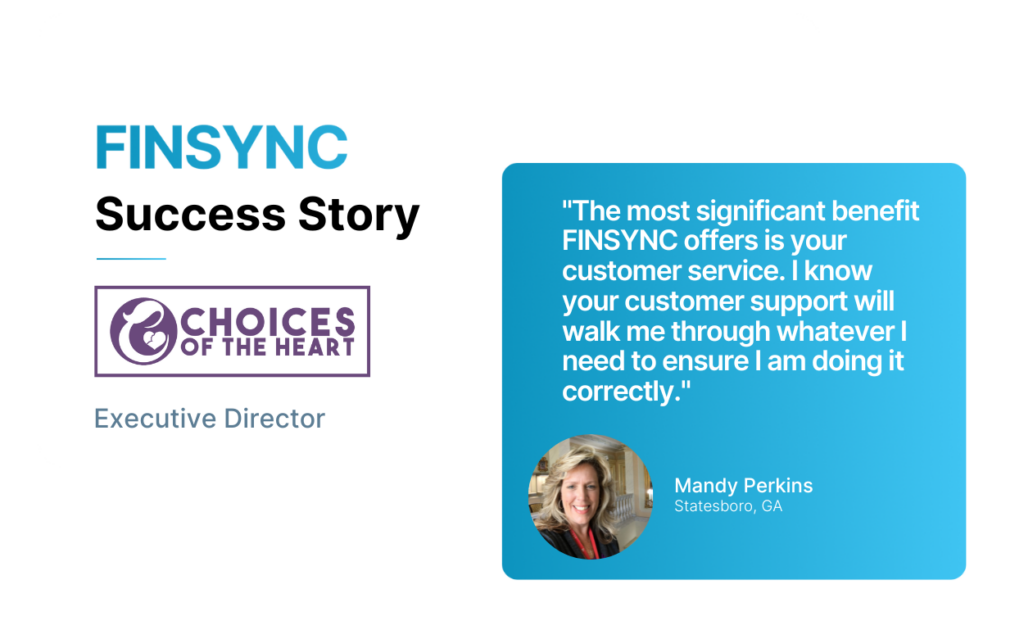
The most significant benefit FINSYNC offers is its customer service, without a doubt. I talked to Phil Weidner on many occasions because I am not very comfortable with technology, and Phil was very patient with me and helped me get set up. Phil is still helping me, and he has transferred all my bank statements from 2021 to be up to date. Phil has helped me with ACH payments and transfers and eventually reconciling. I know he will walk me through whatever I need to ensure I am doing it correctly. 


We have to thank our friends and partners at Morris Bank for this introduction and relationship; tell us a little more about your relationship with them.

I am so happy with Morris Bank. My feeling all along is that we are a local non-profit, so we should be with a local bank and have each other’s back. When we moved Choices from Synovus to Morris, I told Robert Benson, who I have known for some time at Morris, that I was so frustrated with Quickbooks. Immediately, Robert said, “Let me tell you about FINSYNC.” I told him that if it keeps track of my donors and allows me to reconcile donations, I am in! So Robert put me in touch with Jack Stone, who walked me through the software and showed me how simple it is, which I like. I am so happy with what FINSYNC allows me to do. 


Could you talk more about the partnership between Morris Bank and FINSYNC, particularly at the beginning of the relationship?

My husband and I already have our personal accounts and other business accounts through Morris Bank here in Statesboro. So when I called, Robert was extremely helpful in this transition. Robert is the son of Dr. Benson, who we know personally. When I started working at Choices of the Heart, my first thought was Morris Bank. 


Do you have any other financial institutions connected to FINSYNC? How would you compare the relationships?

When I go into Morris, everybody recognizes me and says, “Hey Miss Mandy!” so happy and cheerful. When I walked into Synovus, it wasn’t like that at all. I wasn’t recognized. They didn’t know who I was; they were there to do a job, and that is it. They weren’t involved in the community. 

It is a huge difference, and I guess if you are not a business owner, maybe it doesn’t matter so much. But when you are a business owner, you want to call up your banker, and they know who you are. 


How would you grade your experience connecting your bank accounts to FINSYNC? How has this helped make your business life easier?

Very high! It was very easy. Phil did most of it. He will tell me to press here and click on that. I really appreciate that extra help. Phil was able to design it for what we needed. If I ever have a problem, I know he will figure out a strategy somehow. 


What advice do you have for others running a business or 501c3 (non-profit) like yours?

Pray a lot! Learning along the road is the best way because if you come into a non-profit with no prior experience in 501c3, it will shape you to what it needs. Versus someone coming in thinking they know everything and changing the organization. 

With non-profits, our budget is our main thing, and we have to stay in line with our budget since we don’t have discretionary funds. 

Finally, you have to have the attitude that we are here to serve, not just be served. I think all non-profits work in that way. 


Anything else you would like to share with other potential and actual small business owners?

You need to love what you are doing. If you don’t love it, you don’t need to be in a non-profit. This is not a job; this is a calling. If you want just to earn a paycheck, don’t work for a non-profit.

The girls that walk through those doors into our clinic need to know the moment we greet them that they are not being judged. They are truly our #1 focus. You can’t do that if it is not in your heart. I have often said if this ever gets to be “just a job,” I will move on to something else. Right now, my heart is here.


FINSYNC allows you to run your business on One Platform. You can send and receive payments, process payroll, automate accounting, and manage cash flow. To learn more about how we can help your business start, scale, and succeed, contact us today.

8 Steps to Defining Project Scope for Business Success

Organizations typically know what goals they want to accomplish and have grand ideas and intentions from a high-level, big-picture perspective. However, organizers often overlook the detailed, actionable steps in achieving these big ideas defined in the project scope.


“Ideas are cheap. Ideas are easy. Ideas are common. Everybody has ideas. Ideas are highly, highly overvalued. Execution is all that matters” — Casey Neistat


According to Lucid Chart, there are four phases in a project management life cycle: initiation, planning, execution, and closure. Even though the phases have distinct qualities that overlap, this article focuses on defining the specifications within the first phase, the project scope. 


Project scope is a process that helps determine the overall project goals, tasks, deliverables, deadlines, and budgets as a part of the initiation process. Your project scope helps your business envision the entire project’s lifecycle to ensure the end goals are achievable and worthwhile. 


Below are eight steps to defining your project scope and effectively deploying within your organization.


1. Establish Objectives


Before defining your project scope, you first have to establish objectives. Project objectives describe and measure the “what” of a project. Eventually, your project scope will get you there, but first, we must determine what “there” is. 


Great questions to ask at this stage include:

    • What does project success look like?
    • What factors are involved in this project?
    • How will we measure performance? 


A project objective can act as a guidepost while always reflecting the project’s overall purpose. If a goal is to increase website traffic, an objective would be to increase pageviews by 10% over the next 90 days, recording results every two weeks.


Without project objectives, an organization doesn’t have a straightforward way of communicating goals to members over the project life cycle or even verifying if they are hitting their target. Objectives provide a measurable process to evaluate success. For teams looking to align objectives and maintain momentum throughout the project lifecycle, utilizing effective goal management templates can provide a practical structure for tracking progress, clarifying responsibilities, and ensuring everyone is working toward well-defined targets


2. Parameters and Limitations


Understanding what a project will not do is essential to create boundaries and meet expectations before beginning this venture. Determining what the project will not cover will ensure your team members aren’t wasting time on irrelevant tasks. 


In the beginning, decide which assignments are necessary to complete the project and who is responsible for the respective duties. Document everyone’s jobs so that employees stay on track. 


If you do not document the necessary steps, confusion is imminent, and some workers may assume specific tasks will get done. Still, since no one was appointed, these unexpected duties will eat up more of your timeline and budget. As the leader, it is your job to provide clarity to all members who play a role in the project. 


3. Project Scope Requirements


It is vital to discern exact requirements to estimate costs and timelines. This knowledge will require you to work with the project stakeholders to understand their needs. If you don’t know what the customer and users need or want, project success cannot be achieved.


Without doing your due diligence in this critical step, you may find yourself running into the following issues:

    • Requirements that constantly change
    • A complete rethink of deliverables mid-project
    • The outcome not being what the client expected


By conducting interviews, customer surveys, and personally call your users to gain the information necessary to understand there is a need for the project. Understanding the requirements will bring you closer to establishing resources, deliverables, and a timeframe to complete while maintaining the project margin.


4. Scope Documentation


A project scope statement puts all of your research to use in detailed documentation describing the justification for the project. This statement explains the individual project deliverables objectives and how to accomplish them.


This documentation ensures the stakeholders and team members are all on the same page while maintaining expectations and staying on track.


5. Train Team Members


Once you discuss the project scope with your team, you must ensure these employees can complete their assigned tasks. Additional specialized training or education may be necessary, and it is important to anticipate these costs and time requirements before beginning the project. 


6. Institute Deadlines


To ensure your project is completed within the allotted time, create weekly or bi-weekly deadlines while checking in with each team member or department to ascertain they are meeting these deadlines. 


7. Change Management


If certain members or departments are falling behind, it is essential to reallocate resources rapidly. There will always be roadblocks or limitations you didn’t expect. By swiftly identifying these constraints, you can quickly minimize the problems and overcome hurdles.


Scope creep occurs when additional features, functions, requirements, or work is added beyond the original parameters. Project cost increases, time delays, and low productivity are examples of potential causes for scope creep. 


Establishing an effective change management process can help avoid scope creep. Change control is a methodology used to manage any change requests that impact the baseline of your project. It is a way to capture a change, such as weather delays or low staffing levels, and evaluate the request with the stakeholders who will approve or deny the change, along with any necessary adjustments to your budget.


8. Communicate Well


Good communication is the single most crucial component to the success of your project.


The best method to ensure effective communication within your project is to develop a communication plan using a unified communication platform. This plan documents all communication activities and provides alerts to ensure you have an adequate follow-up plan for your stakeholders team members, and anyone else involved. 


During the project management process, unexpected events are sure to pop up eventually, which is why it is critical to have a well-researched plan in place. By managing the project’s scope, the PM can document all required resources to accomplish the project goals within the timeframe while staying on budget. 


Overall, setting a defined project scope ensures stakeholders are happy as their project will be completed on time, team members are empowered to manage their workload, and project managers have the flexibility to restructure as needed.

About FINSYNC


FINSYNC is a leading financial technology company dedicated to empowering entrepreneurs through an all-in-one platform that manages banking, payments, cash flow, payroll, accounting, and more. Through its CO.STARTERS Program, FINSYNC is committed to building stronger communities by empowering entrepreneurs with the tools, resources, and networks they need to succeed. For more information, visit FINSYNC.com.

SEO Link Building to Should Adopt for Your Website

Whether you have just started optimizing your website or you are a more seasoned SEO expert, link building continues to reign high in successfully increasing your site traffic. 


SEO, or search engine optimization, applies methods and techniques to your website and individual posts to promote your company. When someone keys in a search request to Google, the returned pages are ranked according to how well they correlate to the search. SEO techniques are used to catapult web pages to the top of the search results so that more users will click on your page.  


Since search engine algorithms are constantly changing, it can be overwhelming to keep informed of the current trends. This article conveys what link building is and how it helps drive free traffic to your business. 


What Is Link Building?


Link building is the process of connecting other websites to your own via hyperlinks. A hyperlink, more commonly referred to as anchor text or sometimes backlinks, refers to the clickable words used to link one web page to another. These words often default to a different color to indicate they are interactive. 


For search engines to verify the site your anchor text is linking to, Google crawlers or bots will search your linked site to ensure you are referencing material related to your original page. Crawlers or spiders are simply programs that screen or crawl your website along with all related sites. 


The actual text is what Google uses to determine authenticity and is similar to tabulating votes. If I create a link under the phrase “protein bars,” the crawlers will expect the site I am linking to address protein bars. If others do the same with that same site, this increases Google’s confidence that the page address should rank for “protein bars,” which boosts the site’s overall search ranking. Using SEO services Perth will help businesses improve their local search visibility with expert strategies tailored to their target market.


This very concept also explains the importance of backlinking. Backlinks are when another website uses our site in its anchor text. It is crucial to acquire backlinks from credible sources. You never want to pay for backlinks, as this would take your site down the “black hat” rabbit hole, which represents tactics that directly violate search engine guidelines. 


Internal Links


Internal links use anchor text to link to a different page within the same base URL. A proven internal linking method is to use blog posts to connect and highlight various aspects of your site. 


An example would be to promote a page to showcase the different styles of dog collars you sell create an article that describes how to choose a quality collar based on durability, comfort, and style that provides optimal value for the individuals researching this question. The overall strategy is to provide a link that easily connects readers to your dog collar products. 


Internal linking helps the web page become discovered and crawled. After all, the goal is to get your pages crawled by Google bots as much as possible. Therefore, if a page has no one linking to it, it is less likely to be crawled, making it harder to find. 


Creating an Internal linking structure helps Google understand that a particular page has a lot of “votes” that will enhance the equity a page has built up. How you structure your website and link one page to another is extremely important to make your site relevant and important to Google. 


But don’t overdo it; 2-4 internal links per page is a safe target. If your web page includes too many internal links, this can actually hurt your ranking. 


External Links


An external link or outbound link is anchor text that points at an external domain, not part of your root URL. On average, websites with more unique root domains (five and under) outrank websites with fewer unique root domains. We will explain why.


If you link to a credible site, it can add value to your page and possibly rank it higher in search results. You can think of external links like the bibliography page for a research paper. This supplemental information shows that you have already done the research, and readers can easily view it. 


If everyone links to the sources we consider the best, we end up higher in the search results, and thus, we all benefit. Therefore, selecting the specific anchor text that the site already ranks high on when connecting to an external site is critical. 


An example would be writing an article that has tips on choosing the best bed and breakfast. It would be vital to use Airbnb.com in the external linking strategy.


If you are not sure which sites rank highly on the terms you are using for your hyperlink, here is where premium SEO software like Moz, Semrush, and Ahrefs come in handy. These tools show how often each page is searched and the traffic potential for any keyword you are anchoring. 


Domain Authority


According to the data, there is a powerful correlation between linking and rankings. However, internal and external linking are examples of overall SEO techniques. To get the most out of your linking strategy, it is essential to prime your website to increase your domain authority


Domain Authority is a search engine ranking score developed by SEO tools such as Moz, Semrush, Ahrefs, etc. that predicts how well a website will rank. This score ranges from 1 to 100. The higher the score, the better its ability to rank. The data accumulated to create a domain authority is primarily built on links. 


Links from higher domain rating websites are more impactful than links from lower domain ratings. In addition, not having a recent site index, broken or orphaned links (pages not connected to your root site), and not having relevant or quality content will all lower your overall website authority. 


The SEO landscape has changed fundamentally over the last 10-15 years, and some practices that were once applicable have become obsolete. Follow this link-building guide, and you will be on your way to increasing your website and business traffic and overall success. 


How FINSYNC Can Help


FINSYNC allows you to run your business on One Platform. You can send and receive payments, process payroll, automate accounting, and manage cash flow. To learn more about how we can help your business start, scale, and succeed, contact us today.

7 Common Black Hat SEO Techniques That Can Impair Your Website

It is hard to know which search engine optimization (SEO) techniques you want to deploy and which to avoid when optimizing your website. The suitable methods are represented by the term “white hat,” and these are tactics in line with the terms and conditions provided by Google. 


The more your webpage matches the user’s search terms, the higher you rank on the search results. The goal is to get your website to the front page or the #1 spot. White hat is overwhelmingly the recommended solution in building your site authority with long-term, sustainable strategies.


On the other hand, “black hat” represents the dark side of producing SEO strategies. These tactics violate search engine guidelines and are geared to boost the search engine results page (SERP) instead of the user experience. 


Even though it is advisable to steer clear of black hat strategies, it is crucial to recognize if your website is using these techniques, perhaps by short-term optimization professionals. These tactics become obsolete with new technology and updated algorithms. Since these strategies are strictly against Google’s best practices, you could be penalized and banned from Google search results.


1. Keyword Stuffing


Circa 2008, websites that ranked high were filled with keywords that did or didn’t match the searcher’s intent. It quickly became a big business to stuff all web pages with as many words as possible that users were entering. Some would even use “invisible keywords,” which hid these keywords using the same text color as the background to make them indistinguishable from the reader.


This attempt to manipulate SERP was short-lived. Eventually, Google improved its algorithms and “crawlers.” Web crawlers, sometimes called spiders or bots, are the programs Google implements that automatically scan sites, identifying words that don’t belong while tracking all links on each page. If links go to unrelated pages, this will penalize the ranking score. 


A great way to avoid keyword stuffing is to create quality content related to the topic discussed. Quality content will naturally prevent keyword stuffing and remove the ability to use black hat SEO tactics.


2. Content Cloaking


Cloaking is an optimization technique where the information presented to the user is different from that supplied to crawlers. The goal of the tactic is to boost higher on the search engine results page (SERP). A page using this approach will provide lines of HTML text to search engines but show images or Flash videos to the user. 


The most common reference to cloaking is clicking on a site that looks like a funny cartoon image from the search results, but when clicked on, the site produces adult content or a paysite.


Regardless of what code is present, if it is radically different from what the user experiences, Google will flag and remove it entirely from search results.


3. URL Redirects


Many users have come across site redirects a time or two. This scheme occurs when a website uses Javascript to redirect and show content to the user that a search engine cannot see. Similar to cloaking, redirects present the users with a different experience than Google bots.


Not all redirects are bad. There are several reasons a site may want to redirect, especially if the URL changed or the page was updated. The black hat approach is when the new link reveals content unrelated to the original website. Redirecting a user to a page with different content than what was made available to the search engine crawler penalizes the website.


4. Duplicate Content


Duplicate content is a black hat SEO technique where someone scrapes or steals large blocks of text across either the same website or various domains. When this happens across domains, someone is likely attempting to steal blog posts to outrank the original source.


Another purpose for duplicate content is to create the same article with multiple location pages. This tactic is a way to gain website traffic on local searches, which is typically easier than nationwide or global searches. This approach is essentially the same content used, except for the city or other locational metrics.


Search engines prefer unique content, so pages purposely duplicated across different domains are considered one of the worst black hat techniques.


5. Poor Content


Similar to duplicate contact, posting poor content can be a mark against your overall search ranking. When a website provides incorrect information or delivers little to no value to the reader, this is a problem for Google.


Article spinning is a black hat phrase that occurs when hackers use plagiarism software to copy and paste multiple posts, resulting in “unique” content. However, the flow of the article is often very choppy and rarely makes sense. 


When you create content for your website, make sure it is your own and make sure it is good while supplying value to the searcher.


6. Paid Links


A backlink originates when one website links to another. You can think of it as a referral process where websites certify each other. By linking to another website, one site owner vouches for the content of another to be worth reviewing.  


Backlinks are an excellent way for Google to ensure your site is trustworthy and can be considered the backbone of their search engine ranking system. Unfortunately, these links take years to accumulate, and many SEO strategists devise a way to pay for links to speed up their results. 


These paid links, not seen by the users, are often from categories and industries unrelated to the site. This is why paying for links is against Google guidelines, and they have repeatedly stated they will penalize both the buyer and seller for such links.


7. Spam Comments


Our final black hat tactic is spam comments or user-generated spam. You have probably come across these when looking at social media comments and someone randomly posts: “Check out our free weight loss tool here.”


These comments are created either by users or bots to create free backlinks. Usually, they provide little value for overall SEO results, which deems them almost entirely ineffective. However, there is a more ethical way to sell your site.


After researching your market, you can locate the pages that your potential customers frequent. But instead of pasting a random link, provide thoughtful information that answers people’s questions or how the site benefited you personally. There is a chance this technique could still hurt your domain authority; however, the more original and unsolicited, the more likely you are to increase traffic and backlink potential. 


Conclusion


The black hat tactics listed are just some of the prevalent strategies developers and hackers have implemented over the years. Regrettably, this dark art is constantly evolving, with more designs and techniques surfacing every year. 


Thankfully, Google also identifies and disallows these unethical shortcuts to manipulate their engines. Producing high-quality searches for the users is their primary objective. 


Most SEO strategists understand that toying with black hat tactics is always a risk. For many, any success they find is fleeting because, sooner or later, the algorithm catches up and actually penalizes the site.


How FINSYNC Can Help


FINSYNC allows you to run your business on One Platform. You can send and receive payments, process payroll, automate accounting, and manage cash flow. To learn more about how we can help your business start, scale, and succeed, contact us today.
 

Apply For Business
Checking Account

Before you get started

1

We are not able to service these businesses at the moment:

  • Crypto Currency and Money Services
  • Privately Owned ATMs
  • Marijuana-Related
  • Gambling
  • Money Services Business
  • Business headquartered outside of the U.S.
2

At this time we are offering online business checking accounts through bank partners in these states:

  • Arizona
  • California
  • Idaho
  • Nevada
  • New Mexico
  • Oregon
  • Texas
  • Utah
  • Washington

Is your business in one of these states?