Use White Hat SEO Strategies to Increase Traffic

In the world of SEO or search engine optimization, there are the good guys, the ones who play by the rules, and the bad guys who try to trick Google’s algorithms to increase their site traffic. The term “white hat” represents the good guys and is also known as “ethical SEO”. By optimizing your site according to these procedures, your site will be less likely to be penalized by Google.  


We will cover the bad guys or “black hat” SEO in a separate post. For the moment, this article focuses on the importance of white hat optimizations, techniques you can apply, and also its limitations. 


Importance of White Hat SEO


The goal for all types of SEO is to get web pages to the top of Google search results to drive organic traffic to the optimized websites. Since there are millions of pages on the web, search engines need a way to differentiate and rank these pages in order of the ability to answer the search. 


If your page is not on the first page of results and preferably in the top 3 results overall, you won’t get meaningful organic traffic.


When someone types in their search query into search engines, a list of sites appears on the search engine results page (SERP). SERPs typically contain two types of content – “organic” results and paid results. 


White hat strategies influence the organic results that appear according to the search engine’s algorithms. If you are applying strategies based on giving value to your audience, then you are in the white hat lane. 


There are several advantages to getting traffic from white hat approaches. First of all, it is cheaper since you do not need to repair violations that have been penalized by Google for applying black hat tactics. Another advantage is consistency. Rankings that originate from a more stable, legitimate approach are more long-standing than quick tricks that Google eventually catches up to. 


Finally, relevancy is probably the biggest advantage of white hat strategies. Because you are targeting and providing value to the individuals who are more likely to be looking for your material, there is a strong possibility they will engage and convert. 


White Hat Techniques


1. Provide quality content – The phrase “content is king” is more relevant today than ever before. Providing your audience with the materials and knowledge they are seeking is invaluable. Blog posts are used by 86% of marketing teams today.


2. Keyword research – Choosing keywords that your audience is currently searching for is nearly a surefire way to get them to click on your content. At the same time, many people struggle with SEO because they choose to rank on keywords that are too competitive. If you research long-tail keywords, which are keyword phrases with three or more words, you can find phrases that are not as competitive and are still a popular search. You can use free sites like Uber Suggest and Answer the Public to locate long-tail keywords.


3. Page speed – Does your webpage load in under 3 seconds? If not, it is time to condense videos, reformat images, and install plugins to get your page speed down. Users get frustrated when sites do not load quickly; as such, Google ranks your page lower because it is not fulfilling the user experience.


4. Mobile-friendly – Out of the 8.5 billion searches on Google every day, 63% of them originate from a mobile device. Fortunately, it is not difficult to make your website mobile-friendly. There are websites like Experte that allow you to quickly evaluate whether your website is being penalized for mobile users. 


5. On-page – This practice refers to the content and HTML source code of a page that can be optimized. Adding things like metadata, alt tags, anchor text, headings, and sub-headings are just a few examples of applying on-page SEO strategies.


6. Quality link buildingBacklinks gained organically versus paid links have become a hallmark of SEO practices. Most linking will come from content and social media. If you are starting from square one and do not have many backlinks, you will need to do a lot of email outreach to websites that provide similar content for your users. 


White Hat Limitations


Even though white hat SEO is typically more cost-effective than black hat, the barrier of entry is often too steep for many companies to implement. The recommended optimizations above certainly work, but there is a great deal of complexity and time needed to modify the technical aspects of your website.


Another challenge with white hat tactics is the amount of time it takes a website to rank on the first page of Google search results. Many organizations give up before the front page is realized. But if you consistently create strong content that your audience uses over time, you will surpass this barrier eventually.


The biggest limitation with white hat optimizations is competition. In certain industries, you are up against many companies that have highly optimized websites ranked purely with white hat techniques. In these aggressive markets, to avoid waiting, sometimes years, to reach the front page, you can either pay for advertising or create more digital strategies that enhance engagement.


Overall, white hat SEO strategies focus on providing your users with high-quality and relevant content that optimizes the user experience. By focusing on quality and user experience, it is only a matter of time before your website beats out the competition and is catapulted to the front page.


How FINSYNC Can Help


FINSYNC allows you to run your business on One Platform. You can send and receive payments, process payroll, automate accounting, and manage cash flow. To learn more about how we can help your business start, scale, and succeed, contact us today.

 

How Project Margin Affects a Business’s Margin & Overall Profitability

As a business owner, you already know how easy it is to get caught up in the day-to-day management of a particular project. We all get tunnel vision at times and only focus on completing the tasks directly in front of us. 

However, it is important to pull back and get a big picture of how a project is functioning and affecting the organization’s overall profitability. Project margin helps to solve this problem.

Many business owners don’t factor project margin into their project management analysis. However, this statistic affects more than tracking and forecasting a project. While many areas could be affecting an organization’s profitability, this article emphasizes how monitoring on the project level will contribute to your overall success. 

What Is Project Margin?

Like profit margin, project margin is calculated by subtracting the costs from the revenue but on the project level. This deeper dive provides additional insight while concentrating on each project to determine which ones bring in the most revenue.

The costs associated with each project can be broken down into separate components. For example, you can track and observe the time your team devotes to a particular project and additional expenses such as equipment and third-party vendors.

An organization’s margin is divided into two parts: Current and projected. 

    • Current Margin – This value represents a specific point in time and is constantly fluctuating due to expenses going out and revenue coming in. 
    • Projected Margin – This value is the forecasted amount expected once the project is at completion. 

To better understand project margins, you will need to track the current margin and then add in any scheduled cost in the future to predict the projected margin accurately. 

Once you have this information, you can view the P&L of a specific project to discover trends.

P&L for Each Project

Let’s say your company is producing more new sales, and from the outside, your business appears profitable. However, you still aren’t creating consistent cash flow. Where do you look to find the source for where this money is going?

Many profitable organizations manage every project as a separate profit & loss (P&L). This approach reveals each independent project’s ability to generate profit. These metrics make it easy to refine your offerings and double down on the projects bringing in the most capital. 

This level of insight makes it easy to predict outcomes, so you can still make changes in time to meet your project targets. By making these predictions, you can quickly move resources, adjust staff numbers or change your project scope before the deadline approaches. 

Leading & Lagging Indicators

Project margin is a lagging indicator which means this metric evaluates only the current production and performance. Many business owners use leading and lagging indicators to track business trends month over month. Below highlights the main differences between these two statistics.

    • Leading Indicator – these measurable factors define what actions are necessary to achieve your goals. They are considered leading because they point toward the possible future to meet overall business objectives. Examples used in business include a new product pipeline, new market growth, and brand recognition.

Leading indicators make business owners ask questions such as:

  -How can we simplify processes to boost our outcome?

  -Where can the team make improvements to reach our goals?

  -What steps can be taken to speed up production or development?

    • Lagging Indicator – these indicators can only be known after the event completion, and changes in the project landscape can cause companies to alter their course. Even though this factor is not revealed until the end, you can use this information to gain knowledge and prevent future mistakes.  

Lagging Indicator questions could be:

  -How much of the final product did we produce?

  -What were the reasons we missed our deadline or goal?

  -Did any other variables pop up to alter the course?


These indicators regularly track performance by creating benchmarks to meet KPIs and overall business objectives. 

Since lagging indicators focus on outputs rather than outcomes, some organizations focus too much on the end results and miss opportunities that would have changed the outcome. 

Project Margin Best Practices 

Below are a few best practice recommendations when tracking and measuring your project margin. 

    • Resource planning: Project resources often change during the creation of a project. It is critical to have a plan to check and review any resource changes every week so the project margin data is accurate. 
    • Timesheets: Your business must have a reliable process for employees to complete timesheets on time every week. Utilizing payroll processing software that automatically checks accuracy and alerts for overages might be a great solution to keep projects in check.
    • Account reviews: Managers should have recurring monthly meetings with staff to review the leading indicators on specific accounts. These forecasts are a great way to head off potential problems to make strategic changes to the project.
    • Benchmarking: As well as measuring and tracking project margin, it is also advantageous to compare your statistics with other organizations. This information can give you a bigger perspective and indicate if you spend too much time and resources in a specific area.


How FINSYNC Can Help

FINSYNC allows you to run your business on One Platform. You can send and receive payments, process payroll, automate accounting, and manage cash flow. To learn more about how we can help your business start, scale, and succeed, contact us today.

Create the Statement of Cash Flows for Small Businesses

The statement of cash flows, or the cash flow statement, is one of the three primary financial statements used to determine a company’s financial health. The other two statements, the balance sheet and income statement, have already been addressed in previous articles. 


This article centers on the statement of cash flows under the accrual accounting method, where transactions are recorded in the general ledger as soon as they are earned or incurred. This recording happens even if the cash has not yet changed hands. 


This process of regulating the cash coming in and going out over a period of time is vital to the success of a business. We will cover the importance of developing a cash flow statement, the components, and how to calculate and interpret this valuable data. 


Why Do We Need a Cash Flow Statement?


The cash flow statement (CFS) takes the previous period’s ending cash or net income. It compares this to the closing amount of the current period while tracking the precise cash movement throughout the entire period.


An important factor from a business perspective is the CFS can verify that the revenues and expenses reported on the income statement are consistent with the actual cash movement in and out of the organization. Because of this, the CFS acts as a bridge between the income statement and the balance sheet. 


Another important factor in creating a cash flow statement is liquidity. Regardless of your company’s revenue, you must ensure enough liquid cash to cover necessary expenses like taxes and payroll. 


Finally, one can use the cash flow statement to create cash flow projections. These projections allow you to plan for the future and understand how much money your business has 6-12 months down the road. If you are secure in your cash flow projections a year from now, you can be more confident in making purchases now. 


Components of a Statement of Cash Flows


There are three main sections within the statement of cash flows. Each examines a different source and uses for the cash. These are operating activities, investing activities, and financing activities. Together, all three comprise the basic structure of the cash flow statement and are detailed below.


1. Operating activities – are the main revenue-generating activities of the business. These transactions monitor when a company has delivered its goods or services. 

2. Investing activities – are set outside of the business’s core activities. This group includes selling or purchasing property, stock in other companies, patents, etc.

3. Financing activities – are related to funding the business. This cash involves repayment or equity to third-party banks or business owners. 


Both revenue and expenses are in each of these groups. Negative numbers represent cash outflows, and positive numbers represent inflows. Generally, a company is successful if it consistently brings in more cash than it spends.


Calculation Methods


To calculate your organization’s cash flow, you need to apply either the direct or indirect method. 


◦ Direct method: this method mirrors the income statement. Under operating activities, the cash receipts from customers reflect revenue and cash paid to suppliers, employees, loan interest, and taxes mirror expenses. The company needs to produce and track cash receipts for every cash transaction. For that reason, smaller businesses typically prefer the indirect method.

◦ Indirect method: The indirect cash flow method is more straightforward, as it doesn’t require details of every cash movement, such as the date and amount of cash received and when a customer pays for goods. All the figures needed are on the income statement and the balance sheet.


A benefit of the direct method is that it is more precise. This precision makes the direct method an advantage if a business is experiencing cash flow problems and must calculate these metrics regularly. However, the indirect method is the more practical choice most of the time.


Final Thoughts


Cash flow statements reveal to investors and lenders which phase the business is currently operating. Analyzing the numbers indicates if a company is a rapidly growing startup or a mature and profitable company. It can also reveal whether a company is going through a transition or in a state of decline.


The CFS shows a different aspect of your business that the other two financial statements overlook. You can see how much cash a specific product or service generates or if a business is spending too much on its investments. This information allows owners and managers to make appropriate changes to the organization as necessary.


A company’s understanding of its cash inflows and outflows is critical for meeting its short-term and long-term obligations to its vendors and suppliers, employees, and lenders. In addition, seeing how your cash changes over time, rather than an absolute dollar amount at a specific point in time, is a solid metric to recognize for your company’s financial well-being.


How FINSYNC Can Help


FINSYNC allows you to run your business on One Platform. You can send and receive payments, process payroll, automate accounting, and manage cash flow. To learn more about how we can help your business start, scale, and succeed, contact us today.

 

The Income Statement: Revenue, Expenses, & Profits

Out of the three primary financial statements, we have already covered the balance sheet, which represents the value of your business at a specific point in time. This article focuses on the income statement, which outlines the profitability of your organization over a period of time.  

As a business owner, it is critical to read and analyze data from the income statement. Not only can you determine your company’s current financial health, but this understanding can also help you predict future opportunities, optimize business strategy, and create meaningful goals for your team.

Understanding the Income Statement

The income statement or profit and loss (P&L) illustrates how much income your business makes or loses during a period. The result is either a profit or a loss by subtracting expenses, possibly including cost of goods sold (COGS), from the total revenue.

The core function of the income statement is to disclose the company’s net income by comparing these profits and losses.

Business owners can refer to this statement to reveal if the business is spending more than they earn and the effectiveness of new strategies. Based on their analysis, owners can determine if they will generate more profit by increasing revenue or decreasing costs. 

Income Statement Format

An income statement should include all of the following line items:

    1. Total revenue: Revenue or operating income is your company’s income from its normal business operations.
    2. Cost of goods sold (optiona: COGS is the direct cost your company pays to make the product it sells, including the raw material and labor costs. Service companies don’t typically include this section.
    3. Gross profit: Gross profit is the net sales minus the total cost of goods sold. This metric shows how much a company would have made had it not incurred other expenses. 
    4. Gains: Gain results from selling appreciated assets that cause an increase in an organization’s income. This number differs from regular revenue and is often found in a separate section near the bottom called “Other Income.”
    5. Itemized expenses: All income statements should have a detailed list of individual expense categories. To calculate their operating profits, some companies separate their expenses into operating costs and non-operating expenses.
    6. Earnings before tax (EBT): This measures a company’s financial performance prior to paying tax. EBT is calculated by subtracting non-tax expenses from income.
    7. Net profit: Your company’s net profit is the gross profit minus expenses and is the final line on your income statement. 

Depending on industry and company policies, these components may be further divided into individual line items by project, product line, or department. 

Analysis

It’s important to know how to analyze an income statement as it can reveal the profit structure of your business and can highlight which line items need more attention. 

From top to bottom, reading an income statement can be divided into three sections: top, middle, and bottom. The top section is related to revenue and sometimes includes costs directly associated with generating that revenue.

The middle section provides information on the money going out, and this section lists expenses like marketing, depreciation, and research that aren’t necessarily direct inputs for what is sold. 

Finally, the income statement’s bottom section is the net income, which represents your company’s financial performance during a specific reporting period.

Finally, lenders or investors can analyze an income statement by completing a vertical and horizontal analysis. 

    • Vertical Analysis – This method compares one line item to another. For example, you can determine how a specific product may affect cash flow. Using vertical analysis, one can observe where a business may be overspending and which line items most contributed to profit margins. 
    • Horizontal Analysis – This analysis compares the same figures across two or more time frames, which is useful in spotting trends. For instance, reviewing a company’s consistent growth over time can predict how well that business will perform in the months or years to come.

The Bottom Line

An income statement provides valuable insights into various aspects of a business. As a business owner, you can understand the organization’s operations, the efficiency of its management, and potentially spot problem areas. 

The income statement is also an excellent benchmarking tool to see how your business stacks up to other companies within the same industry. You can determine if your costs are high for the revenue you bring in, and you can also ascertain if your profitability is worse, better or similar to other firms who sell the same goods or services.

In conjunction with the statement of cash flows and the balance sheet, income statements help management understand the complete picture of a company’s financial results to determine its value and forecast its trajectory.

The Balance Sheet: Understand Your Financial Health

The three primary financial statements: balance sheet, income statement, and statement of cash flows, work together to provide a financial report of a company’s profitability during a period.  

The income statement is a business’s income within a certain period. The cash flow statement shows how much cash a business generates and where it spends that cash during a period. However, the balance sheet is a statement of a financial position at a single point in time (a particular calendar day). 

This article dives deeper into the balance sheet and details its components and significance to understand your business’s profitability and overall financial value. 

What Is a Balance Sheet?

The balance sheet provides a picture of what a business owns and owes and how much is invested. The balance sheet is commonly used for a great deal of financial analysis, focusing on a company’s assets, liabilities, and equity. By looking at these three numbers, banks, auditors, owners, or investors can learn a lot about your organization. 

In order for your balance sheet to balance, it must be divided into two sections. On the left are the company’s assets, and on the right are liabilities and equity. Shortly, we will get more granular in the differences among these critical metrics. 

First, we will look at how a balance sheet works in tandem with the accounting equation in uncovering a company’s viability. 

The Accounting Equation

The balance sheet adheres to the accounting equation where everything a business owns (assets) equals everything they owe (liabilities), plus the owner’s equity in the company.

The Accounting Equation - Assets equal liabilities plus owners equity

The accounting equation states that a company’s total assets are equal to the sum of its liabilities and its shareholders’ equity. These sections of the balance sheet being “in balance” are considered to be the foundation of the double-entry accounting system.

Assets

The business owns assets that have a monetary value and are listed in order of liquidity or how readily they can be converted to cash. 

Assets are divided between current and fixed. 

Anything you expect to convert into cash within a year is called a current asset. Examples of current assets are cash balance, accounts receivable, pre-payments on future orders, and inventory. 

On the other hand, fixed or long-term assets may be more difficult to turn into cash within the year. Examples of fixed assets include land or buildings, office furniture, equipment, and goodwill. 

Fixed assets are recorded as the original purchase price of an item. A business must subtract the accumulated depreciation from these assets. 

Liabilities

Liability is the money owed to 3rd parties. These funds owed are also broken down into current and long-term categories. 

Current liabilities are expected to be paid within a year and include accounts payable, employee wages, taxes, and insurance payments. In contrast, long-term liabilities would consist of deferred tax liabilities, long-term debt such as mortgages, and pension fund liabilities.

Owners’ Equity

Owners’ equity or net assets is the amount that remains after subtracting liabilities from the assets. 

One way to think about equity is if all assets were sold and the proceeds were used to pay all liabilities, what’s leftover would belong to owners.

Equity can be in capital, private or public stock, and retained earnings for larger corporations. 

Final Takeaway

An analyst can generally use the balance sheet to calculate many financial ratios that help determine how well a company is performing, how liquid or solvent a company is, and how efficient it is with its cash.

Although the balance sheet is an invaluable piece of information, it is not the complete picture. Since it is just a snapshot in time, it can only use the difference between the current point and another single point in the past. Or in other words, this number is static. Therefore, it is beneficial to also draw on data within the income statement and statement of cash flows to paint a fuller picture of what’s going on with a company’s business.


Experience a better way to manage cash flow and grow with less time and better results with FINSYNC. 


What Is an Invoice? Best Practice Guide for Your Small Business

Sending and receiving invoices play a critical role in the success of your business. Therefore, documenting these transactions should be at the forefront of your company’s organizational goals. 

This article covers what an invoice is and the elements within an invoice. We will also cover assigning invoice numbers and creating an overall process for sending and receiving these transactions.

What Is an Invoice?

An invoice or bill is a legal document given to a buyer by a seller that states the total amount due for goods or services rendered. The customer will likely refer to it as a bill and it is how businesses get paid. An invoice lists the products or services provided by the seller, including payment terms such as Net30 (payment due in 30 days), for example. 

Invoices also include other relevant information such as:

    • Business contact information
    • Vendor contact information
    • Invoice number
    • The order or service date 
    • Description of service or product purchased
    • How many units and/or hours worked
    • Total amount due including taxes and shipping & handling charges

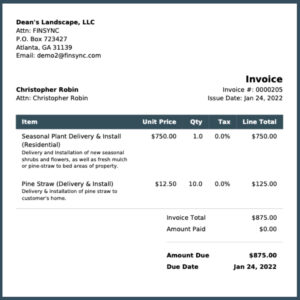
Invoices may be transmitted electronically, in the mail, or within the product package along with the packing slip. However, today many organizations use accounting software to speed up collections and increase operational efficiency. See sample invoice below:

FINSYNC sample invoice

Assigning Invoice Numbers

Since businesses want to get paid as fast as possible, setting up a process around sending invoices to customers is necessary. Assigning invoice numbers is a great place to start. 

Every bill issued has to have an assigned, unique control number for accounting purposes and preferably linked to the product or service requested. 

There are several different approaches to assigning invoice numbers. Here are a few standard methods:

    • Sequential – is the simplest and most common method of assigning invoice numbers. Start with #1 and increment up by one for each subsequent invoice.
    • Customer ID – this method is similar to sequential, but it begins with a customer code before this sequential number. If you assign a specific customer the code of 555, then their first invoice is recorded as 555-001.
    • Chronological – here, the first series of numbers is the date, the second series of numbers is the Customer ID, and the third series of numbers is the sequential number.
    • Project-Based – this method is similar to a Customer ID, where business owners assign unique numbers identifying a particular project. This numbering method works best with businesses that work with a wide variety of projects.

Leverage Best Practices

Using software can help you automate and track your invoicing. However, it is advisable to establish a process for every invoice that leaves your business. Here are a few guidelines to get you started in creating a successful invoicing method for your organization. 

    • Invoice at the right time – Sending a bill when products are ordered, or services have concluded is critical. The more you delay, the longer it will take to get paid.
    • Define payment terms – It is common to give your customers 30 days to respond with payment. However, feel free to adjust according to what works best for your company. Just make sure to notate it on the bill.
    • Online payments – Thanks to efficient software, it has been shown that allowing customers to pay online increases the speed of payment drastically.
    • Offer Lockbox options – This feature benefits businesses that receive a considerable amount of checks. FINSYNC’s Lockbox provides enormous time savings as checks are automatically deposited and applied to the correct invoice. 
    • Incentivize early payments – People love incentives! Reward your customers when they pay early by offering a discount on their following product, or a shout-out on social media can go a long way to collecting payments early. 
    • Send clear reminders – We all get busy and sometimes forget about important obligations. Make sure to send reminders around Day 20 if your terms are Net30. 

Fortunately, many business transactions are straightforward; however, some invoices involve many moving parts. These details should be outlined so both parties know when payments are due and what the penalties for late payments are. 

Summary 

Invoices are an essential tool for your business to handle transactions with your customers. By crafting detailed invoices and following a procedure, organizations will be ready for an audit and get paid on time.

In providing documentation, you can accurately track your orders and payment cycles and when created accurately, invoices provide security with your transactions. The method you choose to establish in your organization will ensure your invoices are compliant and informative for you and your customers.


Business Principle #5: Know your value.

This is part five of ten in a series on foundational principles of being an entrepreneur.

Value is about much more than a price tag; ultimately, value is the reason why someone should buy your product. Fully understanding your value impacts every aspect of your business—from your marketing to how you deliver your product or service. 

So, how do you truly know the value you provide to your customers? 

Understand the problem your customer faces. 

Chances are your customers are coming to you because something in their life isn’t working or some desire is not being met. Your customer has a problem that they can’t easily solve on their own. 

The first step to knowing your value is understanding this problem. Many entrepreneurs miss the mark by failing to see the world through their customer’s eyes. Do the extra work to discover your customer’s pain points to fully grasp the conditions creating this need.

For example, let’s say your customer is a busy mom who needs a jolt of caffeine to get going in the morning. Although she could make coffee at home, she’d prefer a morning latte to start her day. Running into a coffee shop would be nice, but it requires getting the baby out of the car seat. It’s too much hassle, so she goes without.

Your customer’s problem is costing them something. Find out what it is. When you see the world from their perspective, you have a starting point for knowing your value.

Identify how you solve the problem

Once you deeply understand your customer’s problem, you are ready to demonstrate how your business solves it. On one level, it’s straightforward: you solve the problem through the product or service you’re offering. A cup of coffee, a class, an article of clothing, an hour consult. Your solution provides the customer with something tangible or experiential to address the problem.

But you need to go deeper. Think about the benefits—the intangibles—your product or service provides. What are you saving your customer from? Unnecessary frustration, wasted time, uncertainty? Or, what are you adding to their life to improve it? More joy, comfort, free-time?

By providing the busy mom a drive-through coffee option, you save her the hassle of running into a shop along with the comfort of a good latte. She doesn’t have to forego the small luxuries anymore. That comfort, the hassle-free experience, is worth something to her.

Your value becomes clearer as you understand why your offering matters to your customer. 

Know your advantage. 

In fact, take it even further. What does your customer lose out on if they solve their problem another way? What sets your business apart? 

Your value is unique to your business. If your customer can get the same exact product or service  elsewhere, then why should they come to you? You need to identify how you’re different. The customer needs to know how you’re different. Some advantages are easy to see; for example, you’ve built something truly innovative, and there is nothing else like it. Others might be more subtle—personal attention, greater efficiency, unusual expertise. 

Coffee chains like Starbucks often have drive-thru options. But if your place offers small-batch, locally roasted beans and well-trained baristas, you have something special. 

Apply what you learn.

At its essence, your value is the sum of the above components: if you truly understand your customer’s problem and are offering a solution that addresses the problem better than anything else, the benefit you provide brings value to your customer. 

Once you understand your value, it informs every part of your business. You’ll get your customer to know, like, and trust you by appealing to this value. You’ll ensure that delivery of your product or service maximizes your value. 

Moreover, you’ll be ready to set a price that communicates your value well. The benefit you’re providing saves the customer something—usually time, energy, or money. When you know what your offering is worth to them, you can choose a price that reflects that value. 

Many entrepreneurs get this backward and base their price on their costs. While costs should inform your price (you need to make more than you’re spending!), they shouldn’t be the primary consideration.  

The busy mom might be willing to pay a little more for the convenience and quality of the coffee you’re providing. Keeping in mind what she can afford, charge what it’s worth to her. 

Knowing your value is everything for a business. Be sure you know yours.

Are Virtual Meetings More Fatiguing for Your Employees?

COVID-19 forever changed the way many businesses structure their meetings. What once took place inside a conference room now takes place in virtual meetings that are now backed by easy-to-use software and tailor-made home offices. 


Virtual meetings have a lot of advantages: convenience, employees no longer waste time commuting, reduced rent, easier scheduling, etc. These benefits are why many businesses have decided to continue remote meetings even if they require workers on-site part of the time. 


On the flip side, virtual meetings come with their own set of challenges. This article will take you through those challenges and a few options to overcome them so that your employees have healthy job satisfaction and feel less drained. 


Limited Connections


Humans are social creatures. Regardless of being an introvert or extrovert, we are driven to connect, and not being physically around other individuals can cut out potential camaraderie.


These connections at work have been shown to reduce stress and fatigue. Confiding with someone experiencing a similar situation validates and normalizes their experience. Essentially, employees feel they aren’t battling alone.


Working remotely doesn’t need to put an end to this type of communication.


A possible remedy for this would be to encourage cross-talk before or after each meeting. Connecting with others means sharing something about yourself, your family, your pets, and even your dreams. Here are a few exercises you can use to spice it up.  


1. Everyone shares a fun fact that no one else knows.

2. Ask all attendees what is the first thing they would buy if they won the lottery. 

3. Show the camera a personal artifact with memory or importance that you can share.


There are countless ways to make it personal and be seen. Something as simple as giving everyone time to share instead of allowing one or two people to dominate the entire meeting can help engage the entire staff. This involvement will let everyone’s issues be heard and ultimately decrease employee burnout.


Turn Off Cameras to Reduce Fatigue


When people are being watched, they act differently. They may react more animatedly when told a surprising fact. Women especially report that they tend to feel pressure to look effortlessly flawless. Some workers may have an intense fear that their children will walk in or cats will jump in front of the screen.  


In addition, looking at our own faces can be stressful on its own. Viewing what we look like when exhibiting any emotion can take us away from the meeting, and even just seeing how our resting face looks can be jarring.


The solution isn’t to turn everyone’s camera off. Instead, give employees autonomy to choose whether or not to use their cameras. After all, employees who feel autonomous and supported at work are more likely to perform at their best. 


Technical Difficulties


In real life, a normal conversation has a natural rhythm and flow. It can be difficult to replicate this flow in virtual environments when internet speed lags, the camera freezes, or the audio makes someone sound like a garbled chipmunk.


According to the University of Arizona, poor audio or video quality is a significant source of remote meeting stress, sometimes referred to as “Zoom Fatigue.” It can be even more worrisome when the speaker doesn’t realize they are experiencing these issues. An easy way to prevent this is to check your mic and camera before each meeting. 


Finally, if you have been experiencing frequent lag or freezing, it is good to check your router and internet connection. 


Set an Agenda


If people turn up to a meeting with random questions, it could cause the speaker to stray off-topic or go over the meeting time. At the same time, if someone had prepared a long speech when not prompted, it could catch people off guard and unprepared. 


A way to avoid this is to have a solid objective. Start with a list of items you want to cover and calculate approximately how long each point will take. For longer meetings, try to break everything down into 10-minute chunks to maintain focus and engagement.


When you have an agenda together, share it at least 24 hours before the meeting. You’ll give people the time to do their thinking before the call and maximize the return on your time.


Developing an agenda is an excellent opportunity to encourage participation by asking your attendees their thoughts on the topics. One could even ask questions before the meeting to facilitate conversations. 


Lastly, a well-planned meeting should avoid going over the allotted time. It is important to respect everyone’s time and workload. Some employees with a tight schedule get derailed when a meeting lasts a lot longer than expected. Setting a time limit will help ease a strained workday and inevitably increase productivity. 


Summary


Virtual meetings do not appeal to everyone, and despite their upsides, there are also some notable disadvantages that businesses should consider. 


Remote work can be difficult; however, it is here to stay. As a business owner, the best steps you can take are to ensure that your meetings are inclusive, effective, and well-organized to reduce fatigue and build team solidarity.


How FINSYNC Can Help


FINSYNC allows you to run your business on One Platform. You can send and receive payments, process payroll, automate accounting, and manage cash flow. To learn more about how we can help your business start, scale, and succeed, contact us today.

DSO Meaning & How to Calculate to Safeguard Your Small Business

Many analysts report that poor cash flow management is the number one reason businesses fail. Therefore, analysis and having the best tools at your fingertips is essential to safeguarding your business against bankruptcy, and one of the most critical analyses is “Days Sales Outstanding,” or DSO. 


DSO is a crucial metric to interpret and manage the cash flow of your business. This article will cover the importance of DSO, how to calculate this, perform analysis, and ways to improve this key number.  


Importance of DSO


Days sales outstanding (DSO), also referred to as the average collection period (ACP), is how many days it takes to collect money owed to your firm. We want DSO to be as low as possible from a cash flow perspective. If day’s sales outstanding goes down, then cash flow goes up and vice versa. 


Collecting revenue later than necessary puts you in a vulnerable position; the organization may need to borrow money or sell assets to cover the cash-flow deficit. If there is a structural problem with collecting these receivables, a company can even experience bankruptcy.


Before we move to the calculation, here are a few relevant terms:


◦ Cash sale: A sale settled immediately. The payment can be made by a card, actual cash, or check. 

◦ Credit sale: These are purchases made that do not require payment in full at the time of purchase. Payment can be made later or over a period of time. For companies that use invoices, NET 30, NET 60, and NET90 refer to payments done in 30, 60, or 90 days.

Accounts receivable (A/R): The accounting term for all outstanding invoices owed to your company. 


DSO Calculation


Days sales outstanding can be calculated by dividing the total accounts receivable by the total net credit sales during a certain time frame. This number is multiplied by the number of days in the period of time.


The time used to measure days sales outstanding can be monthly, quarterly, or annually. If you calculate monthly, the measured period will be the number of days in that month, likewise for quarterly or yearly.


DSO formula


You can find the accounts receivable total on the asset side of the balance sheet and the revenue in the income statement.


Analysis


Now that you have determined your day’s sales outstanding, how do you interpret this data?  


A frequent place to start is to figure out if invoices are past due, and this information should be within the terms of a customer contract. Language such as “net amount due in 30 days” is how to determine if invoices are not paid on time. 


What are the reasons behind late payments? It is important to research potential issues like shipment problems or late invoice delivery. If a firm is requiring their customers to pay by paper check, offering an electronic option could speed up collections.


On the other hand, a low DSO is considered more favorable, and it shows that customers are paying on time or the company is strict on its credit policy. There is a possibility the organization is missing out on sales opportunities that would come from companies requiring more favorable credit terms.


Overall, having a low DSO for small to medium-sized businesses generally carries considerable benefits. Fast credit collectability decreases problems related to paying operational expenses, and a company has more cash on hand for other purposes. 


It is beneficial to look at this measurement and its change over time. If this number increases, a business may need to tweak its accounts receivable or overall business processes. 


Solutions


It might be a good time to invest in accounting software that does online and automatic invoicing. These features can shorten the delay in payment. Additionally, platforms like FINSYNC can track payment status, send automated payment reminders, and customize invoices with payment terms included.


Another option would be to include more payment options like ACH and online payment alternatives to get paid faster. Additionally, it may be practical for online users to store their credit card information to streamline their payment process.


If customers are repeatedly late or unable to pay, it is time to question the effectiveness of the credit review process when enrolling new buyers. Get your sales team on board and determine potential red flags that can occur during the onboarding of new clients.


Across the board, DSO is an excellent metric for determining the efficiency and effectiveness of your organization’s collection process for outstanding payments. 


Given the significant role of cash flow in an organization, having easy and regular access to your DSO values can help your business discover ways to collect outstanding bills as quickly as possible. 


How FINSYNC Can Help


FINSYNC allows you to run your business on One Platform. You can send and receive payments, process payroll, automate accounting, and manage cash flow. To learn more about how we can help your business start, scale, and succeed, contact us today.



Business Profitability: How to Perform Break Even Point Analysis

As a business owner, one of the most important factors to ascertain is how many goods or services you need to sell to cover your expenses to become profitable. This accounting metric is known as the break-even point. 


In previous articles, we have conveyed the importance of a business’s cash flow and developing a system around cash flow management. This is the cornerstone of running a successful business.


In this article, we are still concentrating on an organization’s revenue and expenses; however, we are simplifying the process down to one number. Let’s explore the intricacies of this number and how to model it for your business. 


Understanding Break-Even Point


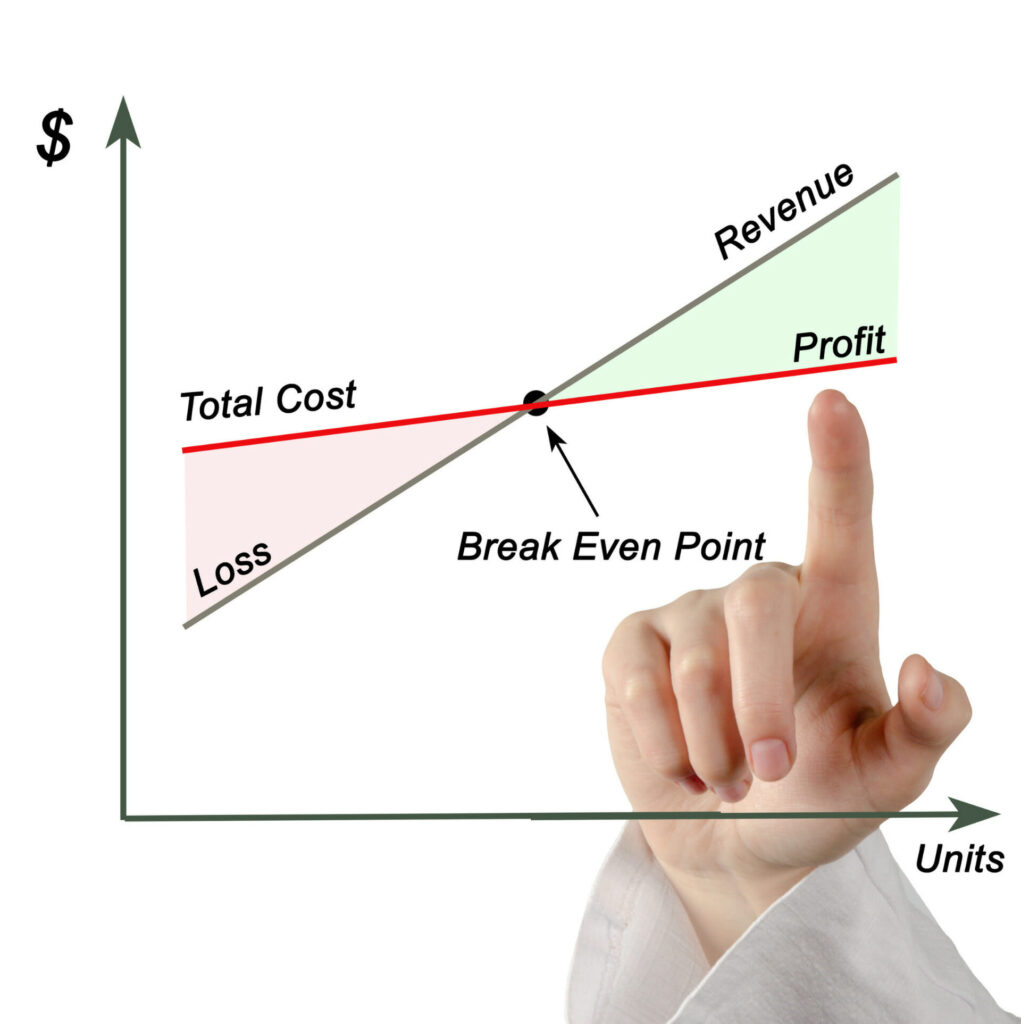
A company’s break-even point or break-even analysis is the point at which its sales equal the cost of doing business. The organization has not made a profit yet but is not operating at a loss. 


Every product a company sells or service offers carries an associated cost. Whether it is the cost of the raw materials or wages to implement new software, there are always costs incurred when running a business. 


These costs show up as the cost of goods sold (COGS) in a production environment. The more physical products you produce, the higher your COGS. 


By understanding how much output is required for the company to break even, adjustments can be made accordingly. A business can adjust output as well as the sale price of their products or services. 


Beyond the break-even point,  all incremental revenue beyond this point contributes to the organization’s gross profit. 


Break-Even Point Formula


A break-even analysis is a formula that shows how many units of phones, chairs, legal services, etc. you need to sell to cover your costs. 


Calculating the break-even point involves taking the fixed cost and dividing the amount by the contribution margin per unit. To find the contribution margin per unit, take the price per unit and subtract the variable costs per unit. 


equation for calculating break-even point


Before calculating this formula, we need to pinpoint the following three variables.


1. Fixed Costs – these are costs independent of sales volumes, such as rent, insurance, and loan payments. These are commonly known as SG&A.

2. Variable Costs – are expenses that fluctuate up or down per sales volume. Examples are raw materials, manufacturing labor costs, and sales commissions, which are generally part of COGS.

3. The sale price of the product or service.


After you can establish these numbers, you can calculate the break-even point expressed in units produced or quantity of service sold.


Example


To illustrate the break-even point, let’s assume a sock manufacturer has fixed expenses that total $10,000 per month. Their variable cost (COGS) per unit is $5 per pair of socks, and the socks retail for $25 (sale price). 


We first find the contribution margin, which is $20 per pair of socks. Then by dividing the fixed costs by the contribution margin, you will know how many units of socks you need to sell to break even.


example plugged into break even equation

Analysis


A break-even analysis is helpful whether you are just starting a business or have been operating already for several years. It is never too late to start using this new tool, and there are also a few instances where this metric becomes increasingly valuable.


◦ Before starting a business – it is essential to conduct this financial analysis when developing a business plan. Then you will have a good idea of the risks involved. 

◦ New product or service – existing businesses should conduct this analysis before launching a new product to learn how it will affect profitability. You might discover you will need to sell too many units to cover your overhead. 

◦ Performing a break-even point for a new product may help determine the right price for the item. 

◦ Changes in manufacturing – a business is considering outsourcing a portion of their manufacturing. Suppose the organization can produce the same quality with a lower variable cost but isn’t sure if working with a partner would increase the fixed cost. In that case, this analysis will play a critical role in determining if the change would be cost-effective. 


All businesses want to be as profitable as possible. Calculating the break-even point is just one component of cost analysis, but it is often an essential first step in establishing a retail price point that safeguards a profit.


Conducting a break-even analysis is a powerful tool for planning and decision-making. Performing this calculation on a long-term basis can identify critical information like price variability, setting appropriate sales targets, and highlighting weaknesses in the current business model


How FINSYNC Can Help


FINSYNC allows you to run your business on One Platform. You can send and receive payments, process payroll, automate accounting, and manage cash flow. To learn more about how we can help your business start, scale, and succeed, contact us today.

Apply For Business
Checking Account

Before you get started

1

We are not able to service these businesses at the moment:

  • Crypto Currency and Money Services
  • Privately Owned ATMs
  • Marijuana-Related
  • Gambling
  • Money Services Business
  • Business headquartered outside of the U.S.
2

At this time we are offering online business checking accounts through bank partners in these states:

  • Arizona
  • California
  • Idaho
  • Nevada
  • New Mexico
  • Oregon
  • Texas
  • Utah
  • Washington

Is your business in one of these states?