A Margin of Error Calculator That Is Simple and Efficient to Use

The word “error” is a somewhat triggering word for bookkeepers and accountants alike. Locating an unexpected error in a balance sheet can sap hours and hours of valuable time from a day. Fortunately, today, we will only discuss a predicted error, the Margin of Error. 


Using the tips outlined in this article, you will understand and use margin of error calculators while also increasing your knowledge of the methods and procedures needed when looking at your clientele.


Margin of Error Validity


Let’s say you flip a coin 100 times. Since there is a 50% chance that a coin will land on “heads,” the average statistical results will be 50 times heads and 50 times tails. However, it is not likely you will get this exact result. 


Therefore, mathematicians in the field of statistics developed a separate label to account for the degree of error that the solution will deviate. This is also known as the Margin of Error. 


Having the ability to recognize and calculate the margin of error is a necessary skill for any small business owner. This metric comes in handy when deciphering survey data and asking for input from your customers.


Define Your Population


In statistics, a population is a pool of individuals from which a statistical sample is drawn within a study. A population represents every member who is grouped by a common trait or characteristic.


Understanding a business’s population parameters is necessary to determine decisions or predictions based on your survey data. 


For example, say you want to determine the most popular social media platform your subscribers use. You may send a survey to your subscribers (your defined population) and ask them to select an answer from a specific set of selections.


While it would be wonderful if 100% of your survey recipients responded, that’s uncommon. In this example, you will use your responses as your sample and infer that the patterns in their responses hold for the rest of your subscribers.


In other scenarios, you may not be able to survey the entire population due to cost and time constraints. Instead, you’ll attempt to pick a representative subset to survey and use those results to draw conclusions.


In either case, the margin of error determines how accurate the sample is to the entire population.


Simple Margin of Error Calculator


Using this quick formula allows calculating the margin of error to be simple and easy.


simple margin of error equation


Let’s say you received 2000 responses to your query about social media platforms. In this case, the margin of error would be .022. Therefore, there is a 2.2% margin of error in your sample. 


Extended Margin of Error Calculator


Here is the universal formula for calculating the margin of error for a sample.


extended margin of error equation


Z = Z score; this is already calculated. You can reference the following Z Score Table.

p̂ = sample size proportion

n = sample size


Step 1: Calculate p̂ by calculating the number of respondents that you are selecting. Ex: you can look at each social media site individually and then compare it to the entire sample. The p̂ value is represented by a percentage of respondents. See the example below for more details.


Step 2: Find Z Score corresponding to a 95% confidence level, or 1.96 in this case.


Step 3: Calculate and convert to a percentage.


Using the social media example again, let’s say the company conducted a survey and found that 30% of their customers prefer Facebook as their social media platform. Since you are comparing the 30% of users who preferred Facebook to the 70% who preferred a different platform, here is how the equation would look:


extended margin of error equation example


When we input these numbers, our answer is 2.0%, slightly different from the easy formula. 


Conclusion


Using samples of a population for survey data will always provide a range, not a specific number. Therefore, the margin of error reveals the imprecision within the sample. 

The only real way to reduce your margin of error and improve your cash flow is to increase your sample size and get more respondents. The smaller the margin of error, the more confidence you may have in your results. The bigger the margin of error, the farther they can stray from the views of the total population.

Finally, the margin of error calculators offer a certain statistical way of predicting the accuracy and reliability of your survey results compared to the entire population.  


How FINSYNC Can Help


FINSYNC allows you to run your business on One Platform. You can send and receive payments, process payroll, automate accounting, and manage cash flow. To learn more about how we can help your business start, scale, and succeed, contact us today.

 

What You Should Know About the 1099 NEC Tax Form

There is a new requirement for employers and firms who use small vendors. The IRS has reintroduced Form 1099 NEC, or nonemployee compensation, as a new way to report pay to self-employed professionals. 


Before 2020, the 1099-MISC Form had been used by firms that utilize contract workers and other nonemployees to let the IRS know what was paid out and provide evidence to cross-reference against what the recipients reported on their 1040s (individual tax filings).


Let’s look at why this Form is making a comeback and the difference it can make in your organization.


History of 1099-NEC


The IRS retired the NEC Form back in 1982. The old form only had one box to fill out. This Form was used to report fees, commissions, and other nonemployee compensation. The remainder of the Form was for identification purposes.


In 1983, the 1099-MISC replaced the NEC Form. MISC stands for Miscellaneous Income. The MISC expanded to include rent, royalties, attorney fees, and healthcare payments greater than $600. 


Non-employee compensation was recorded in Box 7 of the MISC Form. Clients were obligated to issue this to all payees paid $600 or more in a calendar year. 


Since 2020, this Form has been revitalized. Now, the 1099-NEC Form replaces the entirety of Box 7. Box 7 of the current MISC Form is now only used to report direct sales of $5,000 or more. 


Reasons for the 38 Year Absence


The main reason the IRS is bringing the NEC Form back has to do with the 2015 Protecting Americans from Tax Hikes Act or PATH Act. Prior to this act, taxpayers could file one Form, 1099-MISC. Non-employee compensation and other miscellaneous payments were reported by February 28th each year. 


After 2015, the PATH Act changed the reporting non-employee compensation deadline to January 31st each calendar year. 


Because of the date discrepancies, companies began separating non-employee compensations into two 1099 Forms. These different deadlines created a lot of confusion for businesses, taxpayers, and the IRS as well. 


The IRS decided to bring back Form 1099-NEC to report non-employee compensation to clear up the complication.


Who Uses Form 1099?


The IRS requires all businesses to report payments over $600 made to independent contractors or vendors as non-employment compensation. 


Examples of NEC include:


◦ Independent Contractor

◦ Freelancer

◦ Rideshare Driver

◦ Delivery Driver

◦ Gig Worker


Keep in mind there are penalties for missing the January 31st filing deadline. 


Penalty details are below:

◦ $50 if you file within 30 days

◦ $100 if you file more than 30 days late but before August 1st

◦ $260 if you file on or after August 1st


Bottom Line


Employers must use Form 1099-NEC for all non-employed individuals.


Contractors should be aware they will most likely be seeing this new form. 


The Form 1099-NEC filing date is quickly approaching. Therefore, it is a good idea to make sure your 1099 recipients’ contact and business information are up to date as soon as possible.


You can request copies of official 1099 Forms from the IRS website, and you’ll receive them by mail. Both the 1099-NEC and the 1099-MISC can be filed either electronically or by mail.


How FINSYNC Can Help


FINSYNC allows you to run your business on One Platform. You can send and receive payments, process payroll, automate accounting, and manage cash flow. To learn more about how we can help your business start, scale, and succeed, contact us today.

 

How Cost Accounting Helps Zero in on Your Small Business Expenses

Cost Accounting is a specialized area of accounting that provides insight into the costs associated with a business. Costing helps a company understand where they are spending their money. This valuable information determines which products or projects to develop further and employ. 

Historians believe that cost accounting first appeared during the Industrial Revolution. During the mid to late 1700s, a new global supply chain was created. Demand economies forced producers to track their costs, which paved the way for automating their manufacturing processes. 

Even though history tied manufacturing to cost accounting, today, it extends into the service industry. For example, a bank will often deduce how much it costs to deposit a customer’s check and process international wire transfers.  

As you read further, you will discover several factors that determine the success of an organization’s cost accounting practices. These details will enable you to set up your unique process within your organization. 

What is Cost Accounting?

Cost accounting (CA) is the method of accounting that records and analyzes a company’s total costs related to the production of a good or service. This type of accounting is in conjunction with establishing how a company gains and loses money. 

The goal of cost accounting is to improve the net profit margin of a business. By tracking each project and process to determine how much profit each dollar of sales generates. 

A company’s accountant is already aware of the organization’s fixed costs, such as rent and salaried wage expenses. However, variable costs, like raw materials, change with each product output or service rendered. 

Understanding the intricacies of these costs is a critical component of a company’s growth trajectory. This information gives management the visibility they need to make changes to improve efficiency.

4 Types of Cost Accounting

There are four different types of cost accounting. Recognizing the specificity of each class will help you make strategic decisions and lead your business in the right direction. 

1. Standard

Standard CA is where businesses assign a “standard cost” to a product or service. The costs budgeted for a project look at materials, production supplies, and commissions. 

Standard cost is compared to the actual accrued expenses. This comparison is known as variance analysis

2. Activity-Based

Activity-Based Costing (ABC) is the cost allocated by the activity and effort used to produce a product or service. 

This costing system breaks down overhead costs by the actual consumption of each good and service. 

Both fixed and variable costs are associated with this costing type.

3. Lean

Lean CA is a method that focuses on the value of each part of the production process. 

Lean is a more specialized type of cost accounting that will reduce waste and eliminate errors. This costing type puts the highest value on saving the customer money.

4. Marginal

This type of costing divides all costs against the total quantity of the project. 

Marginal cost equation

Marginal CA only considers the variable costs for a specific product. Whether a business takes on a new project or not, this costing type assumes all fixed costs will be paid each month.

An organization doesn’t have to stick solely to one type of cost accounting method. The beauty of CA is that your company can use a combination of these four systems to design a costing strategy that works best for you.

Difference Between Cost Accounting and Financial Accounting

Both cost and financial accounting are needed to track finances. However, cost accounting is a source of information about specific production costs only for internal purposes.

Financial accounting creates three official financial statements, or four if you consider the statement of retained earnings. These documents track all aspects of a company’s finances and are shared with investors and owners. Regulations and standards govern these statements to ensure consistency across snapshots of multiple businesses.

Advantages to Automation

No accounting process can be successful without strong support and software. Businesses rarely keep track of costs by hand or through Excel spreadsheets. These outdated methods are more prone to errors and are very time-consuming. 

To correctly incorporate a successful CA system, one has to rely on the data. 

Many companies are switching to cloud-based payroll and other automated accounting platforms. These highly developed software systems can accurately disseminate significant data across multiple departments and locations. 

If you acknowledge that profitability is the key driver for any business sector, it becomes clear that employing a trusted system is critical. Measuring profitability could be the most important factor in determining the success of an organization. 

Overall, cost accounting allows management more strategic planning and decision-making power to improve cost efficiency. Adopting an integrative and intuitive approach is the first step to streamlining costs. 


How FINSYNC Can Help

FINSYNC allows you to run your business on One Platform. You can send and receive payments, process payroll, automate accounting, and manage cash flow. To learn more about how we can help your business start, scale, and succeed, contact us today.

 

Straight Forward Approach in How to Calculate Variable Cost

The total expenses accrued by all businesses involve accumulating costs or money required to perform business activities. Successfully calculating variable costs is one of the most significant factors when determining the success of an organization.


Accounting teams will separate costs into two categories: fixed and variable costs. Today, we will focus on variable costs, and by the end, you will feel confident about calculating the variable cost and maximizing your cash flow management

Definition of variable cost


Variable cost represents materials or other inputs acquired by a business. These costs directly correlate to the number of services or goods produced. Variable costs will increase or decrease depending on a company’s production or sales volume. Consequently, these costs will rise as production increases and fall as production decreases.


The two categories in cost accounting are variable and fixed costs. These accrued costs encompass the total cost of running a business. For instance, fixed cost differs in that these numbers stay the same regardless of the company’s output. Examples of fixed costs would be rent, payroll processing, business insurance, etc.


Common Variable Costs


When we look at variable costs, these numbers fluctuate week after week, depending on the sales volume. Below are examples:


• Raw Materials are the materials needed within a manufacturing environment to produce the final product.

• Transaction Fees are an expense that businesses must pay every time there is a credit card purchase or a bank transfer is sent. 

• Utility Costs include expenses such as electricity, gas, water, etc. Note that utilities such as internet connectivity are considered fixed expenses. This is because they don’t change month-to-month and are independent of revenue or production volume. 

• Commissions are additional salaries paid to someone completing a sale or even service work. Some businesses allocate a percentage of the total amount sold to each sales associate, which assists in closing the deal.

• Labor can be a variable cost if the workers are paid hourly or based on each unit completed.

• Packaging and Shipping costs will vary depending on the amount of inventory sold.


Variable Cost Formula


Under the cost accounting umbrella, variable cost is likely the most abstract category. These numbers change month after month and often create much confusion.


The total variable cost equals the number of units produced multiplied by the variable cost per unit. See the formula below:


variable cost equation 


Here is how to calculate this formula: 


    1. First, identify all costs associated with the specific production of a single product unit.
    2. Second, add all of these costs together so you have the total price for each unit.
    3. Finally, the total variable cost is multiplied by the price per unit by the number of units produced.

Average Variable Cost


The average variable cost (AVC) takes the total cost per unit divided by the number of units. AVC explains how costs from increasing output fall, become flat and finally increase as production costs outweigh benefits. 


The formula for average variable cost requires the calculated total variable cost to be complete.


average variable cost equation 


Furthermore, one must divide the total variable costs from the accounting period by the total number of units produced.


Importance of Variable Costs


If a business has a large proportion of variable costs in its cost structure, most of its expenses will vary in direct proportion to revenues. Therefore, businesses are more equipped to weather a sales decline than a company with a high fixed-cost balance. 


Learning how to calculate variable costs will help you accurately forecast expenses as a whole and identify ways to bring down your total costs. For instance, you might find that you can get materials from another supplier for less. These savings will bring down your cost per unit, which directly decreases your total costs.


How FINSYNC Can Help


FINSYNC allows you to run your business on One Platform. You can send and receive payments, process payroll, automate accounting, and manage cash flow. To learn more about how we can help your business start, scale, and succeed, contact us today.

Why Your Business Needs a Statement of Retained Earnings

All three primary financial statements are essential to an organization’s success because they flush out critical financial data to accurately portray a company’s operating activities, performance, and overall business condition. 

In addition to the income statement, balance sheet, and statement of cash flows, there is a fourth statement that is not as commonly discussed: the statement of retained earnings. 

What Is Retained Earnings?

Retained earnings are the net income left over for the business after it pays out dividends to its shareholders. This amount is reinvested back into the company and is typically determined over the period of one year.

Retained earnings are reported on the balance sheet under equity. These earnings can be used to fund future growth opportunities like new marketing initiatives like social media, state-of-the-art equipment, or investing within new target markets.

Importance of the Statement of Retained Earnings

The Statement of Retained Earnings or Statement of Shareholder’s Equity shows retained earnings changes and their fluctuations year after year. This statement is used to display how a company’s management team utilizes profits and how they are redistributed.

The retained earnings statement is not as widely discussed as the income statement, balance sheet, and statement of cash flows. However, the retained earnings statement is one of the most important things small businesses need to know about accounting. Retained earnings represent the money remaining to grow and expand the company. 

This information is also essential when the company applies for a loan and begins fundraising or negotiating with investors. This statement shows the creditor that the company is prosperous enough to have money to repay the loan.

Calculating Retained Earnings

To calculate retained earnings, subtract your company’s liabilities from its assets and deduct the amount that will be paid in dividends at the end of each accounting period:

retained earnings equation

    • Beginning Retained Earnings are the funds the company carries over from the period before the most recent closed accounting period, found on the corresponding income statement. 
    • Net Income is a company’s revenue minus expenses, found on the company’s income statement for the most recent closed period. 
    • Dividends Paid is the amount distributed to the company’s shareholders in the most recent period. 

The following is an example of the Statement of Retained Earnings in its simplest form. This equation will increase in complexity when including the par value of common and treasury stock.

Graph showing example using the retained earnings equation

If a company has a net loss in income, it is important to note that this amount should be deducted from the final retained earnings. 

Comprehensive View

In a sense, retained earnings act like an intermediary between the income statement and the balance sheet. After all, the income statement provides deep insight into how a company generates revenue, and a balance sheet provides what the company is worth. 

Overall, retained earnings and how they change over time directly indicate whether a company’s management is distributing too much money to its owners. Paying out too much in dividends can result in a deficiency, requiring owners to put money in to keep the business functioning. 

Conversely, if a company is sitting on money, not reinvested, this is also ineffective. Management should reinvest this back into the business operations, pay down debt, or distribute it to shareholders. To make the most of retained earnings, businesses often consider placing excess funds in interest-bearing accounts. Utilizing an APY (Annual Percentage Yield) calculator can help estimate potential returns on these funds, aiding in the decision-making process.


How FINSYNC Can Help

FINSYNC allows you to run your business on One Platform. You can send and receive payments, process payroll, automate accounting, and manage cash flow. To learn more about how we can help your business start, scale, and succeed, contact us today.

Cash Flow Management: Tips to Avoid and Recover

Managing and understanding your business’s cash flow is one of the most critical components in building a healthy business. If you can accurately project cash flow, you will steer your business in the right direction. A study by U.S. Bank found that 82% of businesses fail due to inadequate cash flow management.

In this blog post, we’ll help you understand the importance of cash flow and learn some tips to improve your business’ cash flow.

What Is Cash Flow

Cash flow is the net amount of sales and expenses transferred in and out of a business. Cash flow statements consist of three categories: operating, investing, and financing.

    • Operating cash flow is the total amount of money your business brings in from ongoing business activities, such as selling goods or services.
    • Investing cash flow shows the cash generated or spent related to investment activities. These include the purchase of long-term assets such as equipment and property, stocks and bonds, as well as acquisitions of other businesses.
    • Financing cash flow focuses on how a firm raises capital and pays it back to investors through capital markets. These activities also include paying cash dividends, adding or changing loans, or issuing and selling more stock.

To successfully project cash flow, you must assess your prior year’s numbers as a basis of cash flow for the following year. It is important to determine when your business will receive or spend money as part of the budgeting process. As time goes by you should update your predictions to accurately reflect your expenditures and gross profit.

The value a cash flow statement provides is it measures how well a company manages its cash position, meaning how well the company generates cash to pay its debt obligations and fund its operating expenses.

Common Cash Flow Mistakes

There are several common types of mistakes small businesses face when it comes to cash flow management. For example:

    • Overestimating future sales
    • Not tracking cash flow projections properly
    • Not keeping enough cash on reserve
    • Charging too much or too little for your products/services
    • Stocking up on excess inventory or supplies

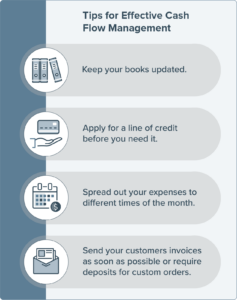
Tips for Effective Cash Flow Management

    • Keep your books updated
    • Apply for a line of credit before you need it
    • Spread out your expenses to different times of the month
    • Send your customers invoices as soon as possible or require deposits for custom orders

Tips for effective cash flow management for small businesses

FINSYNC is Here to Help

FINSYNC empowers you to focus on having the right amount of cash on hand at the right time. We are an all-in-one platform that helps you manage cash flow while growing more profitably.

Yes, our platform includes a cash flow statement as part of the accounting package, but we also provide automated cash flow projections that;

    • Show you your cash position on any day in the future on both a calendar and graphical view
    • Include any known invoices, bills, and future pay runs
    • Can be adjusted with “what if” scenarios to better help you analyze different decisions


Bookkeeping Basics: 5 Best Practices from Financial Experts

Every day, FINSYNC matches small businesses with independent financial professionals who are best suited to help their businesses grow. From bookkeeping and accounting to financial analysis and corporate strategy, these expert services are available on a contract basis when you need them.


We sat down with a few of FINSYNC’s bookkeepers and accountants for some bookkeeping advice for small business owners. Here are five best practices straight from the experts:


1. Reconcile Your Accounts


“Always reconcile your bank and credit card accounts. Everything feeds either through a bank account or credit card, so if you can do that, it gives you a really good sense of where your money is going. Start from your beginning balance and reconcile to the end of the month every month. If the closing balance in your accounting software doesn’t match the closing balance of your bank account, then you need to find out why and make a correction. If you don’t conduct bank and credit card reconciliations, you won’t be able to discover what’s causing the discrepancy and fix it.”


Linda Cappadona, Bookkeeper


2. Build a Payments Rhythm


“The second rule of small business bookkeeping is to build a payment rhythm. Don’t push data-entry and reconciliation tasks off because it’s tedious and time-consuming. It’s crucial that you review your books at least once a week. It can help set recurring calendar events and automate processes wherever possible. One way to build a payment rhythm is to automate your bookkeeping to ensure your books are always up-to-date. If you fall behind on bookkeeping, your books can quickly become a mess, and problems can become more difficult to untangle. At the very least, make sure you always keep accurate and consistent records.”


Linda Cappadona, Bookkeeper


Learn more from Linda about bookkeeping for beginners.


3. Start Prepping for Tax Season Now


“Don’t wait until the end of the year to start tracking expenses. About half of the businesses I work with don’t keep records. At year-end, they run into problems because they don’t have the records necessary to find possible deductions. Most of the businesses I talk to try to deduct expenses that they can’t validate. If we take those deductions and are then in a situation where you’re audited by the IRS, you will end up with the burden and will need to pay.” 


Juan Llantin, Accountant


Get more tips from Juan on reducing your taxes.


4. Hire a Bookkeeper


“The biggest mistake that I’ve seen is business owners trying to do their own books. Unless you have a background or you’re very well taught, doing your own books is the quickest way to create a mess.


My advice is: The skill that you start your business with is the thing that makes you money. Your best use of time is to use those skills to make your money versus trying to learn the whole accounting theory of debits and credits and trying to do your own books. It’s worth the money to pay someone well to do your books.


If you don’t value your bookkeeper, your business is going to suffer. I have clients who every year insist on doing their own books, and every year I end up having to charge them a lot to clean up their books.” 


Jennifer Brenner, Bookkeeper


5. Use an Intuitive Financial Platform 


“FINSYNC has a really good platform for projects — I actually like the FINSYNC platform better than QuickBooks. A business owner can easily get on the FINSYNC platform and see where everything is. They can see where their money is going and where they need to cut back, and they can access reports such as Profit and Loss and Balance Sheets. As a business owner, that is what you should be focusing on.”


Linda Cappadona, Bookkeeper


“If you’re a client that has the ability to work with professionals remotely, the FINSYNC platform provides cost savings and efficiencies. Everything is cloud-based and backed up. All documents are saved online — invoicing, bills, anything — so it’s all paperless and saved.”


Mark Wright, Accountant


How FINSYNC Can Help


FINSYNC allows you to run your business on One Platform. You can send and receive payments, process payroll, automate accounting, and manage cash flow. To learn more about how we can help your business start, scale, and succeed, contact us today.
 

How to Hire a Bookkeeper for Your Small Business

You look around, and suddenly, your small business isn’t that small anymore. Maybe you have several employees, a big warehouse to manage, or a lot of online orders to tackle. Meanwhile, you’re spending all of your time managing the company’s books. The bottom line is you can’t do your own bookkeeping anymore. 


How do you hire an accounting or bookkeeper who will take over the job as seamlessly as possible? We’ve got a few tips.


Map Out Your Bookkeeping Needs


It isn’t always as easy as “I need someone to take care of my books.” Ask yourself what kind of services you want your bookkeeper to perform. Their responsibilities often stretch beyond simply keeping the books in order. Decide if you need help with:


•  Invoicing

•  Projects

•  Bill pay

•  Payroll

•  Reporting


It would help if you also mapped out how many transactions your business has during a month. Figuring that out, together with the bullet points above, will give you an idea of whether you need a full-time bookkeeper or not. It might also help you decide if you want to work with a freelancer or hire a bookkeeping firm.


Freelance or Firm


The next thing you need to think about is whether you want to hire a freelancer or work with a firm. The latter is typically the more expensive option as firms have higher overhead costs than freelancers. 


However, firms also tend to offer a wider range of services. They can offer services outside of typical bookkeeping tasks because they have specialists in other areas. 


With bigger firms, you also don’t have to worry about your bookkeeper being unavailable, as there’s usually another bookkeeper who can step in. But you might end up working with multiple people, which isn’t ideal.


By going the freelance route, on the other hand, you might have more control over what type of person you work with. After all, bookkeeping for eCommerce isn’t the same as it is for a flower shop or dentist. You need to find someone who has experience in bookkeeping for your industry. And you might have better luck finding a niche specialist if you do the research yourself.


There is, however, a third option. You can use a network of vetted professionals (like FINSYNC) to find the right type of bookkeeper for you. The FINSYNC Network is full of bookkeepers, accountants, and other financial professionals who have been carefully interviewed and vetted. So you get access to a talented financial professional that’s best suited to help your business grow. 


Regardless of what route you take, your bookkeeper should have the following qualities:


Attention to Detail

As someone who will be the only one handling every transaction in your business, your bookkeeper must have the ability to spot errors and inconsistencies.

Good Communication Skills

Despite what some may think, bookkeepers should be good communicators. They must be able to ask for any information they need to do their job properly, be it from external vendors or from someone on your team. Your bookkeeper should also help you make sense of the end-of-the-month reports they produce so that you understand how your business is doing financially.

Experience in Your Industry

We said it once, and we’ll say it again. If you want someone to help your business from day one, you need a professional who understands the different terms and insider aspects that come with your industry. Ask for references!


The Practical Aspects of Hiring a Bookkeeper


There are several other things you need to figure out before hiring a bookkeeper. These considerations will make an easier transition when the bookkeeper starts working with your business.


Paperless Office


Is your bookkeeper going to work remotely 100% of the time, or will they come into the office? Although the latter gives you room to keep paper receipts at the bottom of your drawer, digitizing everything is the best option in the long run.


Digital documents are easier to access and less likely to be lost or destroyed, and your team can access them from anywhere in the world. These days, both freelancers and firms encourage their clients to go paperless, so you might consider starting now.


Software


Make sure the bookkeeper you’re considering has experience working with your bookkeeping software. Each solution has its own processes and shortcuts that are important to keeping your books in order. The FINSYNC Network is full of professionals who are certified on FINSYNC’s all-in-one accounting software to ensure you have a smooth transition.


Read about Jennifer Brenner’s story as a certified FINSYNC bookkeeper.


Ultimately, the type of working relationship you have with your bookkeeper will depend on the size of your company, your plans for growth, the level of reporting you want, etc.


How FINSYNC Can Help


FINSYNC allows you to run your business on One Platform. You can send and receive payments, process payroll, automate accounting, and manage cash flow. To learn more about how we can help your business start, scale, and succeed, contact us today.

How Small Businesses Can Manage Reimbursements Efficiently

If you ask an administrator what part of their job they enjoy the least, there’s a good chance they’ll say managing expense reimbursements. 


What could be more tedious and time-consuming than sorting through piles of paper receipts, cutting checks, and tracking payment processing? What about reimbursement disputes or the difficulty of simply getting sales reps to properly file an expense report? 


We’re here to help. In this article, we’ll show you how to manage reimbursement efficiently and how to keep track of expense reports. You’ll also learn expense management best practices and how to deal with expense reimbursements. 


What is Expense Reimbursement Management?


Expense reimbursement management is the process in which an organization reimburses or “pays back” an employee. This includes out-of-pocket business-related expenses. For example, treating a client to dinner or the cost of airfare to a business convention.


Expense reimbursement, though simple in principle, is seldom easy. It’s a complicated process that can be as difficult to track as it is to define. Every company has a different expense reimbursement policy with varying criteria for what is considered a business expense. 


For example, most travel-related expenses like flights, hotels, and meals are considered business-related. Therefore, it is eligible for reimbursement. However, only if incurred while performing duties on behalf of the company. 


For this reason, it is incredibly important that companies not only clearly define their expense management policy but also implement a method to manage expense reimbursements efficiently. 


How to Keep Track of Work Expenses?


Most businesses track work expenses via an internal system that employees use to report their expenses for reimbursement. For example, an employee who travels from New York to Chicago to meet a client may submit his travel expenses for reimbursement by filing specific paperwork. Then, submit his original receipts to the HR/finance department for review. 


This archaic process is plagued by human error and generates mountains of paperwork that someone must get paid to process. Thankfully, there are several ways to efficiently manage expense reimbursement. 


Expense Management Best Practices


To manage expense reimbursement efficiently, a business must ensure a seamless expense management process via a precise and timely reporting system. In other words, you need to make it as easy as possible for your employees to submit their expenses for reimbursement. 


Here are the best practices for efficient reimbursement management. You can implement these to improve the process and minimize unwanted costs.


Clearly Define Your Expense Management Policy

It’s best practice for a company to implement an unambiguous expense management policy. Your expense management policy should include all employee-reimbursable expenses and criteria to exclude personal expenses. 

Once you have clearly defined your expense management policy, you must communicate it with all employees so that they may learn how to track and report their business-related expenses. 

Make it Easy to Submit Expense Reports

To efficiently manage expense reimbursement, a business should make it as easy as possible for employees to track their business-related expenses correctly and submit expense reports. 

The best way to provide employees with a simple way to submit their expense reports is via a paperless expense reporting system. Preferably one in which employees can scan/photo receipts with their mobile devices while traveling. 

Implement an On-Time Payment Mechanism

Timely submission of employee expense reports is critical to managing reimbursement efficiently. The best way to do this is by eliminating a multilayer approval process. Then, sticking to a fixed timetable for approving reimbursements. Learn more about FINSYNC’s payment platform.


What’s the Best Way to Manage Expense Reimbursements?


The best way to manage expense reimbursements is by streamlining the expense reporting system altogether. The more roadblocks you remove from the reporting process, the easier it will be for your employees to accurately report their expenses. Integrated expense tracking software can simplify the task of expense reporting and eliminate the time-consuming task of data entry. 


Besides saving time and money, expense tracking software improves efficiency and enables your business to effectively manage expenditures according to your company’s reimbursement policy. 


FINSYNC bill pay makes it easy to track business-related expenses and automates what your employees once had to do manually. The software integrates with your back office, providing your team with a portal to tag expenses to specific projects, track time, and submit expenses for reimbursement, all from the same place. Since everything is handled in a single portal, it’s much easier to get employees to submit reimbursements on time.


FINSYNC’s suite of software tools is designed to free up your time. That way, you can get back to growing your business. The platform streamlines your back-office operations to help you manage your business better and with less effort. Our automated online expense management software is not just cost-effective. It’s a convenient solution for an inefficient process that also integrates with our other cash flow management tools. You can also use FINSYNC to pay for expenses using a business credit card, even if the vendor doesn’t accept credit cards.


How FINSYNC Can Help


FINSYNC allows you to run your business on One Platform. You can send and receive payments, process payroll, automate accounting, and manage cash flow. To learn more about how we can help your business start, scale, and succeed, contact us today.

5 Signs It’s Time to Hire a Bookkeeper for Your Business

Small business owners pride themselves on minimizing costs and bootstrapping their way to success, often by taking on many of the business roles themselves. If you often wear the hats of the CFO, CMO, COO, and a number of other positions, you know exactly what we’re talking about.


However, at some point, your organization will likely get too big for you and your team to handle everything. When it comes to managing your books, knowing the right time to hire a bookkeeper can go a long way toward the future financial success of your business. While it can be stressful as you grow and bring in more help, failing to do so could end up costing you a lot more in the long run.


Is it time for your small business to hire a bookkeeper? Here are five signs you should look for to determine if the timing is right: 


Spending Too Much Time on Bookkeeping


If you’re still handling all of the bookkeeping yourself, it can quickly start to take up a large portion of your time. Not sure? Use a time-tracking app to determine exactly how much time you and other employees are spending on bookkeeping. This is time being pulled away from other tasks that are critical to your business success.


Your time is more valuable than the cost of a professional bookkeeper. Once you get to the point where a significant percent of your time is spent on an easily delegated task — delegate it.


Your Books Are Behind


Unfortunately, many small businesses fall into a hole where nobody is regularly maintaining the books. This may result in your bookkeeping being months or even an entire year behind. The consequences and symptoms are significant for your company:


• Unclear Profit Margins
If you don’t know how much money you’re making or spending, you aren’t able to make important decisions about the direction of your business. Many companies see their revenue increase but their profits stay the same because they’re unable to properly analyze and manage their profit margins.

• Unpredictable Cash Flow
Not having full awareness of your profits and losses makes it difficult to accurately predict cash flow. This makes it more likely that you could miss payroll or fail to pay vendors on time.

• Trouble with Collections
A professional bookkeeper can keep an eye on your accounts receivable to make sure you’re getting paid on time. If you’re behind on your books, you could go months without realizing that an invoice is overdue.


Taxes are Becoming More Work


Several clear symptoms of mismanaged financials or outdated books come about when tax season rolls around. Ideally, you should be able to hand over the year’s financials to your accountant, immediately file your taxes, and receive your refund.


Without a bookkeeper, your taxes may require much more work. You’re likely to find yourself working a lot more with your accountant to piece together a year’s worth of books in order to get enough information together to file. Paying estimated taxes can also become impossible when you don’t have an up-to-date view of your quarterly financials.


Limited Ability to Make High-Level Business Decisions


As a business owner, you must be able to make decisions to help grow your company and move it forward. Without a complete, updated view of your company’s financial health, you may be forced to act blindly. On the other hand, if you’re spending all of your time keeping your books up-to-date, you’re limiting your ability to spend time on big-picture decision-making.


A bookkeeper can free up your time while providing you with the insights necessary to make informed decisions that help your business grow. 


Learn more about how bookkeepers and accountants can increase business with cash flow advisory.


Budget-Friendly Bookkeeping


Are you in the habit of handing all of your expense reports and invoices to your accountant at the end of the year so they can manage your books? You may be spending more than necessary for bookkeeping. CPAs will generally charge much more for bookkeeping services than you would pay a professional bookkeeper.


Luckily, it’s not difficult to find an affordable bookkeeper — or accountant — that fits your business needs. If your company isn’t ready to hire a full-time employee to handle your books, consider hiring a freelance financial professional. FINSYNC’s Network pairs you with a qualified accountant or bookkeeper that suits your business needs. If you’ve seen any of the above signs in your business, it may be time to take a look.


FINSYNC Specialist, Neisha Casey, CPA, talks about her holistic approach to helping small businesses succeed through FINSYNC’s service network.


How FINSYNC Can Help


FINSYNC allows you to run your business on One Platform. You can send and receive payments, process payroll, automate accounting, and manage cash flow. To learn more about how we can help your business start, scale, and succeed, contact us today.

Apply For Business
Checking Account

Before you get started

1

We are not able to service these businesses at the moment:

  • Crypto Currency and Money Services
  • Privately Owned ATMs
  • Marijuana-Related
  • Gambling
  • Money Services Business
  • Business headquartered outside of the U.S.
2

At this time we are offering online business checking accounts through bank partners in these states:

  • Arizona
  • California
  • Idaho
  • Nevada
  • New Mexico
  • Oregon
  • Texas
  • Utah
  • Washington

Is your business in one of these states?