
Employee Attrition Definition and its Significance

It is vital for businesses to regularly keep track of the number of employees a company loses within a certain period. Reduction of the workforce due to attrition could permanently alter the workflow and culture of the entire organization.


Attrition reduces an organization’s workforce due to retirement, resignation, or removal without a plan to replace the occupancy. Also referred to as downsizing or churn rate, attrition is the gradual reduction in staff numbers. 


We will discuss the causes, consequences, and prevention of employee attrition and how it differs from other forms of staff shortages and reductions. Additionally, using the rate calculator, you can determine if attrition is a problem for your organization. 


Causes of Attrition


Attrition can be good for an organization because a business can decrease labor costs without dismissing staff. Therefore, it is essential to understand the causes and different types of downsizing that may arise.


There are two main types of company attrition: 


1. Voluntary – occurs when an employee leaves on their own accord. Examples can include any of the following.

◦ New opportunity

◦ Professional reasons

◦ Personal reasons

◦ Demographic relocation


2. Involuntary happens when a company decides to remove staff members and positions. This decision is due to the following reasons.

◦ Layoff

Retirement

◦ Death of an employee


When an employee exits, sometimes the reasons are beyond a business’s control. However, based on 150,000 exit interviews, 68% of employees left a company due to controllable factors. More importantly, 72% claim they were unhappy with the quality of the retention effort.


This data suggests that business leaders are missing the mark when it comes to meeting the needs of their staff and not providing overall job fulfillment. 


Consequences of Attrition


Unless your company is prepared when employees retire or quit, a dwindling workforce can be costly, especially if the individual’s history with the company is long-term. 


If an employee has been with the company for years and decides to resign, the organization can lose a wealth of knowledge and experience. Seasoned employees are more familiar with the company’s best practices, policies, and objectives.


The combined costs of recruiting, interviewing, training, and loss of productivity equates to anywhere from one-half to two times the individual’s annual salary. Even when 52% say their manager could have prevented their departure.


Another repercussion of an employer not backfilling a vacancy could be a significant workflow increase for the employees who remain after the departure. Production could suffer, particularly if other staff members widely relied on the role. 


The added workload to the established team could result in a decrease in overall company morale, most notably when the remaining employees have similar feelings and opinions about the company’s response. 


Calculate Employee Attrition Rate


Understanding a company’s attrition rate can be a key performance indicator (KPI) for the business overall.


The following is a formula for measuring the number of employees who have left compared to the average number of employees within a company, multiplied by 100.
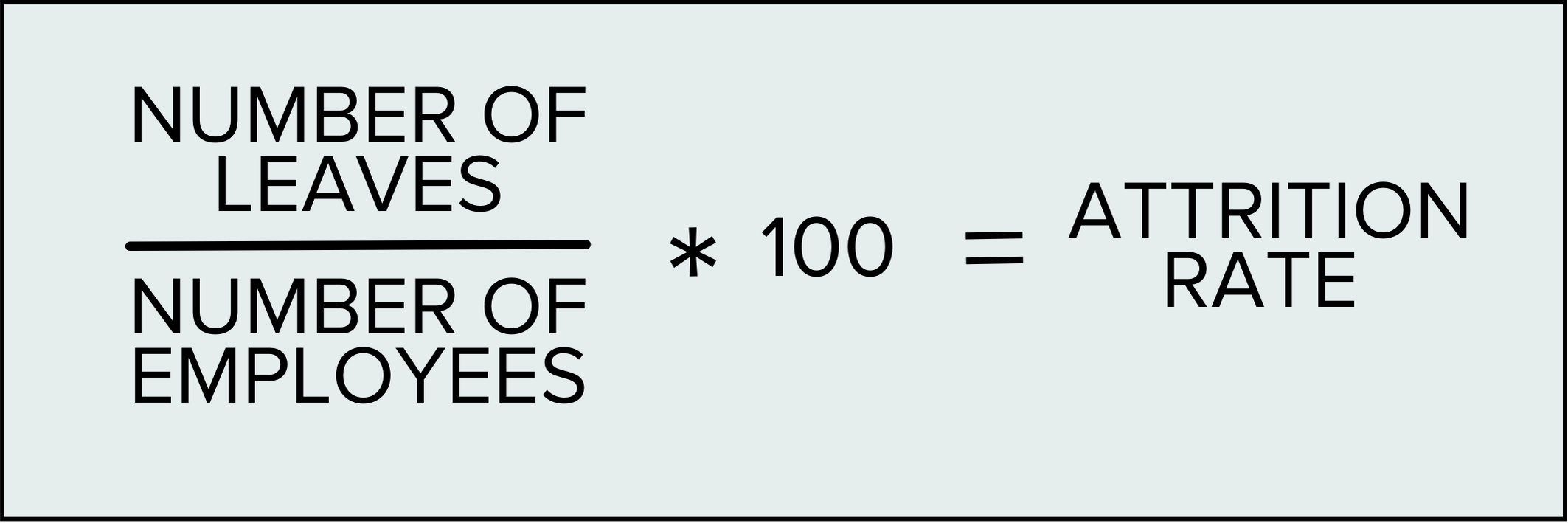
 

Employee Attrition Equation


A high churn rate means a company frequently loses employees, while a low rate indicates employees stay longer. 


If your company’s churn rate is consistently high, you should investigate and develop a strategy to retain your workforce.


Turnover and Layoffs


Other forms of employee exits are turnover and layoffs. Although these terms are similar, they both have distinct differences.


Turnover refers to a scenario in which an employer replaces employees who have left the company. Like downsizing, turnover can be voluntary or involuntary, and backfilling the role is the primary differentiation. 


Layoffs are an entirely different situation. When a company is in a challenging financial crisis, it must dismiss employees (who may be performing as directed) with no immediate plan to re-fill those positions. 


Laying off employees results in attrition as long as the company doesn’t hire as many new employees as were laid off. 


Preventing Attrition


Since we have concluded attrition can be costly and demoralizing for an organization, it is within the employer’s best interest to listen and research the reasons behind a resignation or termination.


Figuring out why employees are leaving an organization is critical. Understanding this valuable component is why many businesses decide to perform an exit interview with each individual who leaves the organization voluntarily or involuntarily. 


Lack of job satisfaction is one of the most common factors for employee attrition. Employees want to enjoy where they work.


Another way to prevent attrition is to provide an excellent work-life balance. Allowing benefits such as working remotely and a flexible schedule can go a long way to enhance employee retention. 


Finally, employees need to have a manager who is willing to go to bat for the benefit of their staff. Good communication is crucial and should be the main priority for a business to enhance team connection and make an employee feel valued. 


Besides recruiting the best people for your company, you also have to nurture and engage your talent to prevent them from leaving. Taking these steps will decrease employee attrition and provide a better overall job experience for the entire organization.


How FINSYNC Can Help


FINSYNC allows you to run your business on One Platform. You can send and receive payments, process payroll, automate accounting, and manage cash flow. To learn more about how we can help your business start, scale, and succeed, contact us today.

What Causes Inflation & How Does It Impact Your Small Business?

Currently, the US inflation rate is the highest it has been in over 30 years. The October consumer price index, which measures changes in the cost of food, housing, gasoline, utilities, and other goods, jumped by 6.2% over the past 12 months. What causes inflation in the first place?


In economics, inflation is the price of goods and services over a period of time. These pricing increases lessen the value of the dollar. Meaning the money saved today will be worth less tomorrow. This often contributes to raising the overall cost of living for citizens everywhere.


Fueled by post-pandemic shopping demand and labor shortages, increased energy costs, and volatile global weather patterns, inflation has many wondering when we should start to worry. 


Supply and Demand


The US continues to recover from the pandemic. The COVID shutdown damaged our global supply chain, contributing to delays in shipping. These delays eventually decreased our overall supply. 


In addition, the labor shortage happening alongside the massive influx of consumer demand exacerbated the problem. Together, this resulted in higher costs for those same goods and services. 


At the same time, the staffing shortages created backlogs of shipping containers on hold in ports, expectantly awaiting a workforce to transfer and unload the merchandise.  


Back in May 2021, travel demands surged as a response to the reopening of small businesses. Coming out of a pandemic, many individuals sought COVID-safe travel options outside of airfare and public transportation.


Suddenly, demand for rental cars and used cars increased dramatically, causing significant price increases in these industries. During this time, it cost 30% more to buy a used car than it did a year prior. 


Our car industry example is a classic illustration of demand-pull inflation or demand caused by a strong consumer desire for a product or service.  


Increased Energy Costs


Another contributor to inflation is the oil companies who lost money during the great lockdown. They are now limiting how much oil they produce, which drives up oil prices or cost per barrel. 


The Washington Post stated that rising energy costs are the main driver of inflation.


Consumers notice these energy price spikes at the gas pump, on utility bills, and at the cash register as shipping rates continue to increase. In essence, anything manufactured or shipped becomes more expensive.


Thankfully, oil refineries on the Gulf Coast have restarted after being shut down in August by Hurricane Ida. This extra supply could ease pressure on gasoline prices.


However, the underlying cost of crude oil will likely remain high, in part because of the continued demand for jet fuel and diesel fuel.


Climate Change


Besides demand-pull inflation, there is a second form of inflation that is currently in effect. Cost-push inflation is when prices increase due to rising costs of production, such as buying raw materials and increasing wages. 


Natural disasters can be a cause of cost-push inflation. Our Gulf Hurricane Ida is an excellent example of this. In the same vein, if a hurricane on the east coast devastates orchards, the supply of apples and peaches will decrease, forcing producers to increase prices to help offset the spike in demand. 


If enough merchants react this way, inflation will ensue. 


Brazil is currently going through a drought, which affects its widely used hydroelectric power. The heightened demand for electricity is causing prices to increase by 11% in some areas. 


We are currently experiencing volatile climate changes all over the world. 


End in Sight


For this inflationary period to end, we need to see both demands wane and the backlog in our supply chains lessening. Eventually, suppliers will adjust, and shortages will dissipate. There is hope on the horizon. 


Companies will begin to manufacture more cars, appliances, and furniture. The central question that continues to plague everyone is how long it will take to catch up.


If the inflation rate gets too high, the Federal Reserve could decide to increase interest rates to slow down the economy. Many of us remember this from the late 1970s and early 1980s. Mortgage rates were advertised at 18% in some areas of the country. This interest boost eventually led to a recession. 


Fortunately, the economy isn’t at that alarming phase yet. Even though prices are currently surging, eventually, this will level out. As long as we have productivity and growth, pricing surges are more than likely temporary. 


Others worry the record deficits to finance emergency coronavirus spending, including PPP loans and the continued low-interest loan rates, are hurtling us toward even more challenging times. 


At present, we are on alert, but there is no panic. The main concern is how much of the inflation rate will stick around. Consumer goods and services are expected to lower as soon as production increases. However, housing prices and rent increases tend to remain constant. 


There is a point where inflation would become a concern for the United States. Economists and policymakers around the world are vigilant and ready to support a sustained and equitable market recovery. 


How FINSYNC Can Help


FINSYNC allows you to run your business on One Platform. You can send and receive payments, process payroll, automate accounting, and manage cash flow. To learn more about how we can help your business start, scale, and succeed, contact us today.

The Packing Slip a Valuable Document or Mass Waste Product

As the holidays are quickly approaching, many retailers are already mobilizing their pack and ship assembly lines. One item that is always included in that fresh new box waiting on your doorstep or in your office is the packing slip.


Sometimes, it is nice to get an overview of what you ordered; perhaps you need to verify multiple supplies. However, this little piece of paper is likely going straight into the recycle bin, never even given a half glance. 


This begs the question: Do we still need to include packing slips? 


We will look at this from various perspectives so you can make an informed decision on how to ship your merchandise this holiday season.


What Is a Packing Slip?


A packing slip is a document created by the shipper that includes a complete list of items included in the parcel. This document can consist of SKU numbers, weights, dimensions, and quantities. 


The packing slip, also known as the shipping list, manifest, or waybill, can come in handy when your shipment comes in multiple containers. You can quickly reference which box contains the appropriate merchandise. Utilizing a route monitoring feature ensures that each shipment’s journey is tracked, providing real-time updates on delivery progress.


The waybill is helpful for internal purposes and quality checks. Catching any discrepancies before the seller ships the items is very important for a company’s reputation. Even one error could affect future purchases from a buyer. 


Lastly, a packing slip is thoroughly scrutinized when shipping an item overseas. Many countries include a value-added tax or VAT on merchandise ordered from another country. Customs can estimate the value of the shipment very quickly by referencing the manifest. 


Packing Slip vs. Invoice


The packing slip describes the physical products in the container, whereas the invoice describes the financial transaction behind the sale of these goods. 


The purpose of an invoice is to inform the buyer’s accounting department of how much to pay and when it is due. The invoice also serves as a record for the seller to keep track of outstanding unpaid shipments. 


Both packing slips and invoices list the items that have shipped and the quantities of the items. However, suppose an item’s availability is delayed two weeks. In that case, this information will likely appear only on the packing slip because this is only relevant to the receiving department that handles the inventory, not the accounting department. 


If a purchase order was used, then accounting will need to be aware as the invoice amount won’t agree with the purchase order amount.


Branding Purpose


Whether the packing slip serves a purpose is still a debated issue. Thus, it is necessary to point out that younger generations have unleashed a phenomenon known as unboxing. This is a process of recording the moment when a product is opened and removed from the original packaging in which it was sold. 


These products range from clothing, electronics, tools, beauty products, and the list goes on. Google announced that the global aggregate time spent watching unboxing videos on YouTube equated to watching the movie “Love Actually” 20 million times. 


Just like that, a new marketing and social media branding tool was created. 


The packing slip has the potential to get a lot of views. Retailers worldwide have already begun using this to their advantage. Some companies will now include their packing slip in a gift envelope, and some will add a nice note in Natalia font or even include glitter and confetti. 


Although you don’t have to go all out, simply adding your business’s logo can bridge a branding gap that wasn’t available ten years ago. That is definitely thinking outside the box!


Conclusion


Many consumers and merchants have indeed paid less attention to this piece of paper over time. Even Amazon has eliminated packing slips with some single-boxed containers. Plus, relying on electronic communication certainly has its environmental advantages. 


One thing is for sure: we live in an ever-increasingly digital world. There were over 2 billion online shoppers in 2020 alone. Nearly 85% of consumers across the globe have made a purchase online. 


That number is not slowing down. New statistics predict that eCommerce is expected to surpass $8.1 trillion during 2026. Amazon is estimated to account for half of all eCommerce sales by the end of the year. 


While packing slips are not mandatory, it is a safer course to include one. Many organizations consider this document as one way to manage a customer’s expectations positively. When we look at the industry potential, it is an excellent approach to take the path that encourages the most confidence with consumers. 


How FINSYNC Can Help


FINSYNC allows you to run your business on One Platform. You can send and receive payments, process payroll, automate accounting, and manage cash flow. To learn more about how we can help your business start, scale, and succeed, contact us today.

 

7 Reasons Why Small Businesses Should Seek Out Change

“The curse of knowledge is that it closes our minds to what we don’t know.” Adam Grant, author of Think Again

Change is happening all around us. Businesses are closing or switching to remote work. Most schools now teach part of their curriculum online. Plus, many of us are all too familiar with that sinking feeling of forgetting our masks when it is required for entry. 

Heraclitus was correct; change is a constant. 

Why, then, do many of us spend so much energy resisting the inevitable? 

Why is it so hard to get past our fears and learn something new?

It is only reasonable to accept what is not going away, especially from a small business perspective. With the constant barrage of sales calls and pop-up ads, it has become the default to close the door to anything new. Even when what is known does not fully meet our needs.

Below are seven reasons we should seek, accept, and even sometimes embrace the changes that cross our paths. Because if we don’t, we will never know what we don’t know.


1. Furthering Our Education

I am not referring to finally getting that master’s degree. I am talking about something much more important. The lifelong commitment to education. This is when one remains open to new information. It’s like learning how many bones are in the human body while sitting in your Uber. ~206 bones

The passion for attaining new knowledge allows us to never stop learning. 

We can easily translate this into our business. Just look at how client and customer management has evolved over the past decade, with the proliferation of CRMs and new channels like chat and text. 

Some would argue that employee retention has changed dramatically within the last 2-3 years, with some news articles referring to a phenomenon called “The Great Resignation.”

Even more, marketing shifts through a complete metamorphosis every few months. 

It can feel more comfortable to keep running your business the same way you always have. But comfortable doesn’t always equate to better.


2. Emotional Intelligence

The concept of Emotional Intelligence, or EQ, has made its way through social media channels and bookstores all over the world. However, the most impact it can have on society is at work. 

Imagine being at work, having a good day, and everything running smoothly. Then, all of a sudden, you get an email that the multi-million dollar sales contract fell through. We become angry and fearful. It is our very human instinct to react to fear. This is how we define stress. 

Stress is when our thoughts are aligned with a potential consequence instead of the outcome we desire.

We build emotional intelligence by accepting the ebbs and flows of the storm. Having a big picture and accepting changes ties into our beliefs, which better prepares us to handle setbacks. Your coworkers appreciate this as well.


3. Goal Completion

It may seem counterintuitive that seeking and exploring new ideas would eventually help you reach your goals faster. But we are not talking about a short sprint. 

Similar to education, the act of pursuing change is equivalent to achieving goals. It is all about the long game! Because often, when we battle our goals, we are resisting change. We might not be aware of this at the time. 

Once we accept that change, like when climbing a mountain, we will settle our emotions until we reach the top. 

At the base of a mountain, sometimes fears will surface. But your continuing in this mindset is not how to reach the summit. You have to accept that the change will take several hours to complete. When this realization happens, you then begin to relax and enjoy the view.


4. Overcoming Fear of Failure

Avoiding failure is a worldwide phenomenon. It feels safer and more relaxed not to have to learn a new foreign language or a new phone system. We equate less responsibility with our own personal comfort. However, this is not how we grow our business or ourselves.

Getting to the heart of why we avoid learning new tools involves overcoming our fears. Fear of change. Often, it is our fear of failure. 

Using the hiking analogy again, sometimes we think there is a mountain to climb. We believe that learning French will be hard and take a lot of time. But most of all, we believe we won’t enjoy the journey. Therefore, a person’s belief system becomes accepting change has little benefit. 

Just because you are entering unknown territory does not mean it is bad. Give yourself permission to acknowledge and experience fear and then take action anyway! 

If you are able to accomplish this, you will be among a very small percentage of human beings who exist today. Most people keep doing things the same way repeatedly, all the while pretending not to care if something better is out there. 

The ability to blow past your fear and accept change and failure will allow your business to flourish.


5. Adaptability

The less you resist change within your organization, the better you will adapt to different outcomes. 

“It is the set of the sails, not the direction of the wind, that determines which way we will go.” Jim Rohn

It is often our expectations of a particular outcome that create strife within us. Many times, when something goes awry, it works out for the better. 

Remember when Steve Jobs was unequivocally against making a phone? 

Life can take you in a multitude of directions. The more adaptive you are at letting go of control and allowing it to happen, the more naturally your business progression will unfold.


6. Increased Joy

When you accept and embrace change, you can be more proactive instead of reactive. You are no longer the victim of bad things that happen. You take ownership and become empowered. 

To better illustrate this point, we are going to look at software developments. 

Have you ever found yourself needing a piece of information but not being entirely sure where to find it? You know you spoke to that customer about their order, but was it by email or phone? 

It used to be challenging to enter customers and potential clients into a spreadsheet for future reference. Then along came Client Relationship Managers (CRM) and Demand Experience Platforms (DXP). With just a few keystrokes, you can store all of your customer details in an organized, user-friendly database that everyone can access.

There are hundreds of examples where new software ends up saving us time. Getting our time back increases our joy. We are mastering a project in which we were previously resistant. This win increases our confidence and ability to accept more changes in the future. 


7. Owning our Greatness

It is easy to remain stagnant when you settle for “good.” This is one of the reasons why there are so few great happenings in the world. We miss out on opportunities for advancement because we are comfortable with a good life.

This perspective becomes even more dulled when business owners focus solely on their own lives. But what could they miss by denying that salesperson with a great idea? Could the owner deny greatness because of their comforts?

Greatness only comes when we embrace change. When change pushes us from our comfort zone, we become unstoppable. 

You are responsible for yourself and your business. Don’t stand in the way of becoming great.


How FINSYNC Can Help

FINSYNC allows you to run your business on One Platform. You can send and receive payments, process payroll, automate accounting, and manage cash flow. To learn more about how we can help your business start, scale, and succeed, contact us today.

Business Principle 2 Discover What Your Customer Wants

This is part two of ten in a series on foundational principles of being an entrepreneur.

While your business starts with you, it doesn’t exist without another crucial person–your customer. Someone has to buy what you’re offering for it to actually be a business.

Many entrepreneurs believe that in order to get customers, you have to always be selling; you have to convince them to buy. While this might have been the old way (build it, then convince people to buy it), new approaches are getting better results. 

One method you might have heard of is often referred to as the “lean startup.” One of the core tenets of this approach is called “customer discovery.” Simply put, customer discovery involves asking your customer what they want instead of telling them what they need. It’s about testing your ideas to see what you’ve gotten right and what needs to change. 

Here’s the key. If you truly listen to what your customers (or potential customers) really want and build exactly that, you shouldn’t need to do much convincing. You’re making what they wished for a reality. 

So how do you discover what they want? 

Ask about the problem. 

Businesses exist to solve problems for customers. Something in your customer’s life isn’t working as well as it could or some desire isn’t being met. You can learn a lot by focusing your attention on the problem itself instead of how you plan to solve it. 

For example, let’s say the business you’re planning on starting is a restaurant. Let’s speculate that your customer’s problem is that they are dissatisfied with current options for eating out. They want more variety. You can learn a lot from them by asking something as simple as “How do you feel about your current options for eating out?” 

Probe into their current patterns. 

Another way to discover what they want is to ask about what they are currently doing. If they are truly experiencing a problem, they’ll be doing something about it. Even if it isn’t ideal.

Going back to the restaurant example, you could ask questions like “Where do you like to eat out? Why there?” to find out what influences their decisions. Understanding why they do what they do will provide you with valuable insights for your business. 

Get them to dream. 

The magic really happens when you get them to dream about what could be. Create the space for them to share their deepest desires and wishes. If there were no limits, what would they envision? 

Asking a question like “What eating options do you wish were available locally?” opens the door for you to get some great ideas about the direction to take your restaurant. The dreams they have might spark and stoke your own. 

Your ideas are where the business starts. In order for it to thrive, you must engage your customer to find out what they want and need. When your ideas evolve your ideas based on their input, you’ll be well on your way to building a business that sells itself. 

Consider FINSYNC for Managing Your Business Finances

As a small business owner, you know the importance of cash flow management. You’re familiar with all the different factors that affect cash flow, such as demand, seasonality, and expenses. If you find yourself feeling overwhelmed or confused with all of the numbers, it may be time to consider a tool to help with your accounting and cash flow management.


In this blog post, we’ll discuss FINSYNC’S all-in-one solution and how it’s helped various small businesses across the U.S. centralize control of cash flow while getting all their finances in sync.


Scale as You Grow


FINSYNC offers plans for all business stages. If you’re just starting your business, you can start by learning how FINSYNC is revolutionizing payments. It only takes 24 hours or less to get up and running. With this plan, you’ll be able to set up business payments via ACH, credit card, and be able to issue checks remotely, and receive them through your own lockbox.


As your business continues to grow and other needs arise, you’re able to add more features such as payroll, accounting, or cash flow management. These features are available individually or as a Complete Solution for only $95 a month plus processing fees.


Save Time & Money


Managing your back-office without software means spending hours on tedious tasks such as time tracking, bank reconciliations, and scheduling. Automating these tasks with FINSYNC allows you to save time, work more efficiently, and focus on growing your business. In addition, understanding your current and future cash flow allows you to make better decisions that benefit your business.


Here are a few of our customer’s favorite features:


• Ability to manage your invoices and customer receipts in the same interface as your bill pay and vendor payments.

• Access to a full calendar view of all payments coming in and out of your accounts

• View all your bank accounts in one place. No more having to import data from multiple sources.


Ongoing Customer Support


Our customer support team is ready to help you from the moment you sign up for a free trial. Once you’ve signed up, a dedicated team member will contact you to provide assistance and walk you through the setup process. Rest assured that your questions are always answered by real humans. Say goodbye to long wait times or unanswered messages. Our team is available via chat, email, or phone.


Other Features Available


In addition to our payments, payroll, accounting, and cash flow management offerings, we’ve partnered with several service providers.


• Get matched with certified professional accountants and bookkeepers. Services start for as low as $20 an hour.

• Find capital for your business. Applying for financing has never been easier. Our application takes less than 5 minutes to complete. Apply once and get the best financing options to grow your business.


How FINSYNC Can Help


FINSYNC allows you to run your business on One Platform. You can send and receive payments, process payroll, automate accounting, and manage cash flow. To learn more about how we can help your business start, scale, and succeed, contact us today.

Top 5 Financial Tips for All Small Business Owners

Whether you are a small business owner or a large conglomerate, properly managing your finances is a must for any healthy business. Having full control of your finances prepares your business to stay afloat during bad times and propel it forward during the good times.

You should familiarize yourself with the following proven financial tips for small business owners that can help you to be more successful in your business.

Set a Budget

Budgeting allows you to stay goal-focused. It lets you know how much you can spend, your exact spending, and on what items. Setting a realistic budget allows you to cut down on unnecessary expenses and estimate what your profit will be at the end of each period.

Before setting your budget, it’s important to familiarize yourself with certain financials from your business such as:

Keep Personal and Business Finances Separate

As a rule of thumb, never mix your personal finances with business funds. Mingling the two can mean you may not be able to differentiate the business assets from personal ones and find it harder to reconcile the financial records.

You’ll also lose the liability protection afforded by an LLC if you commingle business and personal transactions.

Always have a separate bank account for your business. If you don’t know where to get started with selecting a bank, we’ve created a round-up of all the factors you should consider when picking the best bank for your business needs.

Analyze Your Cash Flow

Always keep track of how much money is going in and out of your business at all times. This allows you to plan in advance. By planning in advance, you’ll be able to create a better budget for things such as new raw materials, employee wages, or to build a cash reserve for a rainy day.

Most business owners claim that their business struggles with cash flow. In most cases, the root of cash flow management issues begins with not properly forecasting or projecting the cash going in and out of your business. If you find yourself struggling to manage your cash flow month after month, it may be time to consider accounting software so you are able to:

    • Connect all bank accounts and credit card accounts in one place
    • Have all payments in and out on the same platform
    • View a calendar view of every payment coming in or going out

Don’t Be Afraid to Seek Professional Help

Often, small business owners struggle to keep up with accounting and bookkeeper requirements. They either end up spending more than needed or neglecting it due to time constraints. If you find yourself feeling overwhelmed, it may be time to consider hiring a qualified professional to do the heavy-lifting for you.

Remember to revisit these financial tips to take your business to the next level.


Using FINSYNC’s state-of-the-art accounting software will help you stay on top of your finances.

Importance of Diversity in the Workplace

Diversity in the workplace contributes immensely to not only the success of the organization but also the overall national economy. As the world continues to become more ethnically diverse, there is growing pressure on companies worldwide to reflect that diversity through their hiring practices.

Assembling the right mix of employees on your team can be quite rewarding and challenging at the same time. In this blog post, we have rounded up some crucial tips for managing diversity in your workplace and building a positive environment.

Increased Exposure to Different Perspectives

Diverse cultural backgrounds mean willingness and openness to different learning styles, opinions, and different means of problem-solving. New perspectives help your organization to appeal to a broader customer base, solve different types of problems and open up possibilities in other ways.

Choose Inclusion

As you inch closer towards becoming a more diverse organization, do a deep dive into your existing workforce practices. An effective diversity management process requires amending system-wide existing policies and creating new ones for recruitment, performance evaluations, and promotions.

Prioritize Sensitivity Training

Instead of resorting to damage control in times of crisis, consider investing in sensitivity training to prevent a problematic situation from arising. There may be some resistance from older employees. However, sensitivity training for managers and employees can add more value to your organization. For example, awareness among managers and employees helps create a workplace that is free of discrimination and harassment.

Invest in More Than Just Hiring Practices

While weaving inclusion into the fundamentals of your recruitment process can be very impactful, don’t simply stop here. Confirming that all your personnel policies represent the company’s commitment to diversity will give employees a sense of connectedness to the company.

Building a diverse organization involves an undying commitment. The companies who succeed will find themselves ahead of the curve and reap the benefits in the long run.

Offering Health Insurance as a Small Business

Small businesses have become more prevalent than ever. With more and more people starting their own business, a common question that arises is whether your company should provide health insurance.


Is Your Small Business Required to Provide Health Insurance?


Under The Affordable Care Act (ACA), small businesses with less than 50 employees are not required to provide health insurance to their employees. This means that your company will not face a tax penalty for not providing insurance.


However, if you decide to offer your employees health insurance, you may qualify for a “Small Business Health Care Tax Credit.” There are a few requirements in order to receive this credit, such as:


• The company should have less than 25 full-time employees

• The average salary of workers should be lower than $50,600 per year

• The company should pay at least 50% of the cost of an employee’s health insurance premium


We recommend reviewing the IRS website for the most up-to-date information regarding the Small Business Health Care Tax Credit, as it may change from time to time.


Why You Should Consider Offering Health Insurance


Improved Hiring and Retention

A major benefit of being employed is the health insurance that comes with it. Without health insurance, the out-of-pocket expenses for an individual can get very hefty in no time. In fact, many employees would choose health benefits over retirement benefits if only one were offered. Without a doubt, offering health insurance improves employee retention rates.


There are several different health plan options to choose from depending on desired coverage and cost. A great starting point to research health insurance providers. You can also access a huge network by visiting healthcare.gov.


Lower Payroll Taxes

The financial advantage of providing health insurance through your small business is the tax benefits. Typically, pre-tax dollars pay for health insurance. This means your taxable income decreases. A lower taxable income results in lower business payroll taxes and lower income taxes for employees.


Healthier Employees

A healthier workforce results in increased productivity. In fact, striving for a healthy workforce proves to your employees that you care about their mental, emotional, and physical well-being. When your employees know that they are covered, they have less mental fatigue and can live their lives without worries.


Many health insurance companies offer additional well-being programs to employees at no additional charge. These programs are designed to promote health and fitness. The programs reward your employees by offering discounts or even cash rewards for participating in health challenges and similar programs.


Deciding on health insurance options is a big decision for any company. The most important step is to research which coverage is best for your company and employees.


How FINSYNC Can Help


FINSYNC allows you to run your business on One Platform. You can send and receive payments, process payroll, automate accounting, and manage cash flow. To learn more about how we can help your business start, scale, and succeed, contact us today.

 

The Most Common Bookkeeping Mistakes and How to Avoid Them

Small businesses are extremely important. They provide employment to boost the local economy, which creates tremendous value. In order for businesses to reach optimal growth, they must monitor their financial transactions carefully, which is why having a bookkeeper can set a business up for success.


Bookkeeping activity can help businesses by overseeing their daily financial transactions while they are recorded in the general ledger. Consistent bookkeeping helps in financial tracking and in the preparation of accounting statements.


However, most small businesses struggle with bookkeeping due to time and resource constraints. Without proper or professional guidance, many small businesses commit bookkeeping mistakes that turn out to be costly. Next, we’ll identify some of these common mistakes and learn tips to avoid them.


Failure to Keep Receipts


Many bookkeepers fail to classify and file relevant receipts associated with transactions. This happens mainly in the case of small-value transactions, for example, food receipts. A proper record of them is necessary for proof of expenses. Especially in the case of an audit, having receipts is crucial.


To avoid this, it is advisable to keep a special folder for filing these receipts. Also, make sure to train your bookkeeping staff about the importance of recording every transaction for long-term use.


Wrong Category Entries


Bookkeeping involves the categorization of every transaction in a suitable account within your financial statements. These accounts are typically numbered. This categorization will be a great help for your accountant in analysis while preparing financial documents.


If your organization doesn’t have a proper chart of accounts, it can confuse the bookkeeper. For example, common mistakes include using the wrong expense account. The primary solution to this mistake is to have a solid chart of accounts based on your organization’s business activity prepared for you and train on it.


When you come across a transaction that you don’t know how to categorize, put it in a special account for review. “Ask My Accountant,” or sometimes this account is referred to as a suspense account. Inquiring from the proper channels will prevent guesswork.


Lack of Data Backup


Today, we live in a digital world. It is always good to digitize your bookkeeping activities using accounting software.


It’s recommended to make sure to have a backup option in the form of paper printouts or a second cloud storage device where copies can be stored. A lack of such backup might cause you trouble in the case of any technical failure or data loss. For example, the practice of taking daily transaction printouts from your software will be helpful in case your online backup collapses.


Reconciliation with Bank Statements


Human data entry errors are inevitable during bookkeeping. Errors such as entry reversal (credit/debit), wrong transaction value, typos, etc. are very common. The only way to rectify this is by cross-checking entries with your bank accounts. For example, an income of $300.00 wrongly entered as $30000 can adversely affect your entire understanding of your business’s health. Make it a habit to reconcile your bank accounts as soon as new bank statements become available.


Bookkeeping activity is crucial for navigating your business successfully. Give it the priority it deserves, and don’t forget to provide adequate training for your personnel.


How FINSYNC Can Help


FINSYNC allows you to run your business on One Platform. You can send and receive payments, process payroll, automate accounting, and manage cash flow. To learn more about how we can help your business start, scale, and succeed, contact us today.

Apply For Business
Checking Account

Before you get started

1

We are not able to service these businesses at the moment:

  • Crypto Currency and Money Services
  • Privately Owned ATMs
  • Marijuana-Related
  • Gambling
  • Money Services Business
  • Business headquartered outside of the U.S.
2

At this time we are offering online business checking accounts through bank partners in these states:

  • Arizona
  • California
  • Idaho
  • Nevada
  • New Mexico
  • Oregon
  • Texas
  • Utah
  • Washington

Is your business in one of these states?