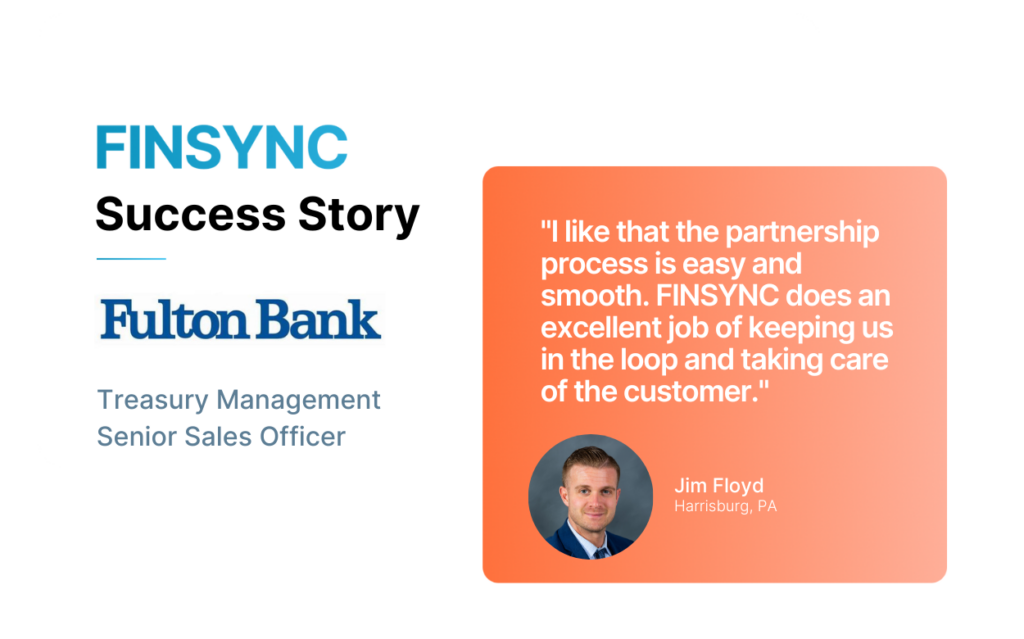
Jim Floyd Fulton Banker Spotlight Interview

Jim Floyd with Fulton Bank knows that partnerships are essential, especially in business. Organizations can pool their resources and knowledge to achieve their goals by working together. A partnership can also help spread support when starting a new business, making the venture more likely to succeed. 


Of course, choosing the right partner is essential to forming a successful partnership. Jim has been very happy with the Fulton Bank/FINSYNC partnership. He has been a great resource to small businesses and is proficient in asking the right questions to determine if they would be a good fit for FINSYNC. Read more about his process below. 


What do you enjoy the most about your job?


I would definitely say working with the audience base that we do, especially with so many small business owners. I like that we work with them from the infancy stages and watch them grow. I have always enjoyed working with the little guys, and then after a year or two, hopefully, they aren’t little anymore. 


There are a lot of things to do out there; if you have a passion for something, you can more than likely make it into a business if you put everything into it. Some companies today weren’t even available when I was a kid. 


What is your favorite part of being on the Fulton Bank team?


I have been with Fulton for seven years. Through college and being out and about, I like that it is a small enough bank where you don’t feel like just a number. There is always a path to the next step. But we are not a small bank, so we still get a foothold and are a fairly recognizable brand.


How do you locate business owners who may be a good match for FINSYNC?


Quite honestly, it is so basic in nature. FINSYNC has been a big help because we have never had a payroll service. We have always had direct deposit facilitation. But everything else, the whole nine yards, the accounting, bookkeeping, taxes, and insurance, we have never been able to offer that in a full suite. So when I am talking to a business owner, I ask them how their payroll looks today. Are they still cutting paper checks? Are they paying for a big company to handle their payroll? 


What is your approach like?


I tell them that we partner with a payroll company, and it is co-branded, so there is still a Fulton Bank touch. Then I mention this partner also specializes in the cash flow space. 


I ask them if they want to schedule a demo and try something new. It doesn’t cost anything, and you guys take it from there. 


Do you think your customers struggle with other software solutions?


Yes, some people like the interface other software has but don’t like the à la carte charges. Also, other customer service teams are not there to assist. 


So, the service with the FINSYNC partnership is parallel with Fulton Bank’s customer service. 


What do you like best about FINSYNC?


Internally, it is a process in which I know I can scratch the surface and get someone’s interest, and then FINSYNC will take care of them from there. I like that the partnership process is easy and smooth. You do an excellent job of keeping us in the loop and taking care of the customer. 


Jim is a shining example of what can happen when individuals work together. Companies, when correctly aligned, can create a win-win situation that benefits everyone involved. 


How FINSYNC Can Help


FINSYNC allows you to run your business on One Platform. You can send and receive payments, process payroll, automate accounting, and manage cash flow. To learn more about how we can help your business start, scale, and succeed, contact us today.
 

How to Close Your Open Invoices With a Few Simple Steps

An open invoice is a request for payment that you have sent to your customers, but they still haven’t paid. In other words, they have an outstanding balance. Open invoices are also sometimes called outstanding or unpaid invoices.

Invoices that stay open longer than intended impede cash flow, which can slow growth or cause downstream problems like the inability to pay vendors or worse, payroll! Monitoring open invoices to be sure customers are paying within the allotted time frame is a critical piece of running a growing business. 

To learn “What Is an Invoice?” visit this previous article that explores the fundamentals. This post details how to track and close your open invoices and how good accounting software will help you save time and money and set your business up for success.  

Track Your Open Invoices

If you are still using a manual or disconnected approach to invoicing, you will need to schedule time frequently to review your invoices, check them against payments received (perhaps in a bank ledger) and then close those that you can. If you’re letting customers slide too often, you may even be unable to pay your suppliers or employees due to insufficient liquidity or cash. To avoid these situations, it is vital to track all of your business invoices.

An invoice tracking system can help you manage the due dates of each invoice and notify you when one is about to expire. This can save your company time and money and reduce the risk of having to actively collect from your customers. This tracking system is often associated with accounting software, which we cover in-depth below. 

If you consistently review a dashboard that automatically tracks open invoices and closes them automatically upon payment receipt, you are regularly aware of which accounts remain unpaid. Then you can work with your customers to receive the funds as soon as possible. From here there are several courses of action with which you can proceed. 

Three Steps to Help You Close Your Open Invoices

The first step in closing your outstanding invoices is to verify their accuracy. Make sure the numbers on each invoice match what was delivered or services provided, and then go from there with supporting documentation such as shipping receipts. An inaccurate invoice can be a significant obstacle to getting paid. 

Second, follow up with customers promptly. You can set up email alerts when an invoice is unpaid beyond a specific timeframe. Or use advanced tracking software to alert you and your customers automatically and sequentially. Also, a polite phone call can often elicit a timely payment as a final resort. 

Finally, be willing to negotiate payment terms with customers if necessary. If you have a customer struggling with cash flow, present them with a partial payment method or other forms of payment such as a credit card through ACH. By being more flexible on when and how you get paid, you may be more likely to collect quickly and efficiently. 

If closing your open invoices continues to be laborious, consider implementing new promotions. You can offer discounts for upfront payments, payment plans, free months of service, or other incentives. Furthermore, take time in the beginning when you create an invoice to include clear payment instructions, so your customers know exactly what they need to do to pay you.

How to Track Your Invoices Using Accounting Software

Using accounting software like FINSYNC, each invoice created has an “unpaid” status by default until the payment has been accepted. When you log in and view your accounts receivable, you can quickly identify the still open invoices. 

An accounting platform can create reminders that are automatic and emailed on an ongoing schedule, daily, weekly, etc., until payment is received. This type of system enables you to be proactive. Sometimes the best way to tackle a problem is to address it right away before it becomes a bigger issue. 

In addition, the FINSYNC accounting platform can provide additional features such as the ability to create recurring, duplicate, and specific project-based invoices. Along with many other features to simplify your cash flow management.    

Summary

Open invoices can have a negative impact on your business’s cash flow and revenue. Every business owner should have a tracking tool that helps them monitor their business’ financial management and operational health.  

You can monitor open invoices by manually entering them into your ledger. However, the best way to close open invoices is with an automated accounting solution like FINSYNC. The good news is that you can reduce your outstanding receivables and improve your bottom line with just a few simple steps. 


FINSYNC provides a straightforward way to collect invoice payments directly from a customer’s bank account. You maintain control over all your payments, saving you time and money

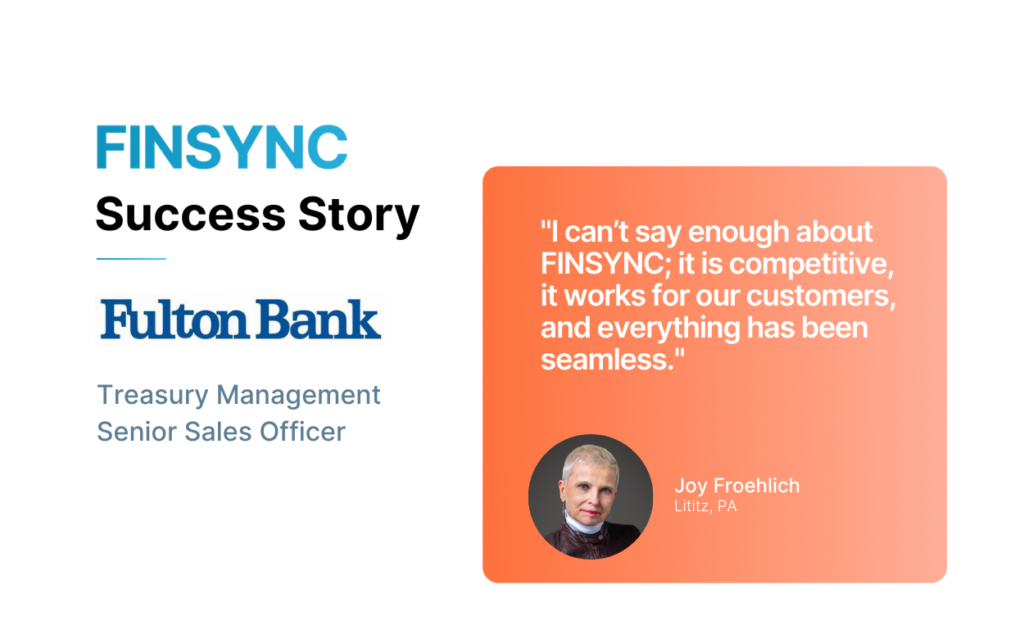
Joy Froehlich – Banker Spotlight Interview

We are living in a time when it is easy to lose sight of what really matters. It’s not just about material things; we need more human connections. Technology can be a fabulous tool that makes our lives easier, but sometimes it overshadows the impact of talking to someone over the phone about an issue. 

Joy Froehlich with Fulton Bank is featured this month for our Banker Spotlight Interview. Read more about her journey with FINSYNC below. 

What do you enjoy the most about your job?

Providing a service that works for our customers. I have a lot of healthcare sales experience. Then in the early 2000s, I went into banking and have been happy ever since.

What is your favorite part of being on the Fulton Banking team?

I worked for 16 years in a large bank. I should have left long ago because Fulton Bank’s culture is phenomenal. I have never been happier in a job. I have been here for seven years and think it is the best. At my age, to be in a workplace where you are very happy is like having the golden ticket. 

In my later chapters, life just keeps getting better and better. I know people want success early in life, but are they really prepared for it? 

How do you locate business owners who may be a good match for FINSYNC?

A lot of those conversations happen at the branch. If we are with a new customer, we might ask them about their merchant processing. After understanding their primary interests, we tell them about representing FINSYNC. We say we represent both cash management and merchant service. The same goes for ACH origination, remote deposits, etc. A tremendous amount of these conversations are happening within the financial sector. 

What is your approach like?

I have to be a good listener. I am not customer-facing; I am on the telephone. I got a referral from one of my partners on the merchant side. She reported the customer was needing a payroll provider. I told them about FINSYNC and that it wouldn’t hurt to do a demo. 

After the demo, he liked the platform but wanted to check with someone in his network that was having trouble getting back to him. I said that was fine and asked him when he needed to cut payroll for his employees. He said next week. I told him I didn’t mean to put any pressure on him, but most people can’t wait for their paycheck; they depend on this to be on time. He thought about it and then agreed. 

I kept thinking, what if that were me and I needed to buy groceries? He was super tolerant, and it worked to his advantage, and he will be better off!

What do you like best about FINSYNC?

I can’t say enough about FINSYNC; it is competitive, it works for our customers, and everything has been seamless. I couple that with Jack Stone, the Director of Partner and Customer Development. Jack and I work very well together; we have a similar style. Jack is hands-on and very patient. He understands if they have a hard time getting onto the call. He makes every effort to talk to them about FINSYNC. His knowledge and follow-ups are spot-on. 

I really appreciate FINSYNC’s availability, sales representation, and customer service. Emails are great to a certain level, but they can be misinterpreted. We are losing that human connection in society, and getting people on the phone is getting harder and harder. I am glad FINSYNC hasn’t lost sight of this.


Looking for a place to find small business news and tips? Visit our FINSYNC blog to stay current on financial, economical, and societal current events. 

Wendy Clarke Banker Spotlight Interview

If a small business owner purchases a software tool to help them run their organization, it doesn’t make sense for that software company to charge a fee when their customer has a question about using their technology. This is exactly what happens when learning other accounting systems available today. 

Our Spotlight Interview this month with WaFd Banker, Wendy Clarke, focuses on giving business owners the tools they need without charging extra costs to use the software. FINSYNC has a no-gated policy which means everyone that uses the platform can use all of the features in use today and future releases happening every week. FINSYNC also does not charge for customer service; this support is available via phone, email, or chat to all of our customers. 

What do you enjoy the most about your job?

I enjoy helping customers the most. I mostly work with small business owners, and I like learning about their businesses, what their goals are, and helping them achieve them. 

What is your favorite part of being part of the WaFd banking team?

The relationships here at WaFd. I work with a great group of people. Everyone is so positive and supportive that if I need help, there is always someone I can reach out to. We are a team. We all have the same inspiration for helping our clients succeed. 

How do you locate business owners that may be a good match for FINSYNC?

Usually, I just bring it up in conversation. I ask them questions about what they are doing for their accounting needs. I find out how they process payments if they are invoicing and how many people they employ. I also ask if they are interested in any payroll services. 

What is your approach like?

I make sure to ask both new and existing clients. One person I spoke with told me he wanted to process ACH payments and also wanted to be able to receive these. I told him about FINSYNC and asked him if he would be interested in talking to someone, and he said, Yes!

Another owner has been in business for 3-4 years. His fiancée had just quit her job and managed the business full-time. She talked about how Quickbooks was such a struggle and wanted to use something easier. 

Do your customers often struggle with other software solutions, such as Quickbooks?

I have never used Quickbooks personally, but I have heard all these nightmare stories about how people hate it. It makes some people feel stupid. QB has all these features but is hard to learn. If you manage to get someone on the phone, they charge you for that. 

What do you like best about FINSYNC?

You don’t charge if people have questions! The service I received from you guys has been great. After I put in a referral, Jack gets back to me right away. If I have any questions, he helps me immediately. I really appreciate that. 

FINSYNC shares the same values we do, making it a good fit. You really care about our customers and want to see them succeed and get the service they deserve. 

What other “banking tools” could we provide you to help you succeed?

I got a lot out of the demo with Jack and learned quite a bit from that. But originally, we got all these pamphlets and brochures, and I wish those could be more clear about what FINSYNC does. 


Wendy, thank you for your continued support of our accounting platform. Your clients are fortunate to have someone as passionate and dedicated on their side.

FINSYNC and WaFd have formed an effective partnership committed to helping our customers. We want to be there when it matters most and walk you through your financial management journey. Our local team offers personal support via email by phone, and our live chat functionality allows clients quick and easy access when they need it most. 


Reach out to FINSYNC if you know someone that could be featured in our Spotlight Interview series. We are better together and welcome new partnerships with open arms. 

Is Your Small Business in Need of Bookkeeping or Accounting Help?

As a small business owner, you wear many hats. In addition to managing your product or service, you also have to take care of the finances. It is common for owners to handle their accounting and bookkeeping, at least at the early stages of their businesses. However, as the business grows, it can become increasingly difficult to keep track of everything. At some point, it may make sense to hire an accountant or bookkeeper. But how do you know when you’ve reached that point? How do you find a bookkeeper or accountant who you can trust? 


This article addresses these questions and details FINSYNC’s accountant and bookkeeper matching program. By the end, you will understand the benefits of these financial magicians and recognize the value of being matched personally to the most qualified individuals for your organization.


Is Your Business Ready for a Bookkeeper or Accountant


The decision to hire an accountant or bookkeeper should not be taken lightly. There are many variables to consider in making this critical choice, including how well you manage the finances on your own and if there is enough in-house experience. It is also critical to scrutinize your revenue stream, current and projected. A lot can change over just one quarter, so it is essential to think through the situation thoroughly. 


Here are some signs that it might be time for you to outsource your accounting:


• You are spending too much time on bookkeeping tasks and not enough time on revenue-generating activities.

• You are making errors in your financial reports.

• You are not keeping up with invoices and bills.

• You are not sure how to file your taxes.


If any of these sound familiar, it is likely time to get some help. An accountant or bookkeeper can take care of your financial tasks, freeing up your time to focus on running your business. They can also provide valuable insights into your financial situation and help you decide where to invest your money. 


Accountant Partner Program


When finding a bookkeeper or accountant, you want to make sure you find someone who is a good fit for your business. FINSYNC is proud to partner with some of the country’s most reputable CPA firms. Our proven criteria ensure that you’ll be matched with the right person for your needs, whether you’re a small business owner or a large corporation. And because we’re free to use, getting started involves no risk. 


Start with a quick and easy 5-minute form that helps us to get to know your business. We then match you with someone who fits your criteria, including budget, location, industry, experience, accounting needs, business objectives, and bookkeeping requirements. This way, you can be sure you’re getting someone who can help your business run smoothly and efficiently.


We vet all the bookkeepers and accountants in our network to ensure they have a clean history, which helps protect your organization. We also perform background checks as it is crucial to choose a bookkeeper or accountant who is both competent and trustworthy. Above all, we make sure your financial records are in good hands and that your business is protected from unnecessary risks.


By offering this free service, we can better serve our clients by connecting them with the right person at the right time. FINSYNC’s matching program was developed from years of experience and research, and we are confident that we can provide the best possible match for your needs. There is no need to go through the time-consuming and expensive process of hiring a full-time professional.


Benefits of Hiring a Bookkeeper


Hiring a bookkeeper may be a game-changer for your organization. You can review the differences between a bookkeeper and an accountant in our previous article. For now, it is essential to understand that keeping accurate financial records is essential for any business, but it can be time-consuming and daunting, particularly for those who have not worked in the industry. 


A bookkeeper can handle all of the financial aspects of your business, including invoicing, payment processing, debt collection, and tax preparation. Also, a bookkeeper can help you stay organized and track your spending, controlling your cash flow, which is a valuable service, particularly if your business is growing. Overall, hiring a bookkeeper is an excellent way to support the success of your small business.


Benefits of Hiring an Accountant


Small businesses have a lot to gain from hiring an accountant. An accountant can help you manage your finances, maximize profits, and comply with tax laws. Navigating the appropriate write-offs can save the business money, and filing correctly will help you avoid costly penalties.


An accountant can also provide valuable insights into your financial data, helping you to make better business decisions by supplying valuable insights into where the business is spending its money and where there may be opportunities for cost savings. An accountant can also help create financial statements and forecasting models to make important decisions about the future of the business. Hiring an accountant can give a small business the professional guidance it needs to succeed.


Best of all, an accountant can create a cash flow management process to keep you organized and on top of your finances. This will free up your time to focus on other areas of your business, such as marketing and sales. 


If you’re unsure whether you can afford an accountant, keep in mind that the cost of not having one can be much higher. Delinquent taxes, penalties for errors, and missed opportunities can quickly eat into your bottom line. So if you’re serious about growing your small business, hiring an accountant is a wise investment.


Conclusion


If bookkeeping and accounting are taking up too much of your time, it might be time to hire some help. An accountant or bookkeeper can take care of all the details so you can focus on running your business. Whether you’re looking for someone to handle all your accounting needs or only need occasional help with bookkeeping, the Bookkeeper and Accountant Matching Program can help you find the perfect fit.


How FINSYNC Can Help


FINSYNC allows you to run your business on One Platform. You can send and receive payments, process payroll, automate accounting, and manage cash flow. To learn more about how we can help your business start, scale, and succeed, contact us today.

 

How to Create an Invoice and Reduce Processing Time for Your Business

If you’re a small business owner, you understand the importance of keeping an eye on your company’s finances. After all, knowing where every penny goes is critical for making informed decisions about future investments and strategies. One way to fulfill this goal is to invoice your customers correctly every time so they understand the services provided and secure prompt payment for your business. 


An invoice is a statement that money is owed from the business providing the goods or services to their client. This document states what was delivered, how much it costs for each item/service (including applicable taxes), and when the payment is due. You can learn more about what an invoice is with this previous article. 


Creating an effective, systematized invoicing process helps manage client relationships while confirming that customers pay on time.


Fortunately, several methods can help you streamline the invoicing process to ensure that your business stays on a solid financial footing with a little effort. This article covers the invoice lifecycle, key elements within an invoice, leaning into automation, and the value of financial platform integration. 


Lifecycle of an Invoice


The first step in creating an invoice is gathering all the necessary information. Match the customer’s name and contact information with the description of the products or services provided. Once you have all of this information, you can begin entering it into an invoice template. Various templates are available as part of accounting software, or you can create your own. Once you have entered all the necessary information, it is transmitted to the customer for approval.


The customer will review the invoice and ensure that everything is correct. If any changes are required, this invoice will return to the draft stage. 


After the customer has approved the invoice, it goes to the accounting department for processing. In this department, the invoice is reviewed for accuracy and completeness. The invoice is entered into the client’s accounting system upon receipt and acceptance, and payments are processed.


The final stage in the invoicing process is when the business that sent the invoice receives payment in full from the customer. In some cases, businesses may offer payment terms to their customers, such as net 30, net 60, or net 90. These terms mean the customer has up to 30, 60, or 90 days to pay. Once the payment is received, the invoice-sending business will update its records accordingly and close out the invoice.


Key Elements


When creating an invoice, there are several components to include to ensure it is precise and complete. Checking off these items will help avoid confusion and ensure the payment is quick and smooth. 


Here are some of the key elements to include:


◦ Date

◦ Company Logo

◦ Company Address and Phone Number

◦ Invoice Number or Unique Identifier

PO Number, if applicable

◦ Products or Services Sold

◦ Quantity 

◦ Fees or Taxes

◦ Total Amount Due

◦ Payment Terms or Due Date

◦ Notes or Unique Message

◦ Acceptable Method(s) of Payment


Be sure to use straightforward, succinct language when describing the service; avoid jargon or technical terms that can be confusing. By following these simple tips, you can help ensure that your invoices are clear and concise, making it easy for your clients to understand what they owe and expedite the payment process.


Embrace Automation


With the rise of automation in accounting, more and more companies are moving away from a manual accounts receivable process. The time commitment can be too much for employees to handle as they write everything down by hand. This technique often produces costly errors such as misclassifying revenue or improperly recording expenses. 


In today’s digital world, everything is at our fingertips. That is why using an accounting platform that can automate invoices and payments can help businesses save time and money. The best platforms allow companies to send invoices directly to their customers’ inboxes, track payments, and automatically apply late fees when necessary. 


In addition, using an automated accounting platform can help organizations keep track of their revenue and expenses. This information is beneficial in managing finances and ensuring that your business is running smoothly. You will also reduce stress when taxes and financial statements are due. Overall, using an automated accounting platform can be a great way to save time and money.


FINSYNC operates a payments network that helps businesses that frequently experience a delay between completing the work and getting paid. We facilitate real-time payments so you can get CollectEarly™ on money earned. This is a game changer for cash flow management.


Accounting Platform Integration


An accounting platform can help streamline your company’s invoices, make tracking your revenue and expenditures easier, and wow your clients! 


One of the most important aspects of running a business is keeping track of payments and receivables to guarantee you have enough cash on hand to meet your financial obligations and avoid any costly penalties.


Here are a few benefits of using an accounting platform for your invoices:


• Track invoices and payments in real-time, making it much easier to stay on top of your finances. 

• Get paid faster by transferring your invoice payments via ACH using just an email address.

• Make your work more efficient by duplicating an invoice that you’ve already sent out.

• Invoice your client for the hours you worked in an itemized format.

• Generate reports and analytics to help you make informed business decisions. 

• Improve your customer satisfaction due to faster payment processing times.

• Manage late payments by setting up alerts and automatically charging and resending an updated invoice. 

• A more efficient way to manage your finances.  

CollectEarly: Create an invoice through the FINSYNC Network and get paid early.


The customer’s experience should be easy and convenient. You can offer them a user-friendly system while also providing an efficient way of tracking bank transfers or credit card charges. 


Eradicating the hassle of sending invoices and accepting payments will make customers happy and keep them coming back. With features like automatic subscriptions, bank transfers, or credit card charges with tracking, it’s easy to see why so many businesses have chosen an integrated invoice system to simplify their accounting needs.


How FINSYNC Can Help


There are three primary ways FINSYNC helps business owners. (1) CO.STARTERS courses through FINSYNC can help turn your business idea or side hustle into a thriving business. (2) You can apply for a business bank account on our website. (3) FINSYNCs software allows you to run your business on One Platform – invoice customers, pay bills, process payroll, automate accounting, and manage cash flow. Contact us today to learn more about how we can help your business start, scale, and succeed.

Start Accepting Mobile Payments Today

The future of payments is now. The use and popularity of mobile payments are continually increasing, so it is time for your business to take advantage and begin accepting them. Now has never been a better time to start obtaining alternate forms of payment, and the best part is that they are easy to set up. 


Various payment options are available, including credit and debit cards, mobile wallets, and mobile apps. These platforms are convenient for companies and consumers and are tailored for a variety of transactions, from paying a contractor to purchasing a new laptop. 


As paying via smartphones becomes more commonplace, we will likely see a continued shift away from traditional payment methods. So keep reading to learn the different types of mobile payments, how mobile payments work, as well as the advantages and how to get started.


Types of Mobile Payments


Mobile payments are any payment made using a mobile device such as an iPhone or tablet. This can include in-app purchases, mobile commerce transactions, and peer-to-peer payments. These payments are convenient because they can be made anywhere and anytime. 


Learn about the different mobile payment types below:  


Browser-Based

Browser-based mobile payments are an excellent option if you’re looking for a new way to receive payments. You might hear this referred to as a web-based or even an online payment. With this type of mobile payment, customers enter their payment information into your website on their mobile phones. 


App-Based

App-based payments are similar to browser-based in terms of the process. Customers enter their payment information into the app versus a browser, and the transaction is then processed through the app.


Customers who use app-based mobile payments tend to be more engaged with the company or brand since they have taken the time to download the app and make a purchase. Unfortunately, creating a mobile application for your business can take a lot of time and money, so be sure to weigh the pros and cons to determine if this type of payment is right for you.


Mobile Readers

Mobile credit card readers are a great way to process customer payments on the spot. They’re quick, easy, and convenient, perfect for businesses on the go. Plus, most card readers today also process digital wallets, making it even easier for customers to pay. 


QR Codes

Mobile processing can also use QR codes. QR codes are two-dimensional barcodes scanned using a smartphone camera. A QR code can provide additional information about a product or service. When paying from cell phones, QR codes are used to process payments without the need for a physical credit card. Instead, your client scans the QR code and enters their payment information into the associated app.


Contactless POS

Contactless payments allow your customers to make a purchase without having to swipe their cards. The merchant device receives payment information from the reader. The POS system processes the payment using Near Field Communication (NFC) technology, which wirelessly sends information between their credit card and phone. More about this in the following section.


How Mobile Payments Work


Mobile payments are made possible by two types of technology, MST and NFC. The difference between them depends on how your customers make the actual purchase. 


NFC technology allows two devices to communicate with each other when within close proximity. NCFs use a virtual token that stands in for the card numbers, which are transmitted to the bank or credit account.


MST, or Magnetic Secure Transmission, uses magnetic pulses to stimulate the card-swiping motion, allowing customers to use their mobile phones to make payments at traditional POS terminals that do not have NFC capability. 


Encryption is also used in both forms of technology for mobile payments to protect users’ information. When customers pay using their phones, their data is encrypted so that it can not be intercepted and misused. 


Benefits of Mobile Payments


Your customers are already using their phones for just about everything else, so it only makes sense that they would want to use them to pay for your products and services as well. Mobile payments are fast, easy, and convenient—three things that customers always look for. But there are additional advantages to you and your business. 


• Payments via your smartphone are secure – When you accept payments from this technology, you use some of the most secure payment methods available. These payments are processed through layers of encryption networks, so it is difficult for hackers to access customer information.

• Mobile payments can save your company money – Did you know that businesses that accept mobile payments can save money on transaction fees? This is because mobile payment processors typically charge lower fees than traditional credit card processors.

• You can use mobile payments to get paid faster. If you’re used to waiting for customers to mail payments or send via ACH, you know it can take weeks to receive the money. But with mobile payments, you can get paid almost instantly. Plus, the convenience of sending directly to your client’s phone will almost guarantee a fast return.

• Manage your cash flow – Best of all, mobile payment systems can have additional functions for businesses to track their sales and overall spending more effectively. Not only do you get a visual record of each transaction, but some platforms enable you to utilize a cash flow management system to make better-informed decisions about your business and operating decisions. Successful Payments with Mobile Apps.


Mobile apps are becoming increasingly popular as a way to manage finances. In fact, according to a recent study, roughly 79% of Americans now use mobile apps. While there are many ways for your customers to pay you using a mobile app, the following tips will help ensure that your first transactions are successful.


1. Choose a reputable app: Make sure that you’re using an app from a trusted source. Study reviews and ratings before downloading a new application, and only download apps from official app stores such as the App Store or Google Play.

2. Check security features: Before making any payments, check that the app has robust security features. Look for features like encryption and fraud protection.

3. Make sure the app has good customer service: If you ever doubt whether a payment went through, make sure you have a consistent line with the app’s customer team for assistance. It is even better if they have multiple forms of contact, such as email, chat, and phone support.


Conclusion


When it comes to technology, there are a lot of options out there, and businesses today are under more pressure than ever from their customers to adopt the latest and greatest technologies. 


Fortunately, mobile payments are safe, fast, and easy, with many benefits that will make life easier. However, it is crucial to keep up-to-date and research your options before making any decisions. Confirm which technology works best in conjunction with what matters most within your organization.


How FINSYNC Can Help


FINSYNC allows you to run your business on One Platform. You can send and receive payments, process payroll, automate accounting, and manage cash flow. To learn more about how we can help your business start, scale, and succeed, contact us today.
Business Principle 10: Celebrate the Small Things

This is the final post in a ten part series on foundational principles of being an entrepreneur.

Entrepreneurship is forever forward looking—to the next phase of growth, toward that dream on the horizon. 

But when you fixate on the future, it’s easy to become stuck in a state of anticipation. You will never feel like you’ve arrived. Dreams remain far off—or are replaced with new, more ambitious ones. 

The “hustle culture” of entrepreneurship tells us we must always want more, strive for the next thing, and keep pushing. Anything short of the hustle is complacency. 

No wonder so many entrepreneurs burn out. 

What if, instead of always focusing on what’s next, we stopped to celebrate what’s already been accomplished?

Celebrate the wins.

As you build your business, take time to reflect on what’s gone well—no matter how small. Did you have a meaningful conversation with a customer? Celebrate! Did you finally hit “post” on Instagram? Celebrate! Did you file your business license? Celebrate!

When you celebrate the small wins, your mindset shifts. Instead of feeling restless, you’ll see that every small thing you do brings you closer to that big dream. You’ll see the progress you are making, one step at a time. 

Pause to appreciate your accomplishments. 

Celebrate the learnings.

Similarly, take the time to reflect on what’s gone wrong—and how you can learn from it. 

When things don’t go according to plan, it’s easy to get discouraged. But in entrepreneurship, there’s a reason why you’re encouraged to “fail fast.” Failure isn’t necessarily bad; it’s an opportunity to learn. With the right mindset, setbacks become the launchpad for your next phase. You learn, change course, and make your business even better than before. 

Celebrate what you’ve learned and what will be different because of it. 

Celebrate the journey.

As any seasoned entrepreneur will tell you, owning your own business is not easy. You’ll encounter many challenges and sleepless nights. You may fail (and learn!). But, in the end, it’s worth it. It’s yours. You made it happen. 

Celebrate yourself and the journey you are on—that you actually did it. You took the scary step into business ownership, you made sacrifices, you took the risk. Venturing down this path is brave and worthy of recognition. 

Spotlight on Small Business Owner: Seth Larson with Alamo Dispatch

For Seth Larson, truck driving wasn’t just a job; it was a way of life. But after he and his wife welcomed their first son Wade Quinn Larson, Seth knew he wanted to be present for the most critical moments in his son’s life, and his priorities quickly changed. He set his sights on a new career that would allow him to be at home with his family, so he started his own company called Alamo Dispatch.

Seth is passionate about his work and takes great pride in helping others achieve their goals. He understands owning his own business isn’t always easy but worth it. Because he clearly understands his “why,” he has created a successful business and been the loving father he always wanted.

Tell me about your company and what inspired you to start.

Alamo Dispatch is a truck dispatching company. We receive a load request from our suppliers and connect these jobs with our drivers to complete the delivery. These jobs can transfer pellets for manufacturing, dog food, or other goods that need to be delivered quickly and efficiently.

I was a driver for six years, and I have a 4-year-old kid. There is a lot of work in transportation that doesn’t require being on the road. I knew I didn’t want to miss out on being a father to my amazing boy!

What are some of the challenges you’ve faced as a small business owner?

Right now, inflation is a challenge. The job rates are not matching up with the increasing fuel prices. The trucking industry has had a steady decrease in drivers over 5-10 years. Last year, trucking companies in the United States suffered a record deficit of 80,000 drivers

What’s the best thing about being a small business owner? 

The money I make goes to my family. I start early and work hard to accomplish my goals and not someone else’s quota. I have the flexibility to get things done and still be a family man. The decisiveness of making decisions and learning from the result of those decisions along the way. Learning is definitely a huge part of being a small business owner.

What prompted you to start using FINSYNC?

I am part of a group of other business owners, and we advise and support one another. They recommended that Randolph Brooks Federal Credit Union start my business account since they are well regarded with the group. 

Someone from the business department called after I opened my account and asked if I was looking for software to do invoicing. The banker recommended FINSYNC as a great resource. It wasn’t until I scheduled a demo that I understood FINSYNC is more than invoicing. I was all set to contact ADP for payroll and Quickbooks for cash flow, and I learned from Jack that FINSYNC could do it all. Jack mentioned that FINSYNC syncs up well with my bank Randolph Brooks, which happens automatically.

What are the biggest benefits your business has experienced using FINSYNC?

The price is right, and there aren’t all these add-on costs that other accounting software charges. The payments, accounting, and payroll are the three services that matter to me. It is nice that everything is all in one place at an affordable price.

All of my drivers are 1099 contractors. They are easy to pay; the system tells me when they have opened the invoice, so I know when they have had their eyes on it. Additionally, we receive money from our clients that need their products transported.

Also, I appreciate your customer service. It is so difficult to get someone on the phone in today’s world, and you are sitting on hold all of the time. But I have spoken with Clark and know I can contact him anytime. He always responds quickly with a solution, and he has excellent communication skills. 

What financial institutions do you have connected to FINSYNC?

I was only 14 when I opened my first checking account with RBFCU. This is a big military town in San Antonio, and Randolph Brooks was connected to the airforce. My dad was active in the military, so we both set up an account. It made sense to create my business account here too.

When I first started using FINSYNC, I felt like it wasn’t syncing every day. I spoke with your customer service, and they looked into it. Now it syncs right away. It also has a “manual sync” option, but I rarely use this anymore because I see the transactions right away.

How does having FINSYNC connected to your accounts make your business life easier?

FINSYNC syncs up with Randolph Brooks so cleanly. I know that other accounting software does this too. FINSYNC does my payments, accounting, and payroll just as well as the bigger names in this industry. There are no compromises, and I have everything that I need all in one place at market standard for a far lower cost. 

It is easy to think that because something is cheaper, you aren’t getting the same quality or missing out on certain features. But that’s not the case. You guys are providing services just as well as everyone else and at a lower cost. What’s not to like about that?

What advice do you have for those who are thinking about owning their own business?

The pennies matter, and it is important to understand how much cash is coming in and out. Knowing your “why” will help get you there.

What features could FINSYNC implement that will make your life a little easier?

I wish the timekeeping features were more robust. If I am using the billing system, it is clear how it has been updated; it is so clean and easy to use. Every step of the way, I can download pdfs and access everything from one place. It is far more polished on the accounting side than on the timekeeping product. 


If you’re looking for more helpful tips, the FINSYNC blog is a great resource. Maybe your successful business will be featured one day!

Colleen Ward – WaFd Banker Spotlight Interview

In today’s world, it can be tempting to choose the most expensive option, thinking it must be the best. However, this is not always the case. Sometimes the cheaper option can be better than the other more expensive tools. As a consumer and business owner, it’s important to know that just because something costs less doesn’t mean losing out on value or functionality. Often these lower-cost options will turn out to be superior across the board. 

This was a prominent topic during this week’s featured banker interview. Colleen Ward understands the needs of small businesses and has been a WaFd veteran for over 10 years. She is an experienced banking professional who understands what her clients need to succeed. Colleen enjoys delighting her customers when she can recommend an accounting platform that does everything the big brand names do, but for a fraction of the cost.

Read more about how Colleen recommends FINSYNC below.

What do you enjoy the most about your job?

Teamwork and brainstorming solutions to customer issues. I enjoy getting to know and helping the customers.

What is your favorite part of being part of your banking team?

I have been part of WaFd for ten years. I love the sense of community my team brings because we really support each other. 

How do you locate business owners that may be a good match for FINSYNC?

I ask them if they have Quickbooks or another accounting software they are using. If they already have a platform, I ask them how open they are to exploring a similar software at a lower price, this usually gets their attention. 

I speak to both new businesses just starting their first account and existing customers as well. The more people I talk to, the more likely I will locate members that would benefit from FINSYNC.

Do you think your customers struggle with other software solutions such as Quickbooks?

I often question the value of Quickbooks and if I can save our clients money down the road, I am happy to provide an alternative. So many times business owners immediately sign up for Quickbooks by default because it is a familiar name. But I want to show them that they don’t have to spend so much on the same features. In fact, I have been told that FINSYNC is much easier to use. 

What do you like best about FINSYNC?

I like that it is an all-in-one platform. It is easy to recommend a financial platform with everything right there in one place. My clients don’t have time to open different tools and download account data into multiple systems. 

In today’s economy, we are all looking for ways to save money. And when you find something that can be just as effective but at a lower price point, why not try it out? You might end up happy with your choice and pleased by how much more efficiently and effectively you will be able to grow your business. 


Take advantage of FINSYNC’s all-in-one accounting platform and start your free trial today!

Apply For Business
Checking Account

Before you get started

1

We are not able to service these businesses at the moment:

  • Crypto Currency and Money Services
  • Privately Owned ATMs
  • Marijuana-Related
  • Gambling
  • Money Services Business
  • Business headquartered outside of the U.S.
2

At this time we are offering online business checking accounts through bank partners in these states:

  • Arizona
  • California
  • Idaho
  • Nevada
  • New Mexico
  • Oregon
  • Texas
  • Utah
  • Washington

Is your business in one of these states?