
Why Your Business Credit Score Matters More Than You Think

As a dedicated entrepreneur, you are likely juggling many tasks each day. From managing operations to driving sales, there is one critical aspect you might be overlooking: your business credit score. This seemingly simple number has far-reaching implications for your business’s financial health and future.


Think of this score as the backbone of your business’s financial stature, quietly influencing many of your company’s major decisions and opportunities. This article will cover the intricacies of the business credit score, revealing its significance, what differentiates it from a personal credit score, and the monumental impact it can have on your entrepreneurial journey.


Personal vs. Business Credit Scores


It is important to understand that your business credit score differs from your personal score. While both scores evaluate creditworthiness, they consider different factors. Your personal score is built upon individual financial behaviors, like how you handle personal loans or credit card bills. 


Your business credit score focuses on your company’s financial habits. It assesses how punctually you pay business invoices or how responsibly you manage business debts.


For your company’s credibility and financial stability, it is vital to separate personal finances from your business. Blurring these lines can make it challenging to assess the actual financial health of your enterprise.


The Lender Perspective


When you approach a bank or any financial institution for a loan, they want to gauge the risk of lending to your business. Your business credit score serves as a reflection of your financial reliability. A high score indicates your company has a history of managing its financial obligations well. It gives lenders the confidence that you will repay the loan as agreed.


The US Business credit scores typically range from 0 to 100, with higher scores indicating better creditworthiness. Generally, a score above 75 is considered excellent, signaling to lenders that your business has consistently handled its financial responsibilities well. A score between 50 and 74 is deemed good, while anything below 50 may raise red flags for potential lenders. This numerical value plays a pivotal role in shaping the financial opportunities available to your business.


Benefits of a Good Business Credit Score


When you dive deeper, you will discover that a strong business credit score opens up a world of benefits:


Better Loan Terms

Lenders feel more at ease lending to organizations with good credit scores. This trust can translate into lower interest rates, saving your business a substantial amount of money in the long run.

Negotiating Power

A strong credit score is more than just appealing to lenders. Suppliers and vendors also view it as a sign of a reliable business. With this reputation, you have the upper hand when negotiating payment terms or prices.

Higher Credit Limits

Financial institutions are more inclined to offer larger loans or higher credit lines to businesses that exhibit financial responsibility. This means your business can access more capital when needed, paving the way for expansion or handling unplanned expenses.

Increased Trust

A solid credit score highlights the stability and reliability of your business. Potential partners or investors will view your enterprise as less risky, creating a greater likelihood of collaboration.

Expansion Opportunities

When you think about growing your business, like moving to a larger office or opening another branch, a solid credit score can make these aspirations more attainable. Landlords, for instance, may check your business credit score when considering lease applications.


Potential Pitfalls


Overlooking the importance of your business credit score can bring about several challenges. For starters, if your credit score is low, high-interest rates on loans become the standard. This not only affects your immediate financial situation but also results in increased expenses in the long run, eating into your profits. 


Furthermore, with an unfavorable credit score, your business might struggle to access needed capital. This limitation can hurt your ability to invest, purchase equipment, or hire more staff. 


Lastly, a low credit score can overshadow your company’s reputation. It might create hesitations for other businesses or potential partners to collaborate with you. In essence, maintaining a good business credit score is important for the overall health of your enterprise.


Tips for Improving Your Business Credit Score


Recognizing the significance of a good business credit score is just the start. Here are actionable steps you can take to boost yours:


• Separate Personal and Business Finances – Open a business bank account and ensure all business-related transactions go through this account.

Pay Bills and Debts on Time – Your payment history significantly affects your credit score. Consistently paying suppliers, vendors, and creditors on time can help improve your score.

Monitor Your Credit Report – Regularly check your business credit report for inaccuracies or fraudulent activities. Promptly address any issues you spot.

Establish a Credit History – Even if there is no immediate need, consider securing a small business loan or obtaining a business credit card. Use them and pay them on time to build a positive credit history.

Summary


Your business credit score reflects your business’s financial health, reliability, and potential. Understanding its importance and taking proactive steps to enhance it will pave the way for favorable loan terms, better business relationships, and more growth opportunities. As you plan for your business’s future, make sure that maintaining a strong business credit score is part of your strategy.


How FINSYNC Can Help


FINSYNC allows you to run your business on One Platform. You can send and receive payments, process payroll, automate accounting, and manage cash flow. To learn more about how we can help your business start, scale, and succeed, contact us today.
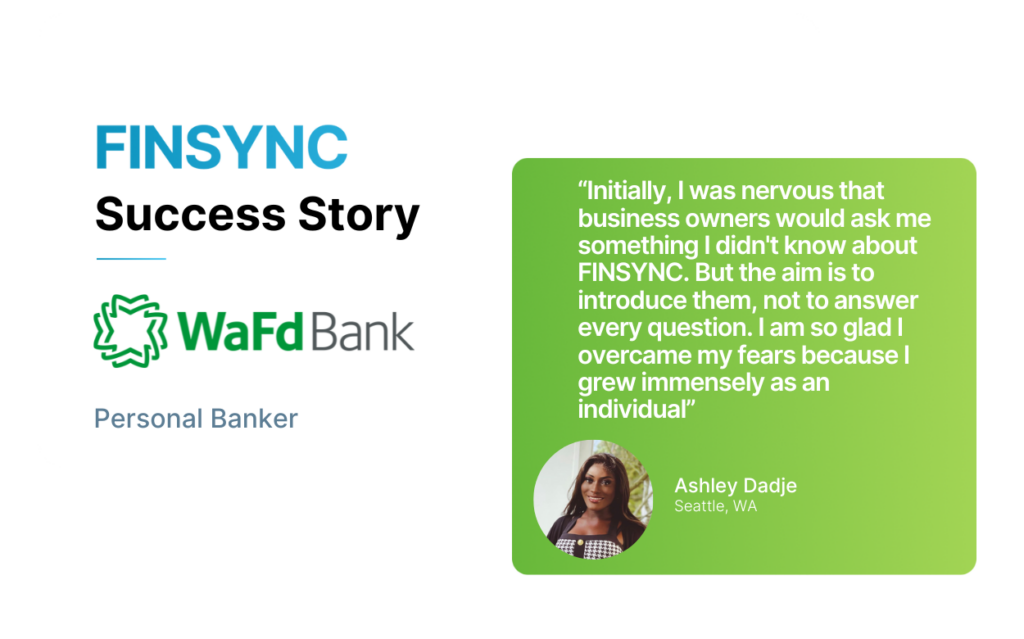

 

Ashley Dadje WaFd Banker Spotlight Interview

Diving into the banking world, especially in personal connections and digital solutions, requires a blend of empathy, knowledge, and resilience. Meet Ashley Dadje, a personal banker with WaFd Bank. Her journey with her clients is as personal as it gets. 


Ashley cherishes the core values of her team. Her perspective provides a unique blend of professional dedication and innovative approach. In this Spotlight Interview, we reveal the passion and principles that guide Ashley in her role, how she identifies potential partnerships, and her insights into navigating the challenges and rewards of introducing new solutions to customers. 


What do you enjoy the most about your job?

The impact I make in every encounter with our clients is significant. This extends from individual members to our small businesses that are expanding. As a personal banker, it’s personal. Each connection is unique, and I’m grateful for the chance to make a difference in their lives.


What is your favorite aspect of being a member of the WaFd team?

I love our core values at WaFd. Integrity is very important to us. When we say we will do something, we do it. If we say we won’t, we don’t. I truly respect this, right up to our CEO. He embodies the same values—humility, integrity, and respect—which I deeply admire about WaFd Bank.


How do you identify business owners that may be a good match for FINSYNC?

First, I ask them if they are using a banking platform for their finances. What I appreciate about your website is the comparison between FINSYNC and QuickBooks. It is truly helpful. I was especially drawn to the success stories. Reading about those who previously used QuickBooks, had unfavorable experiences, and found FINSYNC to be simpler and more affordable was enlightening.


What is your approach like?

I gathered the testimonials and made a list of positive experiences with FINSYNC. I was able to get our Branch Business lists of accounts from my manager as a good starting point. Initially, it was challenging because I wasn’t very familiar with the platform. However, I persisted, continued learning, and gradually built confidence. Whenever I have questions, I reach out to FINSYNC. They are always available, very knowledgeable, and respond promptly.


Do you think your customers struggle with other software solutions, such as QuickBooks?

I appreciate that FINSYNC provides the software platform for payments for free while QuickBooks charges. My customers not only get FINSYNC but also have the backing of WaFd Bank. It is like they are supported on all sides, much like a square.


What do you like best about FINSYNC?

I think FINSYNC is great! It is so simple to use. If customers want to add payroll processing or other accounting features, they just add it by clicking a button. I also love how efficient it is when it comes to your customer support team. I highly believe in FINSYNC! 


What can you say to other bankers who don’t know a lot about FINSYNC?

I joined as a personal banker about a year ago and had to continuously learn and adapt. In supporting businesses, both confidence and knowledge are crucial. Likewise, being proactive and willing to take initiative is equally important.


At first, the webinars felt like a lot of information. But I soon realized it was a decision for an individual to move past that fear and dive in. Initially, I was nervous that business owners would ask me something I didn’t know. But the aim is to introduce them to the platform, not to answer every question. We, as bankers, are the middlemen, while the FINSYNC team is the experts. My main goal is to stay in my lane and invite my customers to learn more. It is key to avoid getting too technical and, most importantly, to stay confident!


FINSYNC allows you to run your business on One Platform. You can send and receive payments, process payroll, automate accounting, and manage cash flow. To learn more about how we can help your business start, scale, and succeed, contact us today.

 

How Is Digital Transformation Shaping Credit Card Payments?

Digital transformation is more than a buzzword; it is a fundamental shift in how businesses operate and deliver value to their customers. Understanding this is essential for small business owners like you, especially regarding credit card payments. 


Understanding and accepting credit card payments in today’s digital era is critical. By genuinely adopting and mastering it, you position your business for greater success, potentially outpacing competitors and ensuring your customers have a positive transaction experience.


Background & History


Rewind a few decades, and the credit card payment landscape was sizably different. Payments were primarily tied to physical cards and terminals. Fast forward to today, and the blend of digital technology with business operations has revolutionized payment processes. This overlap means new opportunities and challenges for your business. However, if you’re experiencing Wi-Fi connectivity issues on your devices, check out this helpful article for troubleshooting tips to ensure uninterrupted mobile payment processing.


Gareth Boyd, Head of Growth at the credit card comparison website Credit Card Compare, says that “digital transformation in credit card payments allows businesses to meet modern consumer expectations, providing faster and more secure transactions through advancements such as contactless payments and mobile wallets.


Digital Shifts


With payment processing, keeping up with the latest tech changes is important. Here, we have highlighted some of the most influential shifts in the digital payment landscape:


Mobile Payments

Making a card payment used to require a hardwired phone line or internet connection. Now, you and other businesses can accept payment anywhere you have an internet connection using phones, tablets, and laptops connected to wifi or cell service. For your business, mobile payments mean you can accept payments from a broader customer base that is always on the go.  

Contactless Payments & Mobile Wallets

Remember when making payments meant the cashier had to swipe the card? Now, customers can make payments by just tapping their card. If they have a mobile wallet configured, they can also pay with a tap of their smartphone. It is faster, often more secure, and most importantly, it caters to modern consumers’ needs.

Integration of AI & Machine Learning

Real-time fraud detection and analytics can help your business avoid costly chargebacks and better understand purchasing patterns. Adopting these technologies can give you insights that could reshape your business strategies.

Enhanced User Experience

Customers today demand functionality and intuitive user experience. Digital invoicing and payment gateways are now customizable, allowing businesses like yours to match online payment pages with your brand’s theme, ensuring a seamless shopping experience for your customers.


These digital shifts are reshaping the payment processing approach, providing businesses with opportunities to innovate, optimize operations, and meet customer expectations like never before.


Credit Card Payment Benefits


Welcoming digital payments does not just give your business a modern touch but also offers several other benefits:


• Efficient Payment Processing: Digital transformation means your business pays less in transaction fees, and the money makes it to your bank faster. 

Increased Customer Engagement: Customers who find your payment process easy and hassle-free are more likely to return, potentially increasing your sales.

Advanced Security Measures: Advanced digital payment methods include better security protocols, ensuring your customers’ data is safe and reducing your risk of accepting fraudulent transactions.

Access to Global Markets: With digital payment systems, you can sell to customers all over the world, pushing past geographical limits.

Streamlined Business Operations: A customizable dashboard provides insights into sales trends, customer behaviors, and inventory status, streamlining your business operations.


Potential Hurdles


While there are many advantages to digital payments, you will also face some challenges:


First, as more people use digital payments, the rules around them can change. It is a good idea to stay updated. You can do this by attending webinars or reading industry articles.


Next, technology is constantly changing. It can be hard to keep up. Set aside time or have someone on your team responsible for tracking new developments.


Safety and security are top priorities. It is important to regularly review and update your protective measures. If needed, get advice from an expert to keep everything secure.


Finally, make sure your team knows how to use the new tools or systems you put in place. This may mean scheduling training or practice sessions.


Success Stories


Explore how businesses have thrived with FINSYNC credit card payment solutions through the following success stories.


Following the pandemic, Siedah Mitchum started a retail store and introduced contactless credit card payments. The positive impact on her business led her to open a second location. Learn about Siedah’s journey


Without a digital invoicing system in place, Ricky Gudino faced numerous challenges. Their bakery, Caked, struggled with tracking orders and even delivered cakes for weddings that had been called off weeks prior. They recognized the need for change. Thus, they moved away from their outdated payment methods and adopted the FINSYNC platform to ensure a smooth experience for all their customers.


Charlotte Sirianni founded Juniper Outpost, a boutique gift shop focusing on local artists and sourcing goods from nearby enterprises. Syncing the bank accounts and credit cards of her business to one software platform helped cut down on manual transaction entries and reduced the time she had to spend on office tasks.


Bottom Line


The landscape of credit card payments is ever-evolving, influenced heavily by digital transformation. Understanding these changes and being ready to adapt will help ensure your business is not just keeping up but thriving in this digital age.


How FINSYNC Can Help


FINSYNC allows you to run your business on One Platform. You can send and receive payments, process payroll, automate accounting, and manage cash flow. To learn more about how we can help your business start, scale, and succeed, contact us today.

 

From Paper to Digital: The Evolution of Invoicing and Accepting Payments

In the not-so-distant past, businesses universally embraced paper-based invoicing systems for sending and receiving payments. While effective for its time, this method, rooted in simplicity and tradition, is changing due to the unstoppable force of digital innovation. The move towards invoicing and accepting payment in the digital realm is a significant shift that will continue transforming business operations.


Traditional Invoicing


Paper-based invoicing originated in ancient civilizations when merchants recorded transactions on clay tablets. In the last millennium, IOUs and bills of exchange moved from clay to paper. From the late 1800s until 20 years ago, common business practice was to send handwritten or typewritten invoices through postal services and accept checks or cash as payment.


But, sending invoices through the mail often led to challenges. Delays due to postal services, errors in manual record-keeping, and file room storage limits were persistent challenges. The nature of paper records may produce a sense of security, but they often do not match today’s standards of cost and efficiency.


Catalysts for Change


The gradual tilt towards digital was a response to multiple triggers. As businesses grew, the need for speedier and more efficient transactions became critical. The blossoming of the internet era and the following e-commerce boom disrupted traditional business practices. Suddenly, a store’s potential reach extended beyond its physical location, turning the world into its marketplace. That also meant businesses needed to send invoices and accept payments in this larger marketplace with speed and convenience.


Advantages of Digital


The digital realm’s allure is undeniable, offering many benefits for businesses. First is the ability of payment systems to send and receive payments much faster, reducing the strain on cash flow for many businesses. 


There is also a considerable reduction in overhead costs when expenses associated with printing, paper, ink, and postage become redundant. Additionally, digital methods champion security because encryption and multiple layers of authentication minimize the risk of fraud. 


Record-keeping, which once occupied physical space and demanded meticulous organization, can now be streamlined, with digital archives allowing easy access and retrieval. 


Digital Payment Solutions


In this technological era, businesses can choose from many platforms for digital invoice solutions. Each has its own unique features and benefits catering to specific business needs.  Many of these systems also integrate seamlessly with other digital tools, like payroll and cash flow management, to boost efficiency and user experience. 


It’s important to evaluate each of the products carefully. Be sure you understand what is included and how it will benefit your business. The pricing will vary from fixed monthly costs to per-transaction fees – or a combination of both – so reading the fine print is essential.


Challenges of Digital Adoption


Transitioning to a digital model, while advantageous, presents challenges as well. Many entrepreneurs worry about the security of their funds and losing important data. However, the main obstacles are resistance to change and the unwillingness to learn new technologies. 


We are creatures of habit, and introducing new digital tools can be met with reluctance, especially among those who are accustomed to traditional methods. This inactivity often comes from a fear of the unknown or sensing that learning a new system is complex. 


To successfully adopt digital tools, choose an intuitive platform that provides free customer support for any challenges you might face. This will empower you and your team to embrace the change.


The Future of Payments


As advanced as they are now, digital payment solutions have only scratched the surface. Automated reminders, predictive analytics, and instantaneous cross-border transactions might soon be the norm. And as artificial intelligence gains traction across various industries, it holds the potential to further refine the payment process. 


The future might also lead us to universally integrated payment networks, reducing transaction fees and ensuring seamless payments, irrespective of geographical barriers.


Transition Tips


For businesses eager to ride the digital wave:


1. Select Carefully: Align your business’s unique needs with the features of the digital invoicing system.

2. Educate Proactively: A smooth transition involves internal training and enlightening clients and customers about the shift.

3. Stay Updated: Digital landscapes are ever-evolving. Being proactive about system updates and maintaining awareness of industry trends will ensure you remain at the forefront.


Wrapping Up


The transition from paper to digital is the natural evolution of innovation. Though challenges arise with every major change, the undeniable advantages of digital adoption are clear. To business owners like yourself, this is the moment. Seize the digital era, prioritize efficiency, and guide your business toward a future filled with opportunity.


How FINSYNC Can Help


FINSYNC allows you to run your business on One Platform. You can send and receive payments, process payroll, automate accounting, and manage cash flow. To learn more about how we can help your business start, scale, and succeed, contact us today.

 

Build Trust with Secure Transactions Insights

In today’s digital age, where transactions happen at the click of a button, the security of these transactions has become a chief concern. This heightened importance places small business owners at the forefront of safeguarding sensitive data and ensuring trust among their customers.


Secure transactions are not just technical details; they play a pivotal role in building trust with customers and establishing a solid reputation. This article explores the world of secure transactions and provides actionable insights that small business owners can implement to protect their customers and businesses.


The Significance of Secure Transactions


Imagine you are a customer browsing through an online store for a product you have been eyeing. You are excited to make a purchase, but then you notice the website doesn’t have a padlock symbol in the address bar. In this situation, you would probably abandon your cart and exit the site. Alternatively, even worse, you may not notice the padlock symbol is missing and accidentally compromise your payment information.


This scenario underscores the critical role secure transactions play in customer confidence. Secure transactions protect sensitive customer data, such as credit card information, and shield your business from potential liabilities and reputational damage. When customers believe their information is secure with you, they are more likely to complete transactions and become repeat buyers.


Common Threats to Transaction Security


Awareness of potential threats is the first step toward protecting your transactions as a small business owner. Cyberattacks, payment fraud, and data breaches are among businesses’ most common threats. These threats can result in financial loss, damage to your brand’s reputation, and even legal consequences.


For instance, consider a scenario where a small business’s payment gateway is compromised. This could lead to customer credit card information being stolen, causing financial hardship to both the customers and the business. Such incidents not only disrupt operations but also erode customer trust.


For a comprehensive guide on defending your business, visit our in-depth article on cyber attacks that contains actionable tips and insights. Your commitment to security can greatly guard both your enterprise’s reputation and your clientele’s well-being.


Implementing Best Practices for Secure Transactions


Securing transactions involves a combination of clever practices and reliable technology. Here is a simplified approach to help you get started:


1. Secure Payment Gateways and Encryption

Use trusted payment gateways that offer encryption to protect customer data during transmission. This encryption ensures that even if intercepted, the data remains unreadable.

2. Two-Factor Authentication

Enable 2FA or two-factor authentication for customer accounts on your website. This adds an extra layer of security by requiring customers to provide a second piece of information, such as a verification code sent to their phone.

3. Regular Software Updates

Keep your website, landing pages, and e-commerce platforms updated with the latest security patches and updates. Outdated software can have vulnerabilities that hackers exploit.

4. Employee Training

Educate your team about identifying phishing attempts and scams. Your employees are your first line of defense; vigilance can prevent potential security breaches.

5. Transaction Monitoring

Implement transaction monitoring systems to track and analyze all transactions in real-time, identifying and flagging any suspicious or unusual activities to prevent fraudulent activities.


Choosing Reliable Payment Processing Solutions


When it comes to choosing a payment processor, it is much like picking a trustworthy partner for your financial journey. You want someone reliable, alert, and always prepared.


A reliable payment processor prioritizes security as much as efficiency. They adhere to industry standards, securing your funds. Essential features like fraud detection serve as security guards for your transactions, while chargeback protection shields against unexpected disputes. Remember, when choosing a strong payment solution, you foster trust with each secure transaction.


Educating Customers About Secure Transactions


While you take steps to secure transactions on your end, it’s equally important to educate your customers. It is essential to bridge the gap between the security measures you put in place and your customers’ awareness. It really helps to communicate the steps you take to improve security and remain transparent with any updates or changes to this process. 


Consider creating an easily accessible section on your website that explains your commitment to protecting customer data. You can also engage on your social media platforms with tips on safe online shopping and how to identify secure websites. 


Regular updates about safe online shopping and how to spot secure websites can build trust with your customers. This reassures them and enhances your brand’s reputation for reliability.


Staying Updated on Security Trends


Cybersecurity is always changing. As a diligent small business owner, keeping up with these updates is important.


Explore trusted sources like Security Week for the latest trends, and tune into podcasts like Smashing Security for insights. Maintaining awareness will help strengthen your business’s digital defense and ensure you are better prepared against threats and.


Start Now


This article has highlighted the importance of secure transactions and provided practical tips for entrepreneurs. As a small business owner, you have a key role in ensuring data safety and building customer trust.


Understanding your role in transaction security is crucial. As cybersecurity keeps evolving, staying alert is a must. Your commitment to this can shape your business’s reputation. Every secure action you accept safeguards data and strengthens the bond with your customers, setting the stage for lasting business success.


How FINSYNC Can Help


FINSYNC allows you to run your business on One Platform. You can send and receive payments, process payroll, automate accounting, and manage cash flow. To learn more about how we can help your business start, scale, and succeed, contact us today.

Tech Transformations: Ethical Challenges for Modern Accountants

The world of accounting has evolved with technological advancements, offering both opportunities and challenges. From digital banking to AI, these tools can enhance accuracy and risk jeopardizing business ethics. Accountants and accounting firms face both challenges and opportunities due to rapid technological advancements. 


As we proceed, we will look into the history of accounting processes and technology, discuss the regulatory framework, the consequences of over-dependence on tech and ethical challenges surrounding this, as well as practical tips that help ensure transparency in your work.


The Evolution of Accounting


Tracing back its ancient roots, accounting has been a foundation of commerce and trade. It serves as the practice of recording and interpreting financial data. Initially relying on handwritten ledgers, this profession has dramatically transformed over time.


Any discussion of this evolution must highlight the monumental impact of technological advancements. The introduction of computers has changed how data is recorded, stored, and analyzed. These advancements have allowed for more practical financial reporting.


Additionally, globalization has further reshaped the accounting landscape. Businesses are no longer confined to local markets; they operate, trade, and invest worldwide. This expansion means accountants now grapple with international financial standards, tax regulations, and reporting requirements worldwide.


Today, the environment in which accountants operate is a fusion of the global and digital. This unique blend comes with its set of challenges. The intricate processes and technical operations can sometimes lead to oversights and potential ethical pitfalls. In this ever-changing realm, accountants need to remain vigilant. They must continuously update their skills and ensure they navigate with both precision and integrity.


Blind Trust in Tech


As technology continues to extend into the financial realm, professionals use tools that streamline tasks and minimize errors. Following ethical standards while expanding tech benefits becomes increasingly complex, especially under pressure from stakeholders eager for outstanding performance.


A growing concern within the industry is the heightened reliance on technological results, sometimes exceeding human insight. Some trust popular software without knowing how it works, which could make some bookkeepers and accountants overlook the basics. This is similar to trusting a calculator too much and forgetting how to do the math.


Furthermore, by chance, today’s data tools have changed the connection between auditors and clients. Armed with an excess of information, auditors might find themselves straying into advisory territories instead of sticking to traditional auditing. Such overlaps, often called “scope creep,” can unknowingly transfer managerial duties to auditors.


Equally significant is the temptation to use technology to tweak numbers to meet specific financial benchmarks. Although these adjustments might appear useful in the short term, they carry potential long-term repercussions. The aftermath could be stiff regulatory penalties threatening the trust between accountants and their clientele.


Regulatory Framework


Over the decades, several standards and regulations have been placed to stress the responsibilities of accountants. Guidelines such as the GAAP, IFRS, and the Sarbanes-Oxley Act lead the financial reporting path. 


In addition, strict internal rules are established within the walls of numerous accounting firms, ensuring accountants and associated financial experts perform ethically.


Real-World Impacts

To get a clearer picture, here are some real-world situations where technology raised ethical concerns:

Scenario 1:

Story: Samantha, an accountant, starts using financial software to optimize tax deductions.

Challenge: She doesn’t realize it, but the software suggests aggressive deductions that are borderline unethical, potentially increasing audit risks.

Decision: Samantha, trusting the software, applies the aggressive deductions without consulting her client. Later, these deductions are flagged during an audit. As a result, the client owes back taxes and faces penalties, damaging the trust between Samantha and her client.

Scenario 2:

Story: Michael, an accountant at a growing firm, starts using a machine learning tool for financial predictions.

Challenge: The tool gives a very positive financial forecast for the company. Michael is tempted to use this to attract investors but knows such tools can sometimes be inaccurate.

Decision: Michael double-checks the tool’s forecast with traditional methods and presents a balanced view to stakeholders. He correctly blends technology with human judgment for ethical financial reporting.

These examples stress the importance of ethical considerations and also the need for adequate training and understanding when implementing new tech tools in accounting.


Practical Tips


The data-driven landscape of modern accounting needs actionable guidelines to help accountants maintain a balance. Here are a few to help you on your way:


Internal Audits

Regularly conducting internal audits can act as a preventive measure. Be sure to verify the software’s accuracy with the financial records. This method not only identifies inconsistencies but also confirms the accuracy of the data without falling into an advisory role.

Transparent Communication

Foster an open dialogue about financial processes with your staff and clients. Such transparency promotes accountability and diminishes the chances of errors and issues.

Ethical Training Programs

Integrate technology into training sessions, educating your team on using tech ethically and responsibly, ensuring they are equipped to handle modern challenges.

Review of Compliance Policies

With the evolving nature of financial systems, regularly review and update your compliance policies, ensuring they align with the latest standards and technology.


Conclusion


As technology in financial analysis continues to gain traction, it is important to understand the boundaries of its application. The question remains: How much trust should we put into technology, and where should human intervention remain?


Balancing technology with ethics isn’t merely a philosophical issue; it is at the heart of every accountant and accounting firm’s daily decision-making. By adopting tech solutions responsibly and upholding financial standards, accountants can help innovation harmoniously coexist with integrity.


FINSYNC Accounting Partner Program


We understand accounting professionals’ critical role in a business’s success. This is why we have designed the FINSYNC Accounting Partner Program. Where a dedicated Account Manager will help you achieve your firm’s goals. FINSYNC’s platform consolidates all financial operations into an all-in-one system, ensuring smooth financial management while connecting businesses with the right financial experts. 


7 Benefits of Using Expense Management Software

Running a successful business means keeping an eye on every dollar spent. No matter how small, every expense can impact your company’s bottom line. To ensure your costs do not outpace your earnings, keeping a close watch and tracking regular business expenses is essential. 


Additionally, you should monitor what you owe employees for things like trips, supplies, or memberships. This practice of closely examining and managing your business expenditures is termed ‘expense management.’


Below, we will explain expense management and examine why using expense software might be the best move for your business. With features like automated tracking and improved accuracy, this tool can change how you handle your company’s finances.


Breaking Down Expense Management


Expense management, also known as expense tracking, is all about monitoring your employees’ spending and figuring out how to pay them back. It ensures your financial records are spot-on and keeps your team happy.


However, repaying employees can be tricky. Companies need to set clear rules on what they will cover. Typically, businesses cover costs like:


Travel (hotels, flights, gas, etc.)

Meals

Work uniforms

Office supplies

Membership dues


Employees who pay these bills can submit a report showing what they spent. This report, with the receipts, goes to HR for review. If everything checks out, they get paid back. But, if something is off or a receipt is missing, it can slow things down.


To simplify things, some businesses give out company credit cards. This lets employees charge expenses directly to the company. But this can come with challenges. 


Benefits of Expense Management Software


Let’s examine how automated expense tracking through software can benefit your business.


1. Efficiency

Of course, one of the major benefits of expense management software is time savings. Forbes recently reported that processing a single expense report takes an average of 20 minutes. Now, imagine doing that for multiple employees. That time also doesn’t include how long it takes for employees to gather receipts.

The right software solution makes it easy for employees to upload receipts and for managers to approve expenses without manual data entry. This frees up time. It also reduces mistakes that require even more time to resolve.

2. Cost Reduction

Streamlining the expense claims process also helps to reduce costs. Ensure employees are fully reimbursed, and your company is not overpaying for irrelevant expenses. Better visibility into employee spending can also help your team optimize budgets.

3. Compliance

There are important regulations teams must follow for expense management. Most importantly, you want to prevent unauthorized or out-of-policy expenses from being submitted or approved. This affects your business’s bottom line and can cause trouble regarding taxes. 

Expense tracking software can help enforce company policies and ensure compliance.

4. Reporting and Analytics

This solution can provide your team with real-time data forecasting and analytics. A complete view of your employee’s spending empowers your finance team to identify cost-saving opportunities and make budgeting decisions. 

5. Improve Employee Experience

Employees who spend their money on business items need to expect to be paid back in full. They want the reimbursement to be timely and accurate. 

Expense management software makes it easy for employees to submit expenses online. This is convenient and helps reduce errors and the need to organize paper receipts. It also helps streamline the entire process to help them receive their reimbursements quickly.


6. Fraud Detection and Prevention

Expense fraud can cost your business big time. Employees may unintentionally make mistakes when it comes to submitting receipts. Others may be more malicious and try to get personal expenses reimbursed.

No matter the case, expense tracking software can help flag unusual expenses, duplicate entries, or expenses that don’t match receipts. This all helps minimize the risk of fraud. 

7. Integration

Finally, we can’t overlook the importance of how an expense management system can be integrated into your other solutions. Integrating it with your accounting software or other enterprise systems allows data to flow seamlessly between them to reduce the need for manual data transfer.


Parting Words


As you consider the next steps for your business, remember that the tools you adopt can profoundly influence your efficiency and accuracy. Expense management has the potential to revamp the way you handle employee spending.  Creating a process will contribute to a more organized and productive operational landscape.


By integrating software into your business, you ensure a reduction in mistakes while also boosting productivity. In turn, this fosters a positive work environment, keeping your employees satisfied and the financial aspects of your business running smoothly.


How FINSYNC Can Help


FINSYNC allows you to run your business on One Platform. You can send and receive payments, process payroll, automate accounting, and manage cash flow. To learn more about how we can help your business start, scale, and succeed, contact us today.

Navigating the Numbers of Your Business: 6 Key Components of Financial Accounting

For many small business owners, “financial accounting” can evoke feelings of complexity or worry. When you are already wearing multiple hats, tackling the numbers and financial statements might seem overwhelming. However, powerful insights lie beneath the surface of ledgers and balance sheets. 


A basic understanding of financial accounting can reveal important information and inspire your company’s path forward. This article will examine six key components of financial accounting and better equip you to steer your business with confidence and clarity.


1. What is Financial Accounting?


Financial accounting is the process of tracking all financial transactions within your business. It provides a snapshot of where your business stands monetarily, helping stakeholders (like partners, investors, creditors, and even yourself) make critical decisions.


2. Role of Financial Statements


Much like a captain depends on a compass or map to reach a destination, business owners similarly rely on financial statements for guidance. Without these essential tools, navigating the business landscape becomes significantly more challenging.


Financial statements can: 

◦ Offer a detailed report of your business’s financial health.

◦ Highlight strengths.

◦ Reveal potential weaknesses.

◦ Map out performance metrics.


By regularly consulting these financial “maps,” business leaders can steer their organizations effectively. You will avoid potential pitfalls and capitalize on opportunities in the market.


Primary Financial Statements


• Income Statement: A summary of revenues and expenses over a specific period, showing profit or loss.

Balance Sheet: A snapshot of assets, liabilities, and equity as of a specific date.

• Cash Flow Statement: Chronicles the inflow and outflow of cash within your business.

Statement of retained earnings: This document shows how much a company has accumulated and kept in the business since inception.


Each of these reports paints a part of the complete financial picture. Regularly reviewing them allows for better financial forecasting, budgeting, and decision-making.


3. Benefits of Financial Accounting


Understanding your business’s money is crucial to business management and growth. First, it paves the way for informed decision-making. With a better understanding of your financials, you can recognize emerging trends, identify bottlenecks, and prepare strategic plans for business expansion. 


Beyond planning, an accurate sense of your finances provides an honest assessment, eliminating any guesswork or assumptions. Reliable and well-maintained records can make it easier to obtain loans or investments because your business is a more appealing prospect for lenders.


Additionally, providing correct and valid accounts is necessary for compliance. This helps your business stick to ever-evolving tax regulations and other relevant financial laws.


4. Common Pitfalls in Financial Accounting


Even the most diligent entrepreneurs can fall prey to common accounting pitfalls. By anticipating these challenges, you can save significant time and money and reduce potential headaches.


Underestimating Expenses

It is easy to focus on costs, but indirect expenses, such as depreciation or utilities, often fall under the radar. Over time, these overlooked costs can accumulate, causing an accidental decrease in your profit margins.

Overlooking Revenue Streams

Specific income sources, such as additional sales or investment returns, might be missed or inaccurately logged during daily operations. It is essential to capture every revenue transaction correctly to maintain your business’s financial integrity and transparency.

Regular Reconciliation

Putting off reconciling accounts is tempting, but doing so can lead to significant discrepancies going unnoticed. Regular monthly or weekly reconciliation keeps your records tidy and helps identify and rectify errors before they balloon into more significant issues.

Blurring Business and Personal Finances

Combining business and personal expenses and incomes might seem convenient in the short term. But, it is a recipe for confusion. Separating your personal accounts from your business accounts will ensure accuracy and ease when preparing for tax season.


By staying vigilant and actively addressing these common pitfalls, you can ensure that your financial accounting remains a powerful tool for guiding your business decisions.


5. Adopting Software


Software that can simplify and automate some accounting tasks has made life substantially easier for business owners. Benefits include:


Automated Bookkeeping: Ensuring transactions are recorded in real-time significantly minimizes the chance of human errors or oversights. You no longer need to worry about missed entries or miscalculations; the software has your back.

Cloud Access: With the world going digital, accessing your data at your fingertips is invaluable. Cloud-enabled accounting tools allow you to check your financial status at a coffee shop, on vacation, or at an overseas business meeting.

Integration with Banking Systems: Software can synchronize with your bank accounts to download transactions automatically, accounting for every cent and automating reconciliation.

Efficient Reports Generation: Need to present your financial statements in a meeting or review them for decision-making? The software can easily generate financial reports from balance sheets to profit and loss statements, aiding in comprehensive analysis and strategic planning.

Integrating software with these features into your business operations saves time, reduces errors, and positions your business for more informed decision-making.


6. Seeking Professional Guidance


As your business expands, it is likely your accounting needs will grow in complexity. When that happens, considering the expertise of a professional accountant or bookkeeper can be invaluable. Such experts bring deep insights and seasoned advice on a range of financial matters, from identifying potential tax breaks to making informed decisions about large expenses. 


Furthermore, with a professional managing your books, you can redirect your focus toward the core aspects of your business growth. You can concentrate on what you do best, leaving the detailed work of accounting to trained number crunchers. 


Final Thoughts


Whether you just started your first business or you are a long-time business owner, improving your financial accounting methods is important. Remember, the goal is not to monitor funds but to use the data to grow your business. Foundational knowledge of these six key components will help you set the stage for the future growth of your business.


How FINSYNC Can Help


FINSYNC allows you to run your business on One Platform. You can send and receive payments, process payroll, automate accounting, and manage cash flow. To learn more about how we can help your business start, scale, and succeed, contact us today.


The Basics of Estate Planning for Small Business Owners: Securing Your Legacy

Think about the countless hours, energy, and passion poured into building your business from the ground up. If something were to happen to you, would your company be in good hands? This is the risk many small business owners take when neglecting estate planning. As an essential part of long-term business strategy, estate planning is not merely about preparing for the unexpected; it is about ensuring the continuation of your life’s work.


In this article, we will cover the basics of estate planning for small business owners. We will highlight the key components and terms, list 4 estate planning essentials, and warn you about challenges and common mistakes.


Key Components and Terms of Estate Planning 


Diving into estate planning can feel unnerving, but a quick overview of its key components can simplify the process:


The Will – The will is a cornerstone of estate planning. It precisely outlines how you want your business assets and personal wealth distributed after your death. Whether it’s bequeathing specific business shares to certain family members or earmarking funds for charitable causes, the will is the document that enshrines your final wishes.

• Trusts – Trusts are not reserved solely for the rich. They can be instrumental for small business owners, acting as mechanisms to ease taxes and direct asset disbursal. For example, establishing a living trust can sidestep the lengthy probate process, ensuring beneficiaries access assets more promptly.

• Buy-Sell Agreements – Buy-sell agreements become important if your business involves partners or additional shareholders. These contracts outline how business ownership should change hands, stipulate how the business should be valued, and spotlight potential purchasers. 

• Power of Attorney – Assigning a power of attorney is about entrusting someone with the authority to make pivotal business decisions if you cannot do so. Without a power of attorney, business decisions can be delayed or not made at all, jeopardizing the ability of the business to continue operations.

• Succession Plan – Transitioning leadership is a necessary consideration. Who will step up when you can no longer lead? A detailed succession plan identifies successors and primes them for the roles they are set to inherit.

• Life Insurance – Life insurance can be a financial win during business transitions. It can infuse cash to support ongoing operations, settle outstanding business liabilities, or even facilitate the execution of buy-sell agreements.

• Tax Planning – Hiring an accountant or lawyer to craft tax strategies can be valuable. This preserves more wealth for your beneficiaries and ensures that assets are not liquidated to settle tax obligations.


4 Estate Planning Essentials for Business Owners


1. Continuity of Business Operations

A well-defined estate plan is crucial, ensuring your business continues operating even if you are not around. This detailed plan delineates roles, responsibilities, and the strategic direction the company should take in your absence. 

Without it, the owner’s sudden departure can lead to confusion and disagreements among stakeholders, employees, and partners. The lack of clarity may result in operational hiccups, revenue losses, and potential conflicts about the company’s direction and management. 

Establishing a plan in advance establishes a framework for decision-making, resource distribution, and leadership succession, ensuring sustainability.

2. Protection of Assets

Estate planning is about protecting your assets from unforeseen liabilities and obligations. When a business owner passes without clear directives, the assets tied to the business can be vulnerable. Creditors might move in to liquidate them to settle any outstanding personal debts, banks may need to close business accounts, or the entire organization could be sold off to cover taxes and other immediate expenses. 

This could undermine the foundation of the business, leading to lost jobs, disrupted services, or even the company’s end. By putting a plan in place, you ensure the company remains intact, serving the long-term vision you have set.

3. Family and Stakeholder Security

Many families rely heavily on the income or benefits derived from a small business. Beyond the immediate family, there also might be stakeholders, employees, partners, and even long-term customers who have deep financial and emotional ties to the business.

Without a structured estate plan, your family may have trouble maintaining their usual lifestyle. Employees, too, could face the threat of layoffs if the business undergoes turmoil or potential closure. Such sudden upheavals can amplify the grief and stress of losing a loved one.

4. Minimizing Tax and Legal Pitfalls

Businesses transitioning without clear directives often encounter unexpected tax implications or legal challenges. For instance, heirs may get hit with hefty estate taxes, which could compel them to sell off parts of the business or its assets to cover the tax bill. Such situations can erode the value of the business and may even jeopardize its viability.

Furthermore, disputes can arise. These might be internal, among family members or business partners. Or there could be issues with outside parties like creditors, suppliers, or customers if contracts change with new leadership.


Challenges and Common Mistakes to Avoid


Venturing into estate planning is a task few of us relish, as no one wants to think about their own mortality. Yet, even with the best intentions, business owners can sometimes overlook critical elements of this process.


First, estate plans should evolve and adapt to new challenges and opportunities. Retaining an outdated plan can be nearly as harmful as not having one because it no longer mirrors the current business landscape or the owner’s latest wishes.


Next, there’s the delicate weave of family dynamics. Decisions made when planning your estate can ripple through familial ties, sometimes causing strain or discord. Being proactive in these scenarios with transparent communication and actively involving stakeholders can be incredibly important.


Tax codes provide opportunities to reduce liabilities, and fully leveraging these can lead to significant financial benefits. Central to this process is the accurate valuation of the company. Overlooking or undervaluing the business can have a domino effect, as this number forms the foundation for many subsequent decisions.


Lastly, estate planning is one realm where professional guidance can be invaluable. The complexities of this field are vast, and leaning on the expertise of professionals can prevent missteps that might be expensive to repair.


Looking Ahead


Estate planning, at its core, is about vision. It is a commitment to the future, ensuring that your legacy remains intact. Sometimes, the stakes are even higher with families, employees, or even entire communities relying on the success of a single business. Setting aside time now to establish a thorough estate plan is more than just an investment in your business; it is a commitment to its continued impact. Hopefully, this article can help secure your organization, ensuring it stays strong for future generations.


How FINSYNC Can Help


FINSYNC allows you to run your business on One Platform. You can send and receive payments, process payroll, automate accounting, and manage cash flow. To learn more about how we can help your business start, scale, and succeed, contact us today.
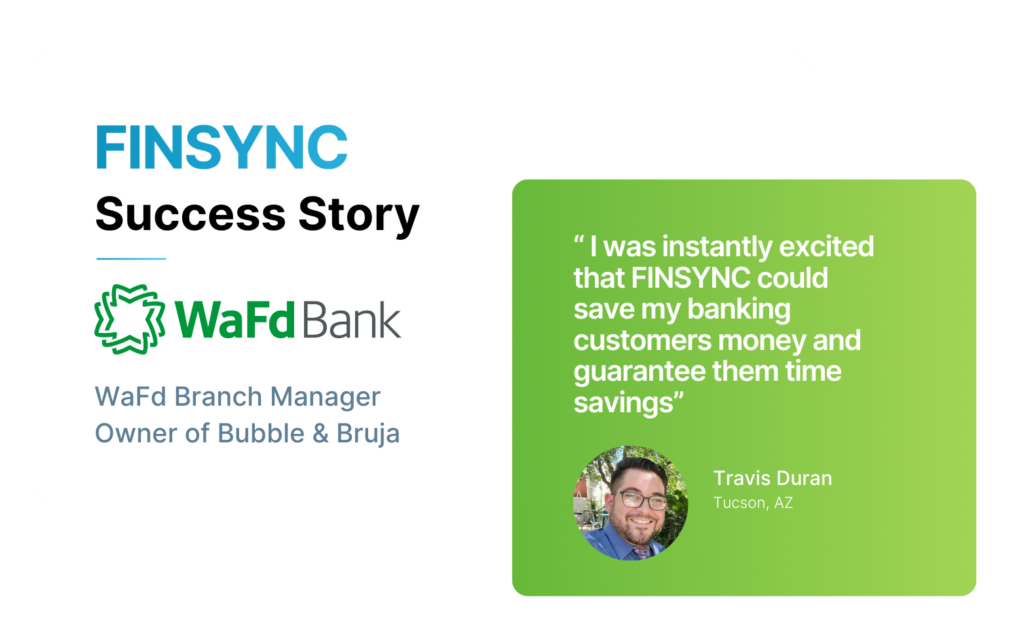
 

Spotlight Interview: Travis Duran, Banker and Entrepreneur

Banking and running a small business are often opposite sides of the same coin. Finding someone who straddles both worlds with as much passion and expertise as Travis Duran is rare. As a small business owner and a trusted banker with WaFd Bank, one of FINSYNC’s respected partner banks, Travis has a unique lens through which he views financial tools and solutions. 


Outside his bank, Travis and his wife run a local bakery in Arizona called Bubble & Bruja. With a name inspired by Shakespeare, their bakery captures creativity and dedication.


In this interview, Travis provides insights into his journey with FINSYNC as both a banker and an entrepreneur. Exploring the platform’s solutions and numerous benefits, he shares his perspective on how FINSYNC has transformed his approach to financial management for his bakery and how it can benefit other businesses.


How did you first hear about FINSYNC?

I was part of the initial WaFd Bank partner rollout with FINSYNC. We at WaFd were excited to get a more comprehensive strategic partnership. Integrating the invoicing, cash flow management, and other services round out the tools we don’t have on the banking side. 


What about the FINSYNC Platform attracted you to it?

WaFd has a lot of self-sufficient customers who are hands-on with their businesses. They start their business for a passion they might have. A common complaint is that they have to be their own accountant. They no longer have time to have dinner with their families because they are running the cash side of their company. I was instantly excited that FINSYNC could save my banking customers money and guarantee them time savings.


As a banker, what specific features of FINSYNC do you believe most resonate with business customers?

We have several tradespeople across the full-trade spectrum, like handyman contractors and home service workers. They struggle with their accounts receivable and ensuring their invoices have been paid. Balancing the books can be a challenge for them. 


Also, invoicing directly through FINSYNC and integrating those invoices directly into the cash flow management side is a big need for our customers. 


How does FINSYNC compare to other accounting platforms you have come across?

We have always heard complaints about QuickBooks. Knowing this was a QuickBooks Online alternative was an easy resource to tell our clients. For our small business customers, we have observed that they sometimes rely on Excel spreadsheets or handwritten notes for accounting, which can pose challenges. So, we like that FINSYNC integrates different systems into one.


The reporting aspect is huge as well. Being able to track to the penny where your money is going, what is owed to you, what will you owe down the road? Being able to answer these questions has been a big resource for clients. Cutting down on their paper and allowing them to ditch QuickBooks. Because there are banking systems that QuickBooks doesn’t speak effectively to, FINSYNC solves this problem.  


How has FINSYNC supported or enhanced your banking relationships with these businesses?

Speaking personally from the banking side, I offer FINSYNC as an alternative to QuickBooks to nearly every business client who walks through the door. 


In addition, my wife and I also run a side business, and FINSYNC helped us get through the holidays and attract customers outside our immediate market. An example of a success story is my own experience with my company. 


Tell me about your company and what inspired you to start.

Here in Arizona, bakery owners can run on cottage food laws as long as they are not selling perishable items. We got a license out of our home, got insured, and sold to farmers’ markets, B2C and B2B. There is a lot of flexibility with our local licensing.


My wife worked for a bakery in Phoenix, so she had more of the know-how, and I am more of a visionary. We both liked the idea of creating something new. We are both literary buffs, so “Bubble & Brujah” is based on Shakespeare’s mysticism, producing a magical play on words.


What are some of the challenges you’ve faced as a small business owner?

Time management was a big challenge since I am a full-time banker. Accessing a broader market outside of our friends and family was also challenging. We were successfully able to do this with the marketing experience I have. This brought its own challenges; the marketing outreach resulted in the need to accept credit card payments. We had to figure out how to accept debit and credit cards. This is where FINSYNC came in. 


What are the biggest benefits your business has experienced using FINSYNC? 

FINSYNC is an all-in-one platform. It links to the bank account and shows me money in and out. It shows me what is coming in; I can balance that once I see when it hits my account. It integrates easily into one. The time management and organizational benefit of keeping everything housed within one platform makes it easy to answer questions like, “What is my profitability?” or “What are our costs this month?” These are questions all small business owners should be asking themselves. 


With inflation being as rampant as it has been the last couple of years, FINSYNC makes it easy to actively track what is going out versus what is coming in. We were buffered from inflation since we could be more nimble to adjust what was necessary to survive. 


How has FINSYNC’s customer support or onboarding process been for you personally and for those you’ve invited to FINSYNC?

We have customers who have been using QuickBooks for a long time, so they bring in their information on a disk. There is no one they can talk to, and they are passed around from one phone prompt to another without resolving their issues. 


I have had experience with customer service on the bank side, where it is super easy to talk to our dedicated service person. I have also had experience on the customer side as well. Whenever I have an issue, there is an expert who knows how to walk me through where I need help. Even though it is a Fintech company, people are working on the backend to help those needing more hand-holding. I am one of those customers.


What advice do you have for those thinking about starting their own business?

It is easy to start a business here in the United States. You can be an entrepreneur if you have the tenacity and confidence to create something that people will want. 


Depending on what you are doing, you can make a difference. We have made wedding cakes, celebrated baby showers and sweet sixteen birthdays, etc. You get to be part of someone’s life at that moment. If you are considering starting a business, I would encourage everyone to at least try it.


FINSYNC allows you to run your business on One Platform. You can send and receive payments, process payroll, automate accounting, and manage cash flow. To learn more about how we can help your business start, scale, and succeed, contact us today.

Apply For Business
Checking Account

Before you get started

1

We are not able to service these businesses at the moment:

  • Crypto Currency and Money Services
  • Privately Owned ATMs
  • Marijuana-Related
  • Gambling
  • Money Services Business
  • Business headquartered outside of the U.S.
2

At this time we are offering online business checking accounts through bank partners in these states:

  • Arizona
  • California
  • Idaho
  • Nevada
  • New Mexico
  • Oregon
  • Texas
  • Utah
  • Washington

Is your business in one of these states?