Maximize Efficiency by Streamlining Online Invoices

Business efficiency is often a game of margins. Running a company is about capitalizing on the right opportunities and optimizing processes to save both time and money. In financial management, streamlining your process for online invoicing is a key factor in achieving this goal. 


Furthermore, features such as payment reminders and tracking of open invoices can be integrated into the system. These automated payment features ensure you can stay on top of your finances, minimizing the chances of overlooking a payment due date.


What are Online Invoices?


Online invoices are more than just digital versions of their paper counterparts. Online invoices facilitate various payment methods, reducing reliance on checks and improving the speed at which businesses receive payments. On average, online invoices are paid 35% faster than paper invoices, which can greatly improve your cash flow. 

They might also include clickable links directing to product details, embedded videos for product demonstrations, or even real-time chat support for instant query resolution. Overall, online invoices make the invoice more engaging and user-friendly while streamlining the tracking and payment process.


Online Invoice Payment Processing


One of the most significant advantages of electronic payments is the substantial reduction in manual data entry errors. Traditional payment methods often require manual input at multiple stages, from recording the transaction to updating accounts and ledgers. This repetitive process is prone to mistakes, leading to financial discrepancies and complications.


Furthermore, reconciling accounts, especially when dealing with checks or cash transactions, can be a time-consuming task. Electronic payments come with detailed transaction records, making reconciliations more straightforward and less time-intensive.


You can redirect business resources by adopting electronic payment methods. This allows you to save time for what matters most instead of getting bogged down in tedious administrative tasks. Digital invoices improve the bottom line and provide a competitive edge in today’s fast-paced business landscape.


Utilizing Payment Processors


Payment processors support a variety of payment types, from credit and debit card payments to ACH transactions and more. Such diversity ensures you can serve a broad spectrum of customers and not miss out on revenue due to a lack of payment options. 


Let’s talk more about Payment Processors:


What Is a Payment Processor?

The primary role of a payment processor is to act as an intermediary in transferring money from the customer’s account to your business bank account. In doing so, you can reduce the time and complexity of handling numerous transactions, particularly if your business has high sales volumes.

Variety Is Important

One of the features of modern payment processors is the variety of payment methods they support, from traditional credit and debit card transactions to e-wallets, bank transfers, and even some forms of cryptocurrency. This diversity helps you cater to a wide array of customer payment preferences.

Security First

Security is one of the primary concerns you might have, especially when dealing with online transactions. Top-tier payment processors employ advanced encryption methods and fraud detection tools to ensure every transaction is secure from potential threats.

Digital Management with Accounting Platforms

While payment processors play a pivotal role in managing transactions, their true potential is unleashed when used with platforms like FINSYNC. By consolidating payments, accounting, and cash flow tracking under a singular system, you can gain a comprehensive overview of the financial health of your business.


As you navigate the complexities of modern business ownership, an efficient payment processor is a necessity. They provide the backbone for smooth financial operations, ensuring transactions are processed swiftly, securely, and seamlessly.


Efficiency Through Software


Software platforms, like FINSYNC, are equipped with analytics and reporting tools. By diving deep into transaction data, you can gain insights into customer buying trends, peak transaction periods, and more. These analytics serve as a roadmap, guiding you to strategize effectively, enhancing profitability, and ensuring customer satisfaction.


One of the hallmarks of modern invoicing systems is their integration capabilities. These systems can sync with other essential business software, such as invoicing, payroll systems, or cash flow management tools. Sometimes, these features can be found in one software platform, like FINSYNC. In both cases,  having a cohesive, interconnected web of operations that offers a holistic perspective of the business’s financial health can be extremely beneficial in growing your business.


How FINSYNC Can Help

FINSYNC allows you to run your business on One Platform. You can send and receive payments, process payroll, automate accounting, and manage cash flow. To learn more about how we can help your business start, scale, and succeed, contact us today.


 

Navigating Credit Card Chargebacks for Small Businesses

As a small business owner, you may have encountered one particularly challenging hurdle: credit card chargebacks. Originally designed to protect consumers, these chargebacks can become a thorn in the side for businesses like yours if you accept credit card payments


Beyond the immediate financial implications, they impact your brand’s credibility. Rest assured, by understanding and adeptly navigating the details of chargebacks, you can safeguard your business against potential setbacks. This article will break down credit card chargebacks, providing insights and strategies tailored specifically for small businesses, so you can confidently address and prevent such challenges.


Understanding Credit Card Chargebacks


When it comes to cash flow management, credit card chargebacks emerge as a particularly tricky area to master. A chargeback happens when a cardholder challenges a charge on their statement, leading their bank to reverse the transaction. This differs distinctly from a refund, where you, as the merchant, willingly return the funds.


At its core, chargebacks serve as a consumer protection mechanism. They ensure that customers have recourse if they believe they have been wrongly charged, perhaps due to fraudulent activity or errors. However, for small business owners like yourself, chargebacks can feel like walking on a tightrope. On the one hand, they uphold trust in the credit card system, reassuring your customers. On the other, they can strain your revenues and potentially tarnish your business’s reputation if they spike in frequency.


When chargebacks are misused or if they arise from misunderstandings, they can become incredibly challenging. Repeated chargebacks can increase credit card processing fees or even jeopardize your ability to accept credit card payments. For the small business owner, understanding the nuances of chargebacks is not just advisable; it is essential for ensuring the smooth running of business operations.


Reasons for Chargebacks


Several reasons behind chargebacks can better prepare your business for potential disputes. Let’s explore some of the common culprits and solutions to avoid or remedy the situation:


1. Customer Disputes

Origin: This is the most straightforward trigger for a chargeback. It emerges when a customer scans their statement and encounters a charge they don’t recognize or believe was misrepresented.

Solution: Maintaining clear and transparent transaction descriptors can help reduce such disputes. 

2. Fraudulent Transactions

Origin: In our digital economy, identity theft, and unauthorized transactions are rising. Upon noticing an unfamiliar transaction, a cardholder might flag it as fraudulent, resulting in a chargeback.

Solution: Implement strong security measures, utilize authentication protocols, and continuously monitor transactions to identify and thwart potential fraud. 

3. Processing Errors

Origin: Sometimes, the fault lies not in the customer’s perception but in genuine errors during the transaction process. Instances like double-billing, billing the wrong customer, incorrect amounts, or other accounting errors can trigger chargebacks.

Solution: Regular audits, rigorous staff training, and reliable point-of-sale systems can greatly reduce the chances of such mishaps. 

4. Authorization Issues

Origin: Transactions without proper authorization due to a system glitch or oversight can come back as chargebacks.

Solution: Always ensure that transactions, especially larger ones, have the necessary authorizations. Investing in up-to-date payment systems that flag unauthorized transactions can be a lifesaver.


The Chargeback Process


Initially, everything starts with the customer. If they spot a questionable charge or have a reason for discontent, they will raise the issue with their bank, initiating a dispute. This step is crucial as it sets the entire chargeback process in motion.


Upon receiving this dispute, the issuing bank dives deeply into the matter, thoroughly investigating the claim. They might scrutinize transaction records, check for anomalies, or even contact the customer for more details.


As a merchant, you are not in the dark during this period. The bank will approach you, allowing you to present any evidence or documentation supporting the legitimacy of the questioned transaction. This could be anything from signed receipts, and communication records, to delivery confirmations. It is your chance to counter the dispute with substantial evidence.


After gathering information from both sides, the customer and you, the bank will consider the nature of the dispute and eventually decide. If the outcome is unfavorable to you, there is still a silver lining in some cases. Certain banks offer an avenue for you to appeal their decision, especially if you believe there has been an oversight or if you come across additional supporting evidence.


The chargeback process, while systematic, requires keen attention from merchants. By being proactive, you can navigate this challenge more effectively and potentially safeguard your revenue and reputation.


Preventing Chargebacks


Aside from the monetary setback from refunds and potential fees, recurring chargebacks can damage your business’s reputation, which is why prevention is always better than cure. Here are effective strategies that can reduce the likelihood of facing chargebacks:


Clear Communication 

Product or service descriptions must be accurate and comprehensive to ensure customers know exactly what they purchase. Additionally, make your return and refund policies easily accessible and straightforward. The more transparent these policies are, the less room for misunderstandings.

Prompt Customer Service

More often than not, a customer’s first port of call when dissatisfied is the merchant. Having good customer relationship management that is available and receptive to their concerns can prevent many chargebacks from materializing.

Use Fraud Prevention Tools

Simple measures like CVV (Card Verification Value) can make unauthorized transactions more challenging for fraudsters. Moreover, always opt for payment gateways known for their solid security features, providing an extra layer of protection for you and your customers.

Update Billing Descriptors

A common reason for chargebacks is unrecognizable names on credit card statements. Ensure that the name under which you bill is readily identifiable to your customers.

Maintain Thorough Records

Detailed records of transactions, correspondence with the customer, delivery proofs, and any other relevant documentation can be invaluable. These records not only help in presenting a compelling case but also speed up the resolution process.

Train Your Staff

Ensure your team understands the chargeback process, knows how to prevent them, and is prepared to respond if they occur.


Conclusion


Chargebacks, while designed to protect consumers, can pose significant challenges for businesses. By understanding the reasons behind them, actively working on prevention, and having a solid plan for dealing with them when they arise, you can mitigate their impact on your operations. In the dynamic business world, being informed and proactive is your best defense.


Remember, it’s not just about protecting your revenue but ensuring your business thrives in a competitive market. Knowledge is power, and in this case, it’s also protection.


How FINSYNC Can Help


FINSYNC allows you to run your business on One Platform. You can send and receive payments, process payroll, automate accounting, and manage cash flow. To learn more about how we can help your business start, scale, and succeed, contact us today.

Accept Credit Card Payments: A Guide for Small Businesses

In small business ownership, adapting to the diverse financial habits of your customers is essential. One way to do this is by accepting credit card payments. In an increasingly digital world, credit card payments have become an indispensable business tool. 


However, the intricacies of setting up such a system can often feel overwhelming. This guide simplifies this process, providing you with the insights you need to confidently navigate your way toward accepting credit card payments in your business.


What is Credit Card Processing


Before delving into how to accept credit card payments, it’s crucial to understand what credit card processing entails. Credit card processing is how money moves from a customer’s credit card account to a business’s bank account after a product or service purchase. Several pivotal entities orchestrate this process. 


After your customer starts the transaction, your role as the merchant is to supply the product or service and handle the payment. When the transaction is initiated, the bank that issued your customer’s credit card, referred to as the issuing bank, intervenes to check the available funds before approving the transaction. 


Card processing networks like Visa or MasterCard ensure that all parties communicate efficiently, making the payment process seamless. Familiarizing yourself with each of these key players will give you a better understanding of how credit card payments work for your business.


Benefits of Accepting Credit Cards


The ability to accept credit cards offers a host of advantages to your business and can be a strategic move that can unlock numerous benefits. The most significant of these is the potential for increased sales. 


In today’s digital age, consumers have grown accustomed to the convenience and security of credit card transactions. When presented with an option, they often lean towards businesses that accommodate their preferred mode of payment, making them more likely to engage and spend more. 


Moreover, by offering credit card payments, you are positioning your organization ahead of those limited to cash-only dealings, maximizing your reach to a broader range of potential customers.


Finally, in a marketplace where trust plays a pivotal role, accepting credit cards augments your business’s credibility. It signals to your customers that you are in sync with modern payment trends and can offer them an efficient purchasing experience. This perception of professionalism can be instrumental in building long-term customer relationships and fostering loyalty.


Choosing a Credit Card Processor


The first step to being able to accept credit card payments is to select a credit card processor. Several crucial elements warrant consideration:


1. Cost per Transaction

This is often the first thing businesses look at. It is necessary to understand the fee structure, including flat fees, percentage fees, or a combination of both. Hidden charges or monthly minimums can also affect the overall cost.


2. Terms of Service

Like any agreement, understanding the terms of service is important. Are there setup fees or termination fees? The contract’s duration and details in the fine print regarding potential rate hikes or other changes should be clarified.


3. Customer Support

Good customer service can save you time, money, and stress. The ability to promptly address issues or answer queries ensures smooth operations and can be invaluable when facing challenges.


4. Compatibility and Integration

How well does the processor integrate with your existing systems? Compatibility with your point-of-sale system, like accounting software or a platform like FINSYNC, can streamline operations.


5. Security and Fraud Prevention

In an era of increasing cyber threats, choosing a processor that employs strong security measures is non-negotiable. Features like tokenization, encryption, and fraud prevention tools can safeguard your business and customers.


Given these considerations, partnering with a card processor that aligns with your business objectives, operational needs, and growth aspirations is paramount. 


Setting Up Credit Card Payments


Once you have chosen a processor, the next step is setting up the mechanism for accepting credit card payments. This typically begins with establishing a merchant account.


Understanding payment gateways (the service that approves or declines transactions) is also critical, as is investing in hardware like Point of Sale (POS) terminals and card readers.


Additionally, accommodating mobile payments for smartphones and online payments is a plus. These add another layer of convenience for your customers, potentially expanding your sales further.


Navigating Common Challenges


Even with all systems in place, challenges may arise. These could include dealing with chargebacks (when customers dispute a charge), addressing technical difficulties, or handling customer service issues. Proactively having strategies ready to tackle these challenges quickly can reduce potential disruptions to your business and maintain high customer satisfaction.


Closing Remarks


In conclusion, accepting credit card payments can significantly boost your small business, opening opportunities for increased sales, customer convenience, and enhanced professionalism. While the process may seem complex, breaking it down into the steps in this guide will make it much more manageable.


Remember, the journey toward accepting credit card payments is not just about facilitating transactions; it is about empowering your business to thrive in today’s increasingly cashless marketplace.


How FINSYNC Can Help


FINSYNC allows you to run your business on One Platform. You can send and receive payments, process payroll, automate accounting, and manage cash flow. To learn more about how we can help your business start, scale, and succeed, contact us today.

 

How Small Businesses Can Avoid Common Accounting Errors

As you navigate the complexities of business ownership, you might deal with financial matters more often than you anticipated. This responsibility brings you face-to-face with an area of business that leaves little room for error – accounting. 


Your financial statements serve as a map of your business’s health, detailing profits and losses, assets and liabilities, and cash flow patterns. However, accounting is an intricate process that allows errors to creep in unnoticed. These mistakes, if overlooked, can distort your financial map, leaving you with an inaccurate understanding of your business’s financial standing.


In this guide, we will dive into accounting errors, shed light on common types, highlight their potential impact on your businesses, and offer ways to avoid these errors. Let’s start by understanding the most common types of accounting errors you may encounter in your small business.


Common Accounting Errors Small Businesses Encounter


Understanding the types of accounting errors that commonly occur can help you avoid them. Here are some of the most prevalent accounting errors that small businesses encounter:


1. Transposition and Transcription errors: These errors occur when numbers are switched or entered incorrectly. For instance, writing 54 instead of 45 is a transposition error, while misreading or mistyping data from one document to another is a transcription error.

2. Error of Omission: When a financial transaction is completely left out of the accounting books, it’s known as an error of omission. This could happen due to oversight or misunderstanding of the transaction’s nature.

3. Error of Duplication: These mistakes happen when a transaction is recorded more than once. This double entry can drastically throw off your books if not corrected promptly.

4. Error of Commission: This type of error occurs when an entry is made at the correct amount and the right time but to the wrong account.

5. Error of Principle: An error of principle happens when the GAAP or General Accepted Accounting Principles are not observed while recording transactions. For instance, recording a capital expenditure as a revenue expense.

6. Compensating Errors: These are simultaneous errors in bookkeeping that cancel each other out, hiding discrepancies and making them more difficult to identify and correct.

Impact of Accounting Errors


Beyond simple mathematical inaccuracies, accounting errors can have far-reaching implications for small businesses.


• Impact on Financial Statements: Accounting errors can distort your financial statements, making them an unreliable source of information for business decisions. This can lead to misguided strategies and missed opportunities.

• Legal consequences and penalties: Serious or recurring errors can catch the attention of tax authorities, leading to audits, fines, or legal consequences.

• Effect on business decisions and strategies: Erroneous financial data can lead to poor decision-making, from daily operations to long-term business strategies.

• Business reputation: Mistakes in financial statements could damage the trust of your stakeholders, including investors, lenders, customers, and even your own employees.


How to Identify and Correct Accounting Errors


Catching and correcting accounting errors as early as possible is crucial to avoid potential financial damage and legal complications. Here are some ways to identify and address these issues:


• Regular auditing and review of financial statements: Regular checks and audits of your financial books can help spot discrepancies and identify errors. Keep an eye out for unexplained changes in revenues, costs, or profits.

• Reconciling bank statements against your journal entries is a process that involves comparing the transactions listed in your bank statements with those recorded in your accounting general ledger to ensure they match. This is an essential step in catching discrepancies.

• Understanding the nature of each error and its correction process: Different errors require different solutions. Transposition errors require a simple number switch, while errors of principle necessitate a better understanding of accounting norms and principles.

• Professional help and consultation: Hiring a professional accountant or bookkeeper can help keep your accounts error-free. They bring expertise and can provide advice and corrections to prevent and rectify accounting errors.


The Role of Accounting Software in Minimizing Errors


Modern technology can be a game-changer in your battle against accounting errors. Implementing accounting software like FINSYNC can reduce the risk of human errors and ensure your financial data is accurate and up-to-date.


Accounting software automates many routine tasks and reduces the need for manual data entry, reducing the risk of transcription or transposition errors. These software platforms also typically have built-in checks and balances to ensure each entry aligns with accounting standards.


Seek features like automated double-entry bookkeeping, real-time data updates, easy integration with bank accounts, tax calculation features, and advanced reporting and analytics.


Numerous businesses have seen improvements in their financial management with the use of accounting software. For example, companies like Lancaster Morgan Funeral Home and Out There Web Designs have reported significantly reduced accounting errors within months of implementing such systems.


Looking Ahead


Managing your company’s finances is vital to running a successful business. And while accounting errors are common, understanding their types and potential impact can help prevent and correct them before they cause significant harm to your business.


By familiarizing yourself with common accounting errors and compensating for mistakes, you are arming yourself with the knowledge to avoid these pitfalls. Incorporating software solutions into your accounting processes can be especially beneficial. You can automate tasks and provide built-in checks to prevent errors. Staying diligent in reviewing your financials and understanding potential errors are key to pristine financial records. Leveraging modern tools and seeking expert advice further strengthen this foundation.


How FINSYNC Can Help


FINSYNC allows you to run your business on One Platform. You can send and receive payments, process payroll, automate accounting, and manage cash flow. To learn more about how we can help your business start, scale, and succeed, contact us today.

 

Tracking Project Margin: A Guide for Small Business Owners

When running a small business, it is important to be aware of every aspect of your company’s financial management. One crucial element is understanding your project margin. Project margins are a key indicator of your business’s profitability on a case-by-case basis. 


This comprehensive guide aims to shed light on this part of financial health. We will highlight the importance of project margins, stress their crucial role, and demonstrate how you can effectively keep track of them as a small business owner. By honing your revenue-tracking skills, you can take proactive measures to improve your overall business performance.


What Is Project Margin?


Project margin is the ratio between the total revenue and the total costs of a specific project. This financial metric is more than just a number; it provides a crystal-clear snapshot of your project’s gross profit


Maintaining a solid project margin demonstrates your business’s ability to manage costs while generating sufficient revenue on a project-by-project basis. Project margins also impact your overall financial management. They are a barometer for operational efficiency, financial health, and strategic pricing. 


High numbers can contribute to a more robust bottom line, increasing your business’s stability against unforeseen economic downturns and creating room for future growth opportunities. Make sure to evaluate the consistency of these margins frequently. Are there certain customers that always have a low project margin? Do you receive enough projects from those customers to justify the lower margin? Or perhaps, there are specific types of projects that invariably have a lower margin. 


In such cases, it may be time to reconsider your pricing strategies for those project categories, ensuring that they align with your financial goals and sustainability.


Putting margin goals in place will empower you to do analysis and then make data-driven decisions that can propel your business forward. 


Job Costing Challenges


A pivotal issue arises from inefficient project or job cost tracking. In the absence of a reliable system for monitoring expenses, costs can swiftly spiral out of control. This escalation can occur subtly, accumulating unnoticed until it significantly damages the project’s profitability. 


Further complicating the issue is not accurately estimating the actual costs of a venture. Many businesses find it difficult to anticipate every expense precisely. This issue is often rooted in the unpredictable nature of business operations, where factors like market fluctuations, supply chain disruptions, or even human error can lead to discrepancies in cost projections. An inaccurate estimate can set a shaky foundation for the entire project, hindering the ability to maintain a healthy margin.


Other unforeseen expenses can sneak in, chipping away at your margin. These could stem from various factors, such as complications during implementation, sudden changes in raw material prices, or unexpected regulatory costs. These unplanned costs can make your budget veer off course, adding extra strain.


Therefore, businesses may price their project proposals too low. This jeopardizes the project’s return and can undermine the business’s financial health. Remember, pricing should not only cover costs but also contribute to profits, and this is where a clear understanding of margins comes into play.


To ensure that your pricing structure can absorb unforeseen issues, consider the following best practices:


1. Contingency Allocation: Allocate 5-10% of the total project cost for unexpected expenses.

2. Itemized Breakdown: Offer a clear cost breakdown for transparency and easier adjustments.

3. Past Projects: Reflect on past projects to set adaptable rates that consider potential scope changes.

4. Research & Consultation: Use industry benchmarks and competitor insights to set prices aligned with market rates.

5. Clear Communication & Risk Assessment: Clarify any additional costs for out-of-scope work and factor in identifiable project risks.


By integrating these consolidated best practices, businesses can better anticipate unforeseen challenges and adjust pricing in their project proposals accordingly.


Key Steps to Calculate Project Margin


By recognizing the challenges we just covered, small business owners can take targeted steps to overcome them. 


Here are the key steps you can follow to determine your project margin:


A. Identifying and Listing Costs

Your first step is to identify all the costs associated with your project. This might include direct costs like materials and labor and indirect or variable costs such as overhead, administrative expenses, and depreciation. Each cost should be carefully listed to ensure a complete view of your expenditure. The more accurately you can capture these costs, the clearer your understanding of your financial standing.

B. Calculating Revenue

Once your costs are identified, your next step is calculating your project’s total revenue. This is the income you anticipate to generate. It can be determined by multiplying the price you sell your product or service by the quantity you expect to sell. Remember, a conservative estimate is better than an over-optimistic one.

C. Determining Margin Using a Formula

With total project revenue and costs, you can calculate your project profit. The formula for this is quite straightforward:

Project Profit = Project Revenue – Project Costs

This will provide you with a dollar value representing your profit. If you wish to express this as a percentage of the revenue, you can calculate the Project Margin this way:

Project Margin = (Project Profit / Project Revenue) x 100%


Software 


While manual calculation is an option, several tools are available to streamline project margin tracking. Spreadsheets are a basic but limited tool. They require significant manual input, leaving room for errors. Consider a platform like FINSYNC that has task and job cost tracking features. This system can automate calculations, provide real-time updates, and help you closely monitor your financial health.


Tips to Increase Project Margin


Exploring strategies to enhance your margins is critical and goes beyond just tracking. Planning and cost estimation are preventative measures, keeping your expenses controlled and within budget.


The pricing strategy you employ also holds significant influence over your project scope. It is essential to ensure that your prices cover the full spectrum of costs associated with a task and align with your goals.


Moreover, implementing cost control strategies such as negotiating better deals with vendors or opting for bulk purchasing can substantially reduce your expenses, which will help your margins.


Lastly, boosting your operation’s efficiency and productivity is integral to margin enhancement. By accomplishing more within your existing budget, you optimize resources, which leads to an increase in your margin.


Conclusion

In conclusion, tracking and managing project margins is a potent strategy for small businesses to maintain and improve their finances. It helps highlight areas of cost overrun, inefficiencies and provides a clear view of your business’s profitability. 


Executing efficient cost-tracking systems, refining cost estimation methods, preparing for unforeseen expenses, and well-researched pricing are fundamental strategies to navigate these hurdles. Overcoming these challenges is crucial for maintaining healthy project margins and ensuring the long-term financial stability of your business.


How FINSYNC Can Help


FINSYNC allows you to run your business on One Platform. You can send and receive payments, process payroll, automate accounting, and manage cash flow. To learn more about how we can help your business start, scale, and succeed, contact us today.

Payroll Processing: A Comprehensive Guide for Small Business Owners

Payroll is one of the most important processes for your business. It ensures your employees are paid on time and in full and your business complies with regulatory requirements.


However, payroll can also feel intimidating for small businesses. Outdated, manual processes can slow the process down and expose your organization to risk. But payroll software may also be overwhelming and, of course, expensive. 


There is no one-size-fits-all solution to payroll processing, but understanding the basics can help you find the best way to run payroll for your business.


Consider this your ultimate guide to payroll processing to help set your business up for success.


Payroll Processing FAQs


All the answers to common payroll processing questions are in one place.


How Do You Process Payroll?

You can find plenty of payroll processing checklists online. Some are more comprehensive than others. 

For small businesses, it all starts with understanding the basics of payroll processing. Here are the six simple steps every organization should follow:

1. Apply for an Employee Identification Number

According to the IRS, an Employer Identification Number (EIN) (of a Federal Tax Identification Number) is used to identify a business entity. Most businesses need an EIN to track payroll taxes and ensure compliance.

2. Collect Employee Information

Ensure you have the correct tax information for every employee, W4 for normal employees, and W9 for contractors. Taxes may differ for salaried employees compared to contractors, and some employees may have deductions while others don’t. Having this information ensures employee wages are accurate.

3. Choose a Payroll Schedule

Determine the best payroll schedule for your business. Business News Daily explains that there are four main schedules: monthly, semimonthly, biweekly, and weekly. This helps employees know when they will be paid. 

4. Calculate Gross Pay

Then, it’s time to crunch numbers. According to Indeed, gross pay is the total amount of money an employee earns for time worked. It also includes any overtime, bonuses, or reimbursements

5. Determine Employee Deductions

This is perhaps the most complicated step. You must keep your employees’ W-4s, federal and state requirements, insurance requirements, and benefits requirements in mind to accurately determine payroll deductions.

6. Compute Net Pay

Simply subtract each employee’s deductions from their gross pay. This is the amount you will pay your employees. That means it’s time to approach payroll and pay your employees through direct deposit, paper checks, cash, etc. 


Why is Payroll Processing Important?

Reliable, consistent payroll processing ensures your employees are paid fairly and you can file taxes correctly. It ensures compliance and creates a positive workplace environment where employees trust they will be paid on time and in full.


How Long Does Payroll Processing Take?

This ultimately depends on your payroll software and the number of employees. Manual calculations can take days, while a payroll service can help streamline the process. The best payroll processing systems only take a day or two to complete this process.


What Are Common Payroll Challenges?

There are many moving parts for payroll processing. Here are a handful of the most common payroll challenges for small businesses:

Compliance And Regulation Issues: Follow payroll compliance best practices to avoid penalties and damage to your reputation. 

Manual Processes: Manually processing payroll slows your business down and increases the risk of human error.

Record Keeping: Paper payroll records are easily lost, which can lead to miscalculations. 

Employee Misclassification: Ensure you properly distinguish between full-time employees and contractors. 

Technology Integration: Siloed payroll services can be doing more harm than good. Choose a fully-integrated solution that’s secure. 


In-House vs. Outsourcing Payroll Processing


When completing payroll, businesses have two options: doing things in-house or outsourcing to a payroll company. 

Can You Complete Payroll Processing In-House?

Yes! However, very few businesses find handling payroll in-house more cost-effective and efficient. Businesses must be careful about compliance with wage and hour laws and stay up-to-date on the latest changes. Payroll processing in-house can be time-consuming and prone to error.


What is Payroll Processing Outsourcing?

You can also outsource payroll to a professional or utilize an automated payroll solution. When done right, payroll outsourcing can help businesses save money and better control their cash flow.

These companies and solutions keep tabs on the evolving payroll processes and allow for seamless data flow to ensure payroll is completed efficiently and correctly. 


What Are Payroll Processing Fees?

These are the costs of payroll services. Some providers charge per month or per employee.


How FINSYNC Can Help


FINSYNC allows you to run your business on One Platform. You can send and receive payments, process payroll, automate accounting, and manage cash flow. To learn more about how we can help your business start, scale, and succeed, contact us today.
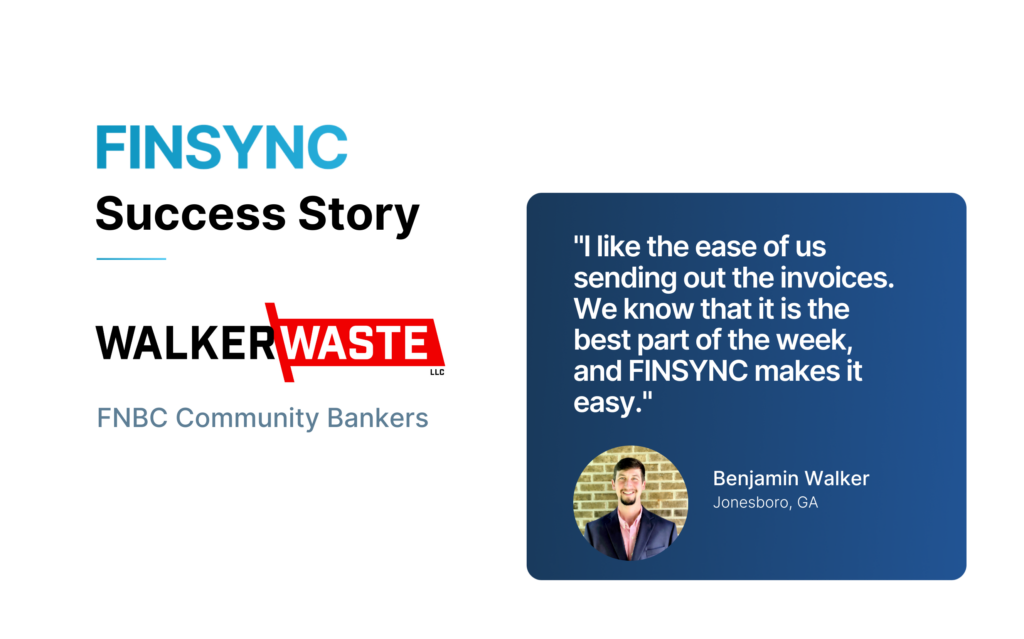
Spotlight Interview with Benjamin Walker of Walker Waste

In the world of entrepreneurship, stories of hard work, dedication, and perseverance often stand out. This Spotlight Interview delves into the journey of Benjamin Walker as he launched his waste distribution venture, Walker Waste.


Starting ambitiously with ten dumpsters and a single truck, Walker Waste has now expanded to a growing fleet, meeting rising demand. Benjamin sheds light on his journey, the role of mentors, the challenges of choosing the right financial tools, and the joy of seeing tangible results from his dedicated efforts. Join us in exploring his entrepreneurial journey and how FINSYNC played a part in his story.


Tell me about your company and what inspired you to start.

My company is a waste distribution company. I take dumpsters to customers, new construction homes, businesses, or renovations. I charge the customer to rent these dumpsters and for my services. 


I had someone like a second dad to me; he started one of these dumpster businesses back home, where I’m from. I saw first hand and knew that it would be beneficial. So I saved up my money, talked it over with my family, and decided to try it out.


I started with 10 dumpsters and 1 truck; now, I have 35 dumpsters and 3 trucks. I need more dumpsters every day. We are very blessed and just put our heads down and work hard. 


What’s the best thing about being a small business owner? 

I like the flexibility and that I can see the results of my hard work. 


What prompted you to start using FINSYNC?

I built a relationship with the people I bank with. They went through some of my price sheets and suggested I try FINSYNC. I thought, as long as it is easy, let’s try it!


What about the FINSYNC Platform that attracted you to it?

The biggest thing that attracted me to the system was I got tired if I had an issue with Quickbooks. I would call the helpdesk, and there was often a language barrier that was very difficult. I know when I called FINSYNC, I would get someone right away, usually within 30-60 seconds, and they would be in the US, probably Atlanta. As long as I can get someone to help me so that I can communicate, this is why I switched to FINSYNC.


What are the biggest features FINSYNC has compared to Quickbooks?  

I like the ease of us sending out the invoices. It is very easy to navigate through. We know that sending invoices is the best part of the week, and FINSYNC makes it easy. 


What financial institutions do you have connected to FINSYNC?

FNBC in Jonesboro. 


What advice do you have for those thinking about starting their own business?

Don’t be scared. I am a little timid; sometimes, I wish I wasn’t and would jump in a little deeper. Fortunately, my father-in-law is good about being aggressive. So I know when someone is willing to give you money, figure out how to take it. 


FINSYNC allows you to run your business on One Platform. You can send and receive payments, process payroll, automate accounting, and manage cash flow. To learn more about how we can help your business start, scale, and succeed, contact us today.

 

Decoding IRS Related Tax Scams: What Every Business Owner Needs to Know

The Internal Revenue Service (IRS) has recently reported a surge in fraudulent activities, specifically during the summer season. These fraudulent schemes frequently claim to resolve tax issues or promise tax refunds. As a small business owner, it’s crucial for you to be aware of these scams to protect your organization’s financial records and overall business health. 


The IRS’s dedicated phishing email account, [email protected], has received many complaints, underscoring the seriousness of the situation. This article will guide you through the various types of scams you need to be aware of to protect your small business.


Types of Tax Scams


Economic Impact Scam

The economic impact payment scam is one of the most common. It incorporates a URL embedded within the message, guiding victims to a phishing site to steal their personal information. This scam has been circulating since 2021 and has continually been updated and modified. 

Always remember that the IRS never initiates contact with taxpayers via email, text messages, or social media channels about a bill or tax refund. IRS Commissioner Danny Werfel recently restated the importance of remaining alert due to increased scams.

Email and Text Phishing

Besides the economic impact scams, the IRS has pinpointed and reported several other fraudulent schemes. One includes deceptive emails that coax individuals into claiming their tax refunds online. These emails typically aim to direct recipients to a false IRS website where their sensitive information can be stolen.

Another widespread fraudulent scheme involves misleading text messages that notify individuals that their tax return has been denied or “banned” by the IRS. These messages, sent by scammers pretending to represent the IRS, often lure individuals into clicking a link that leads them to a phishing website or prompts them to divulge personal information.

Such fraudulent emails and text messages usually exhibit several red flags that can help individuals recognize them as scams. These can include spelling mistakes, grammatical errors, and awkwardly phrased sentences. Moreover, these messages may employ high-pressure tactics, urging the recipient to act immediately or face dire consequences.

Furthermore, they might use a generic greeting instead of your name or come from an email address that doesn’t match the IRS’s official website address. Just another reminder that the IRS will never contact you or your business via email or text. 

Employee Retention Credit

Another scam to be aware of involves bogus claims of eligibility for the Employee Retention Credit (ERC). The ERC is a tax credit introduced during the pandemic to aid employers. Only certain employers qualify for this credit. Still, fraudsters claim they can determine eligibility promptly without detailed scrutiny and often charge fees upfront or based on a percentage of the ERC claimed. As a small business owner, you must understand how to claim the ERC legitimately to avoid these scams.

False Refunds

Identity thieves have also been exploiting taxpayers’ interest in overlooked refunds. These schemes suggest that recipients have missed out on tax refunds, and one such scam instructs victims to claim their tax refund online. 

The IRS has also highlighted a scam delivered via traditional mail. This scheme involves a letter in a cardboard envelope delivered by a courier. The letter, containing the IRS masthead, informs the recipient about an unclaimed refund. 


Guidance from the IRS


In order to mitigate the impact of these scams, the Internal Revenue Service (IRS) has provided specific guidelines to help taxpayers protect themselves and ensure the authorities are promptly alerted.


Should you receive any suspicious emails that you believe to be a scam, or if you yourself have fallen victim, inform the IRS directly at [email protected]. This action serves two purposes: it allows the IRS to investigate the source of the scam, and it helps them in their ongoing efforts to thwart such cybercrimes.


At the same time, it is crucial to file a complaint with the Treasury Inspector General for Tax Administration (TIGTA). This is an internal IRS organization that handles issues related to tax administration, including fraudulent activities and scams.


To better understand how to protect yourself moving forward, the IRS suggests visiting www.identitytheft.gov and www.irs.gov/identity-theft-central. These resources provide invaluable information about identity theft protection, measures to prevent future scams, and steps to take if your identity has been compromised.


Conclusion


Tax scams have become a significant challenge for individuals and businesses alike, especially during summer. As a business owner, it is necessary to stay informed, and this article has equipped you with the knowledge to identify such scams and take proactive measures against them.


Keep in mind the IRS will never reach out through email, text, or social media channels. Through awareness and timely action, we can collectively reduce the impact of these fraudulent schemes and ensure the security of our businesses. So, stay informed, stay alert, and keep your organization safe from tax fraudsters.


How FINSYNC Can Help


FINSYNC allows you to run your business on One Platform. You can send and receive payments, process payroll, automate accounting, and manage cash flow. To learn more about how we can help your business start, scale, and succeed, contact us today.

 

Top 6 Financial Forecasting Techniques for Small Businesses

Running a small business, you know that well-thought-out planning and smart decision-making form the bedrock of success. Yet, one instrument that often goes unnoticed in the business owner’s toolkit is financial forecasting. It might not be on your radar yet, but it is an incredibly valuable tool that can help shape your business’s future.


Understanding and deploying these techniques can boost your business’s growth. Spot-on forecasts enable you to craft your budget, oversee your cash flow, prevent potential roadblocks, and make data-backed decisions.


Before diving deep into these methods, let’s fully understand financial forecasting.


What are Financial Forecasts?


Financial forecasting involves analyzing and interpreting numerical data to give your business actionable insights. These numbers represent a range of critical financial metrics for running your business.


However, the scope of forecasting extends beyond predicting single numbers. It also involves understanding the relationships between different financial variables and how they work together. 


By employing this knowledge, forecasts sketch an all-encompassing view of your business’s financial health. This data delivers a comprehensive picture of your business’s future financial state, helping you make well-informed strategic decisions. 


What are the most effective techniques for predicting your business’s financial future? Here are six tried-and-true methods:


1. Sales Forecasting


The cornerstone of any financial forecast, sales forecasting is a method to anticipate future sales revenue. This practice is more than just gazing into a crystal ball; it is a detailed analysis based on valuable insights from multiple sources.

Historical sales data forms the backbone of this forecast. By studying your past sales trends, including seasonal ups and downs, year-on-year growth, and the effects of marketing campaigns, you can detect patterns and trends that will likely continue.

However, past performance is not the only factor at play. Market research plays a pivotal role as well. This involves studying market conditions, customer behavior, and the competitive landscape to make informed predictions about how these factors might affect your future sales. Is the market growing or shrinking? Are customer preferences shifting? How are your competitors performing, and what are they planning? Answers to these questions can significantly refine your sales forecast.

2. Cash Flow 

Cash flow forecasting predicts the inflows and outflows of cash within your business. It calculates your future, mapping out potential peaks and troughs in your cash balance. This foresight offers an invaluable advantage, allowing you to manage your capital resources strategically and informally.

Your balance sheet gives you a snapshot of your business’s finances right now, while cash flow forecasting gives a glimpse into where you stand in the near or distant future. 

An increase in profit might give you the confidence to invest in new opportunities, whether expanding your product line, hiring new talent, or entering new markets. Similarly, foreseeing potential cash shortages help you take preventive measures. You might tighten your budget, delay discretionary spending, or seek additional funding,

3. Scenario Forecasting

Scenario forecasting is a strategic technique that allows you to imagine different potential futures for your business based on various hypothetical situations. For example, it can help you anticipate the financial impact of decisions such as hiring an additional salesperson, launching a new product line, or entering a new market. This practice equips you with the knowledge to formulate appropriate contingency plans, ensuring your business’s resilience in the face of potential disruptions.

4. Moving Averages

Moving averages is a powerful technique that leverages historical data to generate a trend line that is fluid and more understandable. This averaging process can be instrumental in revealing long-term trends, patterns, or shifts within your business operations, which might otherwise go unnoticed amidst short-term changes.

By averaging a specific period’s data, it creates a trend line that removes large variations, leading to a more clear and consistent path. Whether it is monthly sales revenue, quarterly production costs, or annual gross profit, moving averages can help illustrate the bigger picture.

Highlighting core performance patterns makes it valuable to any business’s forecasting toolbox, especially those operating in seasonally influenced industries.

5. Exponential Smoothing

This forecasting method operates on the belief that the recent past can serve as an informative indicator of the immediate future, offering insightful and timely forecasts.

In contrast to other forecasting techniques that treat all historical data equally, exponential smoothing decreases the weight assigned to older data. As a result, the most recent data points hold more sway in shaping the forecast, allowing the model to stay in tune with any new developments in trends or patterns.

6. Regression Analysis

At its core, regression analysis is a mathematical approach that explores the connection between a dependent variable, such as your sales, and one or more independent variables, which could include factors like market trends, economic indicators, or customer behavior. The objective is to discern how changes in these independent variables may influence your target outcome.

While regression analysis is more sophisticated and requires a particular statistical understanding, its insights can be invaluable. The technique can help unravel the complex web of factors affecting your business and provide a deeper, data-driven understanding of your operational environment.


Closing


Remember, forecasting is not about eliminating uncertainty but mitigating its effects. It’s about equipping your business with the foresight to navigate an ever-evolving landscape confidently. With a proactive and informed approach, you can strengthen your business’s stability and adaptability, positioning yourself for sustained growth and success, regardless of what the future holds.


How FINSYNC Can Help


FINSYNC allows you to run your business on One Platform. You can send and receive payments, process payroll, automate accounting, and manage cash flow. To learn more about how we can help your business start, scale, and succeed, contact us today.


10 Financial Tips Every Small Business Owner Needs to Know

As a small business owner, your financial understanding can mean the difference between thriving and barely surviving. Every decision counts regarding income and expenses; an in-depth understanding of the financial landscape is crucial. Whether you’re just starting your business or have been in the game for a while, there is always something new to learn in the ever-evolving world of finance. 


This blog post will outline 10 essential financial tips for every small business owner. These strategies can help steer your business toward growth, profitability, and long-term success. So let us start paving your financial roadmap. 


1. Cash Flow Management


Cash flow refers to the inflow and outflow of cash within your business. It is not just about profit; it’s about when the profit lands in your bank account. Delayed payments, open invoices, unexpected expenses, or slow sales periods can create a cash crunch. To navigate this, negotiate favorable payment terms with suppliers and incentivize early payments from customers. Regular cash flow forecasting can also keep you one step ahead.


2. Budgeting


Business budgeting is another cornerstone of financial management. As a small business owner, a budget is like a financial roadmap. A well-crafted budget clearly shows your business’s financial health and potential bottlenecks. Track your income and expenses meticulously, adjust your budget regularly based on actual figures, and never underestimate the importance of a buffer for unforeseen costs.


3. Emergency Fund


This extra cash is an important safety net in uncertain times. The ideal amount varies, but a rule of thumb is to cover at least three to six months of operating expenses. Start by regularly setting aside a small portion of your profits and gradually building up your emergency fund.


4. Separate Business Finances


Keeping your personal and business finances separate simplifies accounting, provides a clear picture of business performance, and protects personal assets from liabilities. Open a business bank account and get a business credit card to segregate your finances.


5. Financial Reviews


Regular financial reviews act as a health check-up for your business. These reviews can uncover underperforming areas, cost overruns, and outstanding debts. We recommend a financial review at least quarterly. The review should include an examination of financial records, budgets, cash flow, and debt management.


6. Financial Statements


Another great financial tip is understanding and utilizing financial statements; this is like learning the language of your business. The income statement, balance sheet, and statement of cash flows all offer unique insights. They reflect your business’s profitability, financial position, and cash management. Familiarizing yourself with these statements can facilitate more informed business decisions.


7. Pay Yourself


Paying yourself may seem counterintuitive, especially when reinvesting in your business. However, a fair salary ensures you value your work and reinforces personal financial security. Determine your salary based on industry standards, profitability, and contribution to the business.


8. Debt Management


Managing your debt is another important aspect of financial management. While some debt can provide financial leverage, too much can risk business solvency. You can maintain a good credit score by making timely payments, reducing unnecessary expenses, and prioritizing high-interest debt. Remember, proactive debt management can open up better financing opportunities.


9. Embrace Technology


Utilizing technology can greatly enhance the efficiency of your financial management. With many financial management tools, such as FINSYNC, tasks like bookkeeping, invoicing, and financial reporting have been significantly simplified. Choosing software designed for your business with a user-friendly interface with dependable customer support is critical.


10. Investing in Business Growth


While cost management is an important element of financial success, it is also important to consider investment in growth. Investing back into your business can take many forms: employee training to improve productivity, technology upgrades, and marketing initiatives for expanding your customer base. Considering your business’s financial health and market conditions, it is crucial to weigh the potential returns against the costs. 


Key Takeaway


Mastering your small business finances is an ongoing process. Implementing these 10 financial tips will not only help you manage your finances better but also enhance the financial health and sustainability of your business. Remember, good financial management today sets the stage for continued success tomorrow. Keep learning, stay proactive, and let your financial acumen be the secret weapon in your business arsenal.


How FINSYNC Can Help


FINSYNC allows you to run your business on One Platform. You can send and receive payments, process payroll, automate accounting, and manage cash flow. To learn more about how we can help your business start, scale, and succeed, contact us today.


Apply For Business
Checking Account

Before you get started

1

We are not able to service these businesses at the moment:

  • Crypto Currency and Money Services
  • Privately Owned ATMs
  • Marijuana-Related
  • Gambling
  • Money Services Business
  • Business headquartered outside of the U.S.
2

At this time we are offering online business checking accounts through bank partners in these states:

  • Arizona
  • California
  • Idaho
  • Nevada
  • New Mexico
  • Oregon
  • Texas
  • Utah
  • Washington

Is your business in one of these states?